


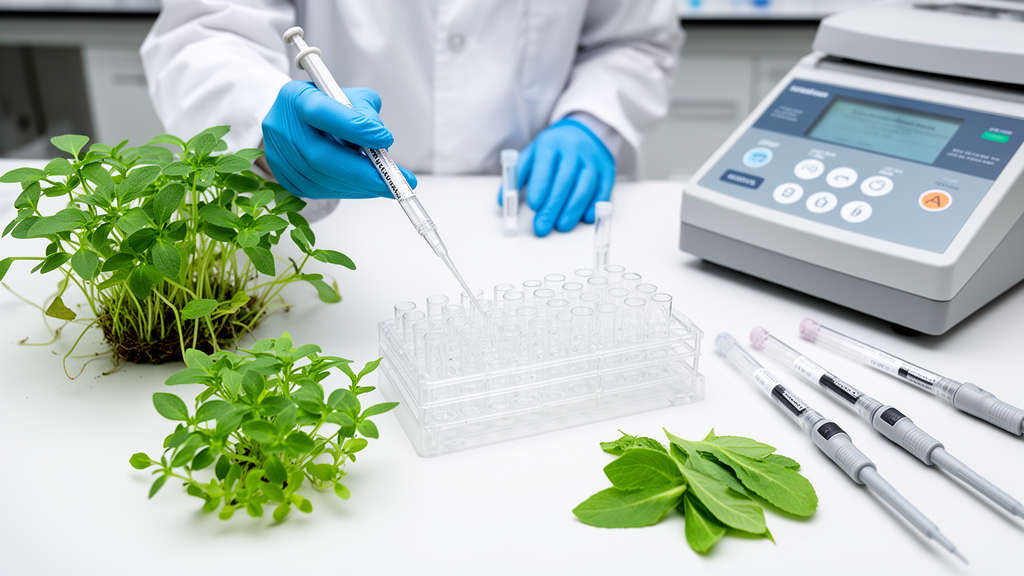
A transcriptome-informed screen has identified condition-specific reference genes for measuring gene expression in Cuphea hookeriana, an ornamental shrub with limited cold tolerance. Researchers assessed the stability of 12 candidate genes across four plant tissues and during a 48-hour exposure to 5 °C, finding that the most reliable normalization panel depends on the type of comparison. For tissue comparisons, the geometric mean of acyl carrier protein (ACP), ubiquitin-conjugating enzyme (UBC) and elongation factor 1-alpha (EF1α) performed best, while 18 S ribosomal RNA (18 S rRNA) and eukaryotic initiation factor 2 (EIF2) were recommended for the low-temperature experiment.
The work addresses a central requirement of reverse transcription quantitative PCR (RT-qPCR), a method used to quantify RNA transcripts. Accurate comparison of expression levels depends on selecting reference genes whose abundance remains relatively stable under the conditions under study. The researchers state that no validated reference genes had previously been reported for C. hookeriana, meaning that normalization choices for the species had lacked an established evidence base. To identify candidates, they used a leaf transcriptome generated during a 5 °C low-temperature time course, which was deposited in the NCBI Sequence Read Archive under BioProject accession PRJNA1117973.
The 12 candidates were EF1α, DNAJ heat shock protein (DNAJ), cyclophilin (CYP), glyceraldehyde-3-phosphate dehydrogenase (GAPDH), actin (ACT), 18 S rRNA, EIF2, tubulin (TUB), protein phosphatase 2 A (PP2A), acyl carrier protein (ACP), ubiquitin (UBQ) and ubiquitin-conjugating enzyme (UBC). Their expression stability was evaluated in roots, stems, leaves and flowers, as well as in leaves sampled at 0, 12, 24, 36 and 48 hours after exposure to 5 °C. Across these tests, the candidate primers had amplification efficiencies of 92.41% to 104.50% and correlation coefficients of 0.992 to 0.999, indicating close agreement between the assay measurements and efficient amplification.
Analysis with geNorm pairwise-variation methods indicated that three reference genes were required for the different-tissue dataset and two were sufficient for both the low-temperature-treatment dataset and the pooled dataset. These results supported the experimental validation of ACP, UBC and EF1α for tissue comparisons and 18 S rRNA and EIF2 for low-temperature-treated samples. For samples combining all tissue and low-temperature conditions, the study recommended EIF2 and actin (ACT). The findings therefore distinguish among several experimental contexts rather than proposing a single universal panel for every RT-qPCR analysis of the species.
The validation experiments also showed why gene selection can affect the apparent expression results. One-way analysis of variance detected significant differences in normalized cycle-quantity values among tissues for CSLD and among treatment times for MYB11. When the least stable individual reference genes, TUB or UBQ, were used for normalization, the resulting relative-expression estimates differed significantly by group from estimates produced with the combinations recommended by geNorm. The study is an assay-validation and reference-gene analysis conducted in one plant species; it does not demonstrate improved cold tolerance or establish the biological functions of CSLD and MYB11. Its practical outcome is a tested framework for more consistent RT-qPCR normalization across tissues, low-temperature treatment samples and a pooled collection of both.
Subject of Research: Validation of RT-qPCR reference genes in Cuphea hookeriana across tissues and low-temperature stress
Article Title: Transcriptome-informed selection and validation of reference genes for RT-qPCR normalization in Cuphea hookeriana across tissues and under low-temperature stress
Article References: Zhang, G., Jin, M., Sun, K., & Gu, C. (2026). Transcriptome-informed selection and validation of reference genes for RT-qPCR normalization in Cuphea hookeriana across tissues and under low-temperature stress. BMC Plant Biology. https://doi.org/10.1186/s12870-026-09907-7
Image Credits: AI Generated
DOI: 10.1186/s12870-026-09907-7
Keywords: Cuphea hookeriana, RT-qPCR, reference genes, gene expression, low-temperature stress, transcriptome, plant biology, qPCR normalization, Transcriptome-informed, selection, validation, reference
Cite Scienmag News
Juliet Wilcox. (October 26, 2026). Validated reference genes support RT-qPCR in Cuphea hookeriana. Scienmag. https://scienmag.com/validated-reference-genes-support-rt-qpcr-in-cuphea-hookeriana/
Juliet Wilcox. "Validated reference genes support RT-qPCR in Cuphea hookeriana." Scienmag, 26 October 2026, https://scienmag.com/validated-reference-genes-support-rt-qpcr-in-cuphea-hookeriana/. Accessed 26 October 2026.
Juliet Wilcox. "Validated reference genes support RT-qPCR in Cuphea hookeriana." Scienmag. October 26, 2026. https://scienmag.com/validated-reference-genes-support-rt-qpcr-in-cuphea-hookeriana/


