


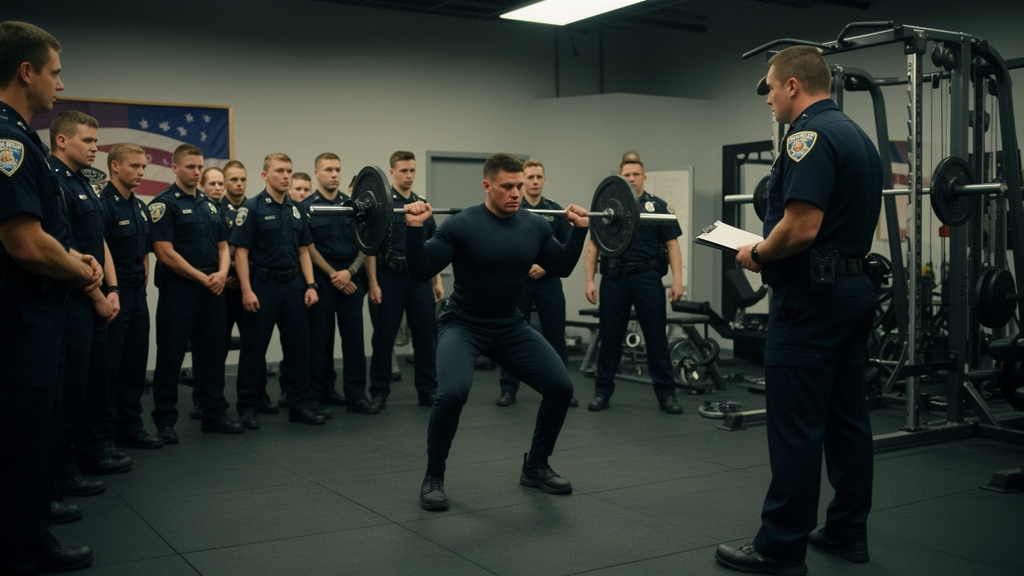
Muscularity was consistently associated with how police cadets judged other people’s physical capability, but not with most judgments about morality, in a study of 308 cadets at a police university in Chongqing, China. Participants rated one male and one female computer-generated combat athlete at four intended muscularity levels, describing each on 14 attributes. More muscular targets were judged stronger and better able to withstand blows in both model specifications. Explosiveness was also consistently associated with muscularity for the female target, but its association for the male target appeared only after an interaction term was removed. No morality measure remained statistically significant after correction for multiple testing. The study detected no reliable evidence that self-reported combatives training changed these impressions, although the exceptionally small group without training experience limited that conclusion.
The image-based experimental study, published in Frontiers in Psychology, tested whether visible muscle influences the attributes people infer from a stranger. Each cadet saw one male and one female target whose pose, face, clothing, camera angle and background were held as constant as possible while muscularity changed. The images were generated with GPT-5, and the authors selected the clearest and most realistic sets from more than 20 candidates. Participants evaluated physical competence, warmth and morality using semantic-differential scales with 11 points between opposing descriptions. They separately rated strength, explosiveness, fighting skill, endurance, coordination and resistance to blows, alongside four warmth items and four morality items. Each item was analyzed separately because the researchers had not validated them as combined dimension scores.
For the male target, muscularity remained associated with perceived strength and resistance to blows in statistical models both with and without a muscularity-by-training interaction. In the full models, the strength association had a partial eta squared of 0.120 and resistance to blows had a partial eta squared of 0.064, with both surviving Holm correction across 14 outcomes. For the female target, strength, explosiveness and resistance to blows also survived correction in both model specifications. The corresponding partial eta squared values were 0.096, 0.055 and 0.048. The female-target explosiveness finding therefore did not depend on removal of the interaction, unlike the male-target result. These statistics concern perceptions of pictured people, not evidence that the targets actually possessed those abilities.
Some conclusions depended on how the analysis was specified. Male-target explosiveness and enthusiasm, along with female-target fighting skill, became significant after the researchers removed the interaction between muscularity and combatives experience. Male-target fighting skill was not significant in either specification, and female-target fighting skill was significant only in the model without the interaction. The researchers therefore treated the consistent strength and resistance-to-blows findings, plus female-target explosiveness, as the most reliable results. The appearance-based pattern was strongest for physical capability and weaker or less stable for warmth, interpersonal conduct and technique.
Combatives experience was defined as self-reported completion of live-sparring training or a university course called “Police Defense and Control.” Of the 308 participants, 280 reported such experience and only 28 did not. Neither the overall difference between these groups nor the interaction between experience and muscularity was statistically significant for either target sex. Adjusted experienced-minus-inexperienced differences ranged from −0.64 to 0.58 points on the 11-point scales, and every 95% confidence interval included zero. Because the inexperienced group was so small, however, these non-significant results do not demonstrate that trained and untrained cadets made identical judgments. The analysis also cannot show that training caused or failed to cause any change in social perceptions.
The investigators fitted Gaussian identity-link generalized linear models to the approximately continuous rating data, adjusting for age, participant sex, year in school, monthly household income, major, body-mass index and self-rated strength. Muscularity entered the full models as a four-level categorical factor, training experience as a two-level factor, and their interaction as three product terms. The models used sum-to-zero contrasts for muscularity and coded experience from −1 to +1. Holm correction was applied separately across the 14 outcomes for muscularity, experience and interaction tests, reducing the chance that isolated nominal findings would be mistaken for robust patterns. The full-model muscularity test gave the two experience groups equal weight, so the 28 inexperienced participants received half the weight of the 280 experienced participants in that contrast.
A sensitivity analysis repeated every model without the interaction while retaining both main predictors and all seven covariates. This changed the model assumption rather than simply reweighting the original results, so agreement between specifications did not prove that the relationship was identical across experience groups. The full models carried 22 parameters and 286 residual degrees of freedom, whereas the reduced models had 19 parameters and 289 residual degrees of freedom. Some muscularity and interaction contrast columns had variance-inflation factors above 5, reaching 6.47, indicating overlap among predictors without statistical rank deficiency. The study reported both raw and adjusted p values, 95% Wald confidence intervals and Wald-based partial eta squared, with exploratory pairwise comparisons distinguished from results that survived correction.
The study also conducted a manipulation check using participants’ ratings of perceived muscularity. The four male images formed a clear progression: their mean perceived-muscularity scores were 7.56, 8.52, 9.51 and 10.07 on the 11-point scale, and every adjacent pair differed in adjusted comparisons. The female means also rose, from 7.52 to 8.32, 9.28 and 9.60, but observers distinguished only two broad groups: levels 1 and 2 were not perceived as different from one another, nor were levels 3 and 4. The analysis retained the four randomized female conditions, but the perceptual evidence supports only a low-versus-high distinction rather than a graded four-step progression. The four image levels were independently randomized for each target set, although the male target always appeared first and the female target second.
Several limitations constrain the findings. The sample came from one Chinese police academy, was 88.0% male and had a mean age of 19.35 years, limiting generalizability. Experience was measured with one self-report question, and unmeasured differences between the training groups prevent causal claims. The design used one static identity for each target sex, so the target images did not represent the wider variety of people encountered in policing. Presentation order was not counterbalanced, leaving possible contrast or carryover effects in the female-target ratings that separate analyses could not remove. Image exposure time was uncontrolled, muscularity was not independently manipulated from body-fat distribution, and there was no independent pretest or expert validation of the stimuli. The judgment items and self-rated-strength item were single questions rather than validated multi-item measures.
For a sample size of 179, the researchers used an a priori G*Power calculation based on a medium effect of f = 0.25, alpha of 0.05, power of 0.80 and three numerator degrees of freedom. The realized sample exceeded that target, but the calculation assumed balanced allocation, did not include the 14-outcome correction and did not anticipate the 280-to-28 imbalance in training experience. Dangerousness, threat, actual police behavior and intervention effectiveness were not assessed. The findings support a specific conclusion: among these cadets, experimentally varied muscular appearance tracked perceived strength and resistance to blows with notable consistency, while female-target explosiveness was also consistent. Morality ratings were weaker, and other associations depended on model specification. Whether specialized training alters such judgments, or whether they carry consequences in realistic policing encounters, remains unresolved.
Subject of Research: Experimental testing of muscularity-related social judgments among Chinese police cadets
Article Title: Muscularity and combatives training experience in social judgments among police cadets
Article References: Mi, Z., Li, Y., Mei, Z., Chen, L., Deng, H., Yin, M., Zhang, X., Tao, Y., & Li, H. (2026). Muscularity and combatives training experience in social judgments among police cadets. Frontiers in Psychology, 17, Article 1831520. https://doi.org/10.3389/fpsyg.2026.1831520
Image Credits: AI Generated
DOI: 10.3389/fpsyg.2026.1831520
Keywords: muscularity, police cadets, social judgment, physical competence, muscle appearance, stereotypes, combatives training, morality judgments, warmth judgments, image experiment, combatives, training
Cite Scienmag News
Glenn Wilkins. (October 26, 2026). Muscularity shapes capability judgments more clearly than morality among police cadets. Scienmag. https://scienmag.com/muscularity-shapes-capability-judgments-more-clearly-than-morality-among-police-cadets/
Glenn Wilkins. "Muscularity shapes capability judgments more clearly than morality among police cadets." Scienmag, 26 October 2026, https://scienmag.com/muscularity-shapes-capability-judgments-more-clearly-than-morality-among-police-cadets/. Accessed 26 October 2026.
Glenn Wilkins. "Muscularity shapes capability judgments more clearly than morality among police cadets." Scienmag. October 26, 2026. https://scienmag.com/muscularity-shapes-capability-judgments-more-clearly-than-morality-among-police-cadets/


