


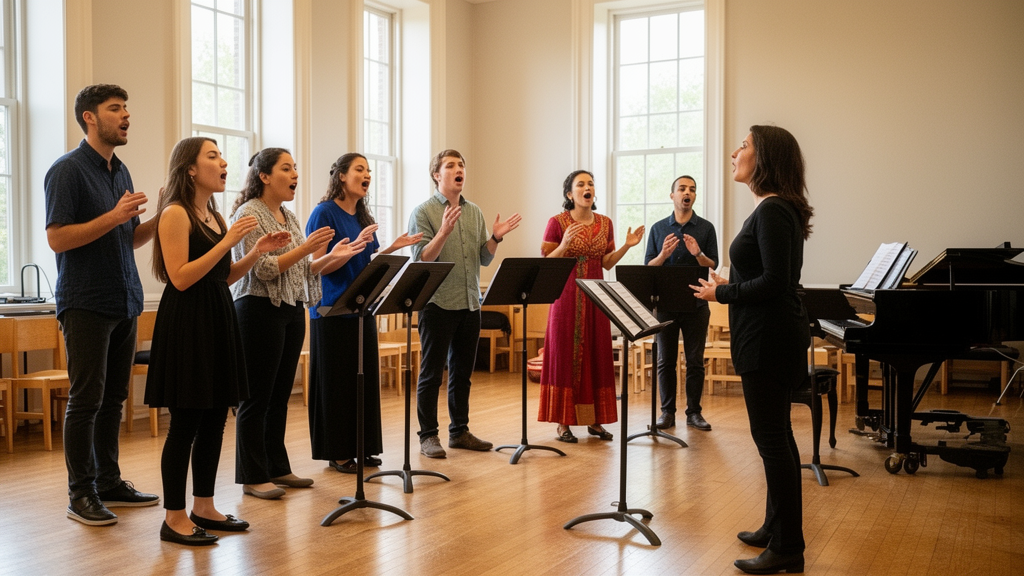
The researchers also found statistical indirect associations between training tradition and wellbeing through self-reported cognitive reappraisal and ethnic-cultural identity. Because the design did not assign students to training traditions, and tradition was completely confounded with institution and country, the findings cannot establish that the pedagogy itself produced the differences. The cross-sectional comparison included 240 students in Western classical or contemporary vocal training and 240 in Chinese programs teaching ethnic minority vocal traditions.
The Western programs were at the New England Conservatory of Music in Boston, the Royal College of Music in London and the University of Music and Performing Arts Vienna in Austria. Chinese participants came from the Central Conservatory of Music in Beijing, Yunnan Arts University in Kunming, Guangxi Arts University in Nanning and Inner Mongolia Normal University in Hohhot. The sampled programs included Mongolian long song and khoomei, Zhuang mountain song, and Yi, Bai and Dai repertoire; the Beijing program combined bel canto with minzu training.
They did not differ significantly in age, years of training, weekly practice hours or perceived cultural congruence. Western participants averaged 4.8 years of training and 9.9 practice hours per week, compared with 5.0 years and 9.7 hours for the Chinese ethnic group. All psychological instruments were translated and back-translated for the Chinese sample, and the research used an equal-weight composite of standardized wellbeing, self-esteem, depressive-symptom and trait-anxiety scores, with higher composite values indicating better wellbeing.
After adjustment for gender, age and training level, the Chinese ethnic group scored an average of 12.52 points higher on the 42-item Ryff psychological wellbeing scale, with a 95% confidence interval of 8.75 to 16.29. Its adjusted self-esteem score was 2.04 points higher on the 10-item Rosenberg scale. The group also recorded 0.89 fewer points on the nine-item Patient Health Questionnaire-9, a symptom screener rather than a diagnostic instrument, and 2.46 lower points on the 20-item trait-anxiety subscale of the State-Trait Anxiety Inventory.
The adjusted difference in the composite wellbeing score was 0.40 standard-deviation units, with a 95% confidence interval of 0.27 to 0.53. In unadjusted comparisons, the group difference in composite wellbeing had a standardized effect size of Cohen’s d = 0.55. The largest separation between the groups appeared in ethnic-cultural identity, measured with the six-item revised Multigroup Ethnic Identity Measure, which assesses exploration of and commitment to one’s own ethnic group.
Chinese ethnic vocal students averaged 3.73 on its five-point scale, compared with 3.30 among Western students, producing the study’s largest standardized difference, d = 0.78. They also reported greater use of cognitive reappraisal, measured with the six-item reappraisal subscale of the Emotion Regulation Questionnaire, with a standardized difference of d = 0.52. This measure captures a self-reported cognitive strategy; the study did not collect heart-rate variability, respiratory sinus arrhythmia, respiration or other physiological indicators.
Nor did it test measurement equivalence across the two groups, an important limitation because the identity measure referred to each respondent’s own ethnic or cultural group and could have carried different meanings in the two samples. Baseline mediation models identified two parallel indirect statistical associations. Chinese ethnic training was associated with an estimated 0.098 difference in the wellbeing composite through cognitive reappraisal, with a bias-corrected bootstrap 95% confidence interval of 0.060 to 0.147.
The indirect association through ethnic-cultural identity was 0.139, with an interval of 0.089 to 0.201. Combined, the two indirect estimates were 0.236, with a 95% interval of 0.175 to 0.313. The identity pathway accounted for approximately 59% of the total indirect estimate and the reappraisal pathway for 41%, although the contrast between those shares was not significant: the estimated difference was −0.041, with a 95% interval of −0.115 to 0.032.
These baseline paths were concurrent and therefore described statistical patterns consistent with mediation, not temporal or causal mediation. The indirect estimates remained non-zero in robustness analyses that accounted for students being clustered within institutions. When whole institutions were resampled, the interval was 0.066 to 0.135 for the reappraisal pathway, 0.096 to 0.185 for the identity pathway and 0.175 to 0.297 for the combined indirect association.
The direct association between tradition and wellbeing, however, was significant with conventional standard errors but not with cluster-based inference, so the researchers did not claim partial mediation. A multilevel model found that institutions accounted for 7.5% of wellbeing variance before training tradition was introduced; that estimate fell to 0.007 after tradition was added. A longitudinal subsample of 192 students, including 96 from each tradition, followed participants for six months.
Mean wellbeing in the Western group changed little, from −0.20 at baseline to −0.17 at six months, whereas the Chinese ethnic group rose from 0.22 to 0.50. The estimated time-by-tradition interaction was 0.042 per month, with a 95% confidence interval of 0.034 to 0.050. Depressive symptoms among the Chinese ethnic participants declined from 5.3 to 3.9 on the PHQ-9, while the Western group remained near 6.5; the interaction estimate was −0.276 per month.
Latent-growth and random-slope models gave the same overall pattern, but the longitudinal analysis did not test whether identity or emotion regulation mediated the change. The study also reported no attrition analysis, and its cross-lagged models were partly circular because the wellbeing composite included the inverse of the PHQ-9 score. Interviews with 40 students, 20 from each tradition, provided context for the numerical results without establishing mechanisms.
Controlled breathing appeared in 36 interviews. Participants described using long phrases, slow breaths and relaxed shoulders to settle their bodies before performances or during daily stress; Chinese ethnic students more often framed breath control as something sustained collectively, while Western students more often treated it as an individual technical tool. Songs connected with family, place, language and earlier generations appeared in all 20 Chinese ethnic interviews and 11 of 20 Western interviews.
Western participants who discussed belonging more often referred to a choir or studio as a chosen family. Teachers’ cultural backgrounds and interpersonal behavior also appeared in 27 interviews, but the formal statistical test did not find significant moderation of the identity pathway by instructor–student cultural congruence. Evaluative pressure appeared in 29 interviews.
Western students frequently described anxiety associated with juries, ranking and grade-oriented competition, and students in the mixed Beijing bel canto–minzu program described similar strain. More intensive practice was associated with a stronger emotion-regulation pathway under conventional inference: the conditional indirect estimate rose from 0.061 at one standard deviation below average practice hours to 0.123 at one standard deviation above average. That moderated effect was small and became borderline when institutions were resampled, with an interval touching zero.
Quadratic tests found no inverted-U relationship between practice intensity and wellbeing, so the interviews did not establish an optimal number of weekly practice hours. Cultural congruence was likewise unsupported as a moderator: its participant-bootstrap interval for the identity-pathway index included zero, and institution-level resampling with only three or four institutions per tradition was treated as unstable. The overall result is best read as hypothesis-generating rather than as evidence that one vocal pedagogy improves mental health.
Students were not randomly assigned, the principal mediation models used baseline data, all core psychological measures were self-reported, and measurement equivalence across the two groups was not established. The institutional and national confounding remained the central limitation, while the sample represented conservatory programs rather than community-based practitioners or the full range of ethnic traditions in China. The qualitative sample was also limited, with a small number of interviews per site.
Nevertheless, the combined self-reported findings, interviews and six-month patterns identify cultural identity, emotion regulation, teacher relationships and assessment climate as variables worth separating in stronger studies. The authors specifically call for multisite research that places both traditions within shared institutions, incorporates longitudinal and physiological measurements, and uses identity instruments validated across groups.
Subject of Research: Associations between vocal-training tradition, ethnic-cultural identity, emotion regulation and psychological wellbeing in conservatory students
Article Title: Ethnic minority vocal traditions and psychological wellbeing: ethnic-cultural identity and self-reported emotion regulation in Chinese conservatory programs
Article References: Qin, L., & Zhao, M. (2026). Ethnic minority vocal traditions and psychological wellbeing: ethnic-cultural identity and self-reported emotion regulation in Chinese conservatory programs. Frontiers in Psychology, 17, Article 1981035. https://doi.org/10.3389/fpsyg.2026.1981035
Image Credits: AI Generated
DOI: 10.3389/fpsyg.2026.1981035
Keywords: ethnic vocal traditions, psychological wellbeing, ethnic-cultural identity, emotion regulation, conservatory students, mixed-methods research, Chinese music education, performance anxiety, music pedagogy, Ethnic, minority, vocal
Cite Scienmag News
Glenn Wilkins. (October 26, 2026). Ethnic Vocal Training Linked to Higher Wellbeing in Observational Conservatory Study. Scienmag. https://scienmag.com/ethnic-vocal-training-linked-to-higher-wellbeing-in-observational-conservatory-study/
Glenn Wilkins. "Ethnic Vocal Training Linked to Higher Wellbeing in Observational Conservatory Study." Scienmag, 26 October 2026, https://scienmag.com/ethnic-vocal-training-linked-to-higher-wellbeing-in-observational-conservatory-study/. Accessed 26 October 2026.
Glenn Wilkins. "Ethnic Vocal Training Linked to Higher Wellbeing in Observational Conservatory Study." Scienmag. October 26, 2026. https://scienmag.com/ethnic-vocal-training-linked-to-higher-wellbeing-in-observational-conservatory-study/


