


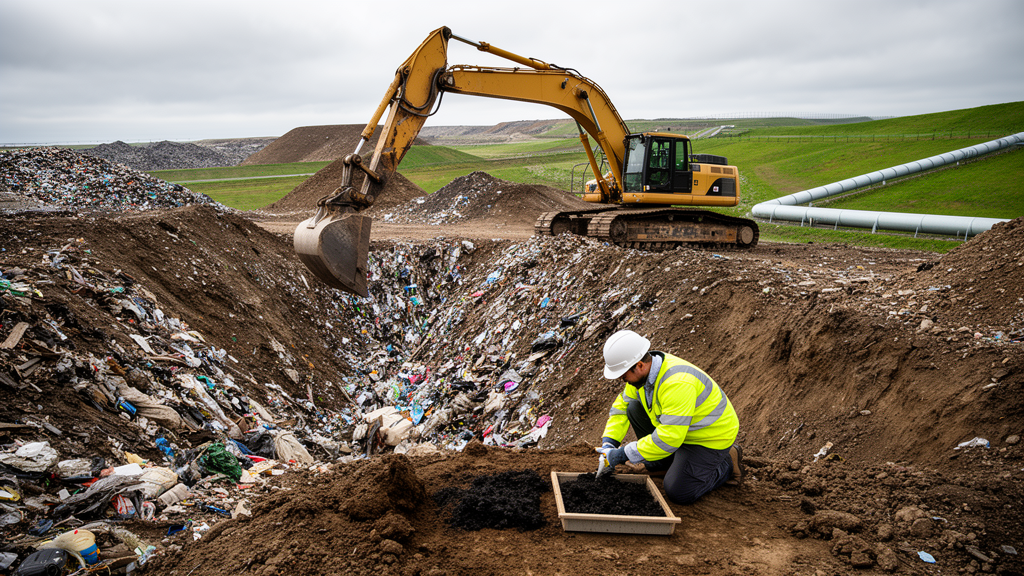
Digging up old landfills to recover resources and remediate land could help countries in the Global South cut emissions, but only if they act within a narrowing window, according to a perspective article published in the journal Discover Sustainability. The authors, led by Venkata Siva Naga Sai Goli, argue that landfill mining (LFM) — the excavation and processing of legacy landfills and dumpsites for environmental remediation and secondary resource recovery — delivers its largest environmental benefits only while certain conditions hold, and that these conditions erode as waste continues to decompose and as energy systems decarbonize.
The argument rests on two benefit streams. The first is avoided greenhouse gas emissions, primarily in the form of methane, which is generated as organic waste biodegrades inside a landfill. Mining a landfill removes the waste before it can continue producing methane, so the avoided emissions are largest when the landfill’s remaining methane generation potential is still high. The second is the substitution of conventional fuels and virgin materials with the residues recovered from the landfill. The authors contend that both streams lose value over time.
The methane-related benefit diminishes because prolonged waste biodegradation steadily depletes the remaining methane generation potential of a landfill. The longer decision-making on LFM is delayed, the more of that potential has already been released to the atmosphere, and the smaller the avoided emissions that a future mining project can claim. In the authors’ framing, this makes every year of inaction a direct reduction in the climate payoff of an eventual intervention.
The substitution benefit erodes for a different reason: changes in the background energy mix. The authors argue that as energy and electricity generation become less carbon-intensive over time, the fuels and virgin materials displaced by landfill-mined residues become progressively less advantageous compared with increasingly low-carbon alternatives. Countries in the Global South are expected to pursue decarbonization of their energy and electricity generation, which means the relative climate advantage of landfill-derived resources shrinks as their grids and fuel supplies clean up.
Because these benefits erode on both fronts, the authors describe LFM as a time-sensitive opportunity. They frame this specifically for countries in the Global South, which face a continuous surge in municipal solid waste generation while simultaneously pursuing decarbonization. In such contexts, the article argues, delaying decisions on landfill mining means continued methane emissions from ageing dumpsites alongside a shrinking relative advantage for landfill-mined residues.
The perspective is careful to note that LFM is not automatically beneficial. Its environmental sustainability depends on trade-offs across multiple impact categories, including climate change, ozone depletion and human toxicity. The authors’ position is that LFM becomes a sustainable solution only when its environmental benefits are maximized and its environmental burdens minimized — a balance that shifts as the two main benefit streams weaken over time.
To support the argument, the authors systematically review and draw conclusions from European LFM case studies, using documented experience from projects in regions where landfill mining has been piloted or implemented to illustrate how benefits and burdens play out in practice. They also review waste management policies that support LFM in the Global South, aiming to inform decision-making in countries considering the approach.
The article is published open access as a perspective piece. The version shared ahead of final publication is citable and carries a permanent DOI, subject to further editorial revisions before the Version of Record replaces it.
Subject of Research: Landfill mining in the global south as a time-sensitive opportunity for environmental sustainability
Article Title: Landfill mining in the global south as a time-sensitive opportunity for environmental sustainability
Article References: Goli, V. S. N. S., Bokade, M., Singh, P., & Singh, D. N. (2026). Landfill mining in the global south as a time-sensitive opportunity for environmental sustainability. Discover Sustainability. https://doi.org/10.1007/s43621-026-05097-2
Image Credits: AI Generated
DOI: 10.1007/s43621-026-05097-2
Keywords: landfill mining, Global South, municipal solid waste, methane emissions, greenhouse gases, resource recovery, decarbonization, environmental sustainability, waste management policy, legacy dumpsites, Discover Sustainability, Landfill
Cite Scienmag News
Sloane Callahan. (October 26, 2026). Landfill Mining’s Climate Payoff Fades With Time, Researchers Warn. Scienmag. https://scienmag.com/landfill-minings-climate-payoff-fades-with-time-researchers-warn/
Sloane Callahan. "Landfill Mining’s Climate Payoff Fades With Time, Researchers Warn." Scienmag, 26 October 2026, https://scienmag.com/landfill-minings-climate-payoff-fades-with-time-researchers-warn/. Accessed 26 October 2026.
Sloane Callahan. "Landfill Mining’s Climate Payoff Fades With Time, Researchers Warn." Scienmag. October 26, 2026. https://scienmag.com/landfill-minings-climate-payoff-fades-with-time-researchers-warn/


