


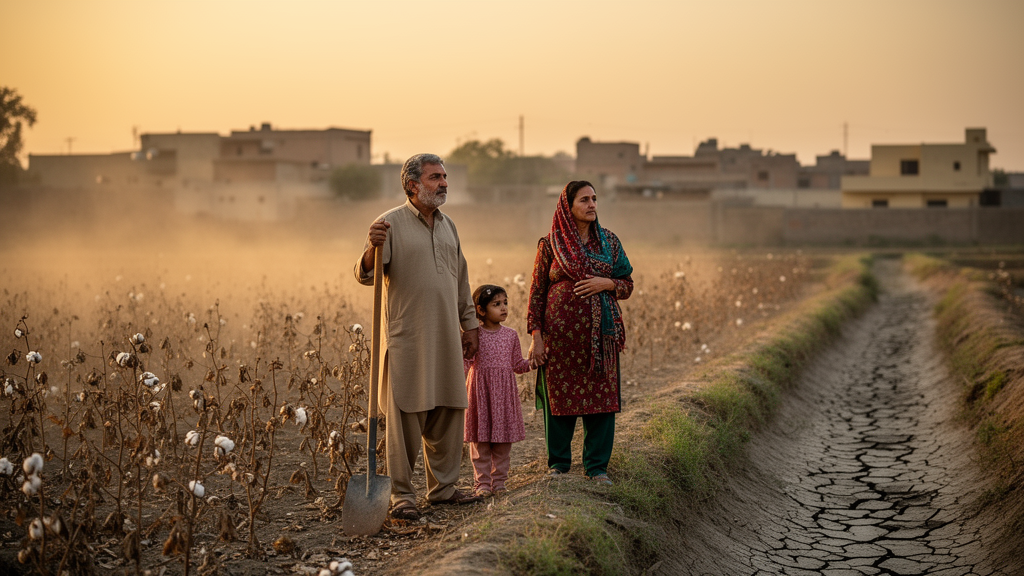
Parents in climate-sensitive farming communities of Pakistan are experiencing a distinctive form of climate-related distress that centres less on environmental degradation itself and more on what an unpredictable environment means for their children’s futures. A qualitative study published in Current Psychology introduces the concept of Climate Livelihood Anxiety (CLA), a framework describing how parents who depend on climate-vulnerable livelihoods translate environmental uncertainty into worries about education, family responsibilities and long-term opportunity. The research, led by Sadia Malik, was based on semi-structured interviews with 27 parents drawn from farming communities in Punjab, Sindh and Balochistan.
The study adopted an interpretive qualitative design, using reflexive thematic analysis to identify recurring patterns in how parents described their experience of environmental uncertainty. Rather than measuring anxiety with psychometric scales, the approach aimed to characterise the structure of parental concern as it is lived and articulated within families. This matters because previous work on eco-anxiety and climate anxiety has largely framed climate distress as an individual emotional reaction to environmental degradation, leaving the family-level and livelihood-mediated dimensions of that distress underexplored.
The analysis identified four interconnected dimensions of Climate Livelihood Anxiety. First, environmental uncertainty was found to undermine parents’ predictive confidence and their capacity for future planning: when rainfall, crops and income can no longer be anticipated with reasonable reliability, the mental models parents use to chart their family’s trajectory lose their footing. Second, livelihood insecurity was translated into parental anxiety about fulfilling family responsibilities, linking the material stability of the household to parents’ sense of whether they can meet obligations to their children.
The third dimension concerns aspiration. Parents increasingly reconfigured their hopes for their children towards education and non-farm employment, treating schooling and off-farm careers as routes out of climate-exposed livelihoods. Yet the analysis showed that confidence in these alternative pathways was itself increasingly uncertain, meaning that the perceived escape routes carried their own layer of doubt. The fourth dimension positions hope not as passive optimism but as an adaptive process that sustains parental agency, allowing parents to keep acting and planning despite unreliable environmental and economic conditions.
Taken together, the findings indicate that climate-related distress in these communities is not only a response to environmental degradation but also a future-oriented, relational, livelihood-mediated and intergenerational process integral to family life. In other words, the psychological impact of climate change operates through the household economy and through parents’ relationships with their children, rather than residing solely in individual emotional responses to a changing environment.
Theoretically, the study contributes to climate psychology by highlighting the family and livelihood dimensions of climate-related distress. It also extends Family Stress Theory, a framework traditionally used to explain how families respond to disruptive events, by showing how environmental uncertainty intertwines with livelihood insecurity and future-oriented parental concerns. The notion of Climate Livelihood Anxiety is offered as a new theoretical lens on the psychological impacts of climate change at the family level, complementing existing individual-focused constructs such as eco-anxiety.
The author notes implications for policy, suggesting family-focused interventions and relevance for climate adaptation and rural development. If parental anxiety in climate-exposed regions is bound up with education, livelihood security and intergenerational opportunity, then adaptation programmes that address only infrastructure or agricultural technique may miss the psychological and family-level pathways through which climate change reshapes decision-making. Supporting parents’ planning confidence and the perceived viability of educational and non-farm pathways could, on this account, form part of adaptation strategy.
As with any qualitative interview study, the scope of the findings is bounded by design: the analysis reflects the experiences of 27 parents in three Pakistani provinces and is intended to build conceptual understanding rather than to quantify prevalence or establish causal effects. The four dimensions of Climate Livelihood Anxiety should therefore be read as an interpretive framework generated from these accounts, one that the author proposes for further development in climate psychology and for testing across other climate-sensitive communities. Within that scope, the study adds a concrete description of how environmental uncertainty is experienced inside families whose livelihoods sit directly on the front line of climate variability.
Subject of Research: Climate Livelihood Anxiety among parents in climate-sensitive farming communities in Punjab, Sindh and Balochistan, Pakistan
Article Title: Climate livelihood anxiety: environmental uncertainty and parents’ perceptions of children’s future opportunities
Article References: Malik, S. (2026). Climate livelihood anxiety: environmental uncertainty and parents’ perceptions of children’s future opportunities. Current Psychology, 45(21), Article 1658. https://doi.org/10.1007/s12144-026-10197-3
Image Credits: AI Generated
DOI: 10.1007/s12144-026-10197-3
Keywords: climate anxiety, eco-anxiety, Climate Livelihood Anxiety, parenting, family stress theory, rural livelihoods, Pakistan, qualitative research, environmental uncertainty, climate psychology, children's futures, climate adaptation
Cite Scienmag News
Glenn Wilkins. (October 26, 2026). Climate livelihood anxiety: how farming parents in Pakistan rethink children’s futures. Scienmag. https://scienmag.com/climate-livelihood-anxiety-how-farming-parents-in-pakistan-rethink-childrens-futures/
Glenn Wilkins. "Climate livelihood anxiety: how farming parents in Pakistan rethink children’s futures." Scienmag, 26 October 2026, https://scienmag.com/climate-livelihood-anxiety-how-farming-parents-in-pakistan-rethink-childrens-futures/. Accessed 26 October 2026.
Glenn Wilkins. "Climate livelihood anxiety: how farming parents in Pakistan rethink children’s futures." Scienmag. October 26, 2026. https://scienmag.com/climate-livelihood-anxiety-how-farming-parents-in-pakistan-rethink-childrens-futures/


