


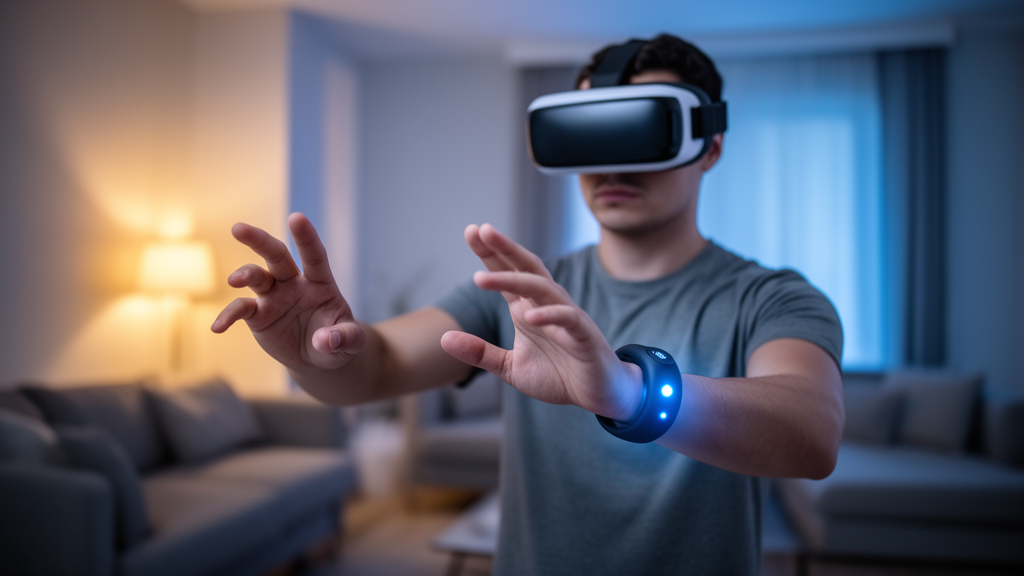
Immersive, game-like virtual environments do not measurably change how accurately people can discriminate stiffness through wrist-worn haptic feedback, according to a new study from Kadir Has University in Istanbul, but they do change how pleasant the experience feels and which interface users prefer. The research, published in Frontiers in Virtual Reality, put sixteen participants through a stiffness-discrimination task in two contrasting virtual settings: a deliberately minimal experimental interface and a richly detailed spaceship environment. Perceptual accuracy and sensitivity stayed statistically unchanged across both worlds, yet the spaceship interface consistently scored higher on pleasantness at the cost of perceived task difficulty, and participants’ interface preferences split cleanly along the way they interacted with virtual objects.
The study addresses a quiet assumption that runs through much of haptics research. Wrist-worn haptic devices have become an attractive alternative to finger-mounted hardware because they leave the hands free, allowing users to handle real tools and virtual objects interchangeably during the same session. In haptic relocation, a person touches or squeezes a virtual object with their hands while the expected touch sensations are rendered at a remote body location, typically around the wrist or forearm. This frees designers from cumbersome devices grounded on the fingers and preserves the ability to interact with real objects when needed. But the perceptual benchmarks that guide these systems, such as just noticeable differences and points of subjective equality, are usually measured in stripped-down laboratory settings with participants sitting still and comparing two visually identical objects.
The researchers questioned whether those carefully controlled measurements transfer to the immersive, game-like scenarios that wrist-worn haptics are actually built for. Prior work has shown that immersion and gamification can influence users’ sense of realism, information transfer, task performance, and enjoyment, and that visual-haptic coherence affects presence and perceptual experience. One earlier study even demonstrated that perceived stiffness can differ between augmented reality and virtual reality contexts. If immersive interfaces are not psychophysically neutral, then thresholds measured in minimalist setups might mislead designers of entertainment and training applications. The team also noted that no previous study had cross-referenced how virtual interface design interacts with different exploration modalities, such as poking an object with a finger versus grasping and squeezing it between both hands.
To test this, the researchers built two virtual interfaces in Unity, displayed on an Oculus Quest 2 headset at a refresh rate of 72 Hz. The experimental interface was intentionally austere: a white desk, a hand avatar, and two identical-looking rigid boxes, set in a room with plain white walls and nothing else. The spaceship interface kept the same task structure but wrapped it in a space-themed environment with vibrant lighting, interactive animations, and a dynamic meteor field visible through the windows. During breaks between trials, participants could fly the ship from a control panel, move through the environment by rotating their bodies and pinching their thumb and middle finger, and pick up, lift, and throw space-themed objects into a trash bin. Crucially, the immersive elements were active only during breaks, not during the haptic exploration itself, to avoid distracting participants from the discrimination task.
The haptic hardware was a wrist-worn device carrying two identical shaftless coin-type eccentric rotating mass actuators, each 10 millimeters in radius and 3 millimeters in height, positioned on the dorsal and volar sides of the wrist roughly 5 centimeters apart and attached to adjustable Velcro strips. An Arduino Mega 2560 microcontroller drove the actuators with pulse-width modulation at 490 Hz and 5 volts, receiving commands from Unity over a UART connection at 115,200 baud. Each actuator could produce a maximum vibration amplitude of 0.75 g at a constant frequency of 225 Hz. The wrist was chosen because it does not hinder normal finger movement during poking or grasping. In the rendering scheme, the stiffness of a virtual object was indicated by the amplitude of real-time vibration at the wrist, meaning the experiment tested vibrotactile indications of stiffness rather than the kinesthetic perception of actual resistive force.
The task itself was a classic two-alternative stiffness discrimination. On each trial, participants saw a pair of identical-looking boxes with different stiffness values and explored both as many times as needed using their dominant hand, either poking with the index finger or grasping and squeezing between both hands, depending on their assigned group. The wrist device rendered vibration intensity tied to each object’s stiffness, and participants then pressed the button next to the box they judged stiffer. One box always carried a reference virtual stiffness of 70 newtons per meter, while the other varied among 60, 65, 70, 75, and 80 newtons per meter. These values were mapped to 8-bit PWM commands of 77, 89, 102, 115, and 128, corresponding to duty cycles of roughly 30.2 to 50.2 percent. Accelerometer measurements taken ten times per level confirmed the five intensity levels were statistically distinct, with mean outputs rising linearly from 0.700 g to 0.750 g and standard deviations between 0.002 and 0.006 g.
The experiment followed a two-by-two mixed factorial design, with virtual interface as the within-subject factor, meaning every participant experienced both the experimental and spaceship environments in counterbalanced order, and interaction modality as the between-subject factor, so each person completed the task with only one interaction style. The sixteen participants, nine male and seven female, aged 20 to 23 with an average age of 21.6, were students recruited at Kadir Has University under a protocol approved by the local review board, with written informed consent from all. Fourteen were right-handed. Each interface session comprised five stiffness pairs repeated ten times, or 50 trials, for a total of 100 trials per participant, punctuated by short breaks and a longer pause of about seven minutes between interfaces. Noise-cancelling headphones playing white noise masked ambient and actuator sounds throughout.
The psychophysical results were strikingly stable. Fitted psychometric curves yielded points of subjective equality, which index perceptual accuracy, of 70.90 plus or minus 1.14 newtons per meter for the experimental interface and 69.94 plus or minus 2.44 for the spaceship interface under poking, and 70.14 plus or minus 0.81 versus 70.81 plus or minus 1.39 under grasping. Statistical analysis found no significant main effect of interface, modality, or their interaction, and none of the four conditions deviated significantly from the 70 newtons per meter reference. Just noticeable differences, which index sensitivity, averaged between 2.90 and 3.98 newtons per meter across conditions, again with no significant effects, although the mean JND was descriptively lower in the spaceship interface for both modalities. Exploration times also showed no significant differences, despite participants in the poking group spending descriptively more time in the spaceship while graspers spent more time in the experimental interface. The authors caution that these JNDs are task-specific estimates interpolated from fitted psychometric functions rather than absolute thresholds of physical vibration amplitude, and that no formal correction for multiple comparisons was applied, making the follow-up comparisons exploratory.
Subjective experience told a different story. On seven-point Likert scales, participants rated the experimental interface as easier for discrimination, 5.4 versus 4.8 overall, with the gap widest in the poking group, 5.6 versus 4.6. The spaceship interface, by contrast, was rated more pleasant, 6.3 versus 5.4 overall, an effect strongest among graspers, who gave it 6.4 versus 5.1. Preference votes mirrored this trade-off: six of eight participants in the poking group preferred the experimental interface, while six of eight in the grasping group preferred the spaceship. The authors speculate that poking aligned with the structured, reductionist character of the minimalist interface, whereas grasping complemented the immersive qualities of the spaceship, and they observed an inverse relationship in which conditions perceived as more difficult were sometimes rated as more pleasant, possibly reflecting engagement or novelty effects.
The practical takeaway is a split verdict for designers. If an application depends on the accuracy and sensitivity of haptic perception, perceptual performance may translate across conventional and immersive environments under the conditions tested here. But because user experience depends strongly on the virtual environment and the interaction modality, designers should recalibrate the psychophysical evaluation of their haptic feedback for the context in which it will actually be used. The study carries clear limitations: the small, demographically homogeneous sample, the between-subject modality design that limited statistical power, the coarse five-step stimulus resolution, the absence of uncertainty propagation for the fitted JND values, and the use of affordable but imprecise eccentric rotating mass actuators, whose response the team plans to compare against linear resonant actuators in future work. The authors also recommend testing pinching as a third modality and designing adaptive environments that adjust complexity to individual users. Within those bounds, the message stands: what people can feel through a wristband may survive the jump into a gamified universe, but how the experience feels depends on matching the interaction style to the virtual world around it.
Subject of Research: The effect of virtual immersion and interaction modality on wrist-worn vibrotactile stiffness discrimination
Article Title: Impact of immersion and interaction modalities on wrist-worn haptics
Article References: Adeyemi, A., Soydugan, S. B., Guntas, F., & Sarac, M. (2026). Impact of immersion and interaction modalities on wrist-worn haptics. Frontiers in Virtual Reality, 7, 1854978. https://doi.org/10.3389/frvir.2026.1854978
Image Credits: AI Generated
DOI: 10.3389/frvir.2026.1854978
Keywords: virtual reality, haptic feedback, wrist-worn haptics, immersion, wearable haptics, haptic relocation, psychophysical experiments, stiffness discrimination, vibrotactile actuators, interaction modality, gamification, human-machine interaction
Cite Scienmag News
Grant Pearson. (October 26, 2026). Gamified VR leaves wrist haptic perception intact but reshapes user experience. Scienmag. https://scienmag.com/gamified-vr-leaves-wrist-haptic-perception-intact-but-reshapes-user-experience/
Grant Pearson. "Gamified VR leaves wrist haptic perception intact but reshapes user experience." Scienmag, 26 October 2026, https://scienmag.com/gamified-vr-leaves-wrist-haptic-perception-intact-but-reshapes-user-experience/. Accessed 26 October 2026.
Grant Pearson. "Gamified VR leaves wrist haptic perception intact but reshapes user experience." Scienmag. October 26, 2026. https://scienmag.com/gamified-vr-leaves-wrist-haptic-perception-intact-but-reshapes-user-experience/


