


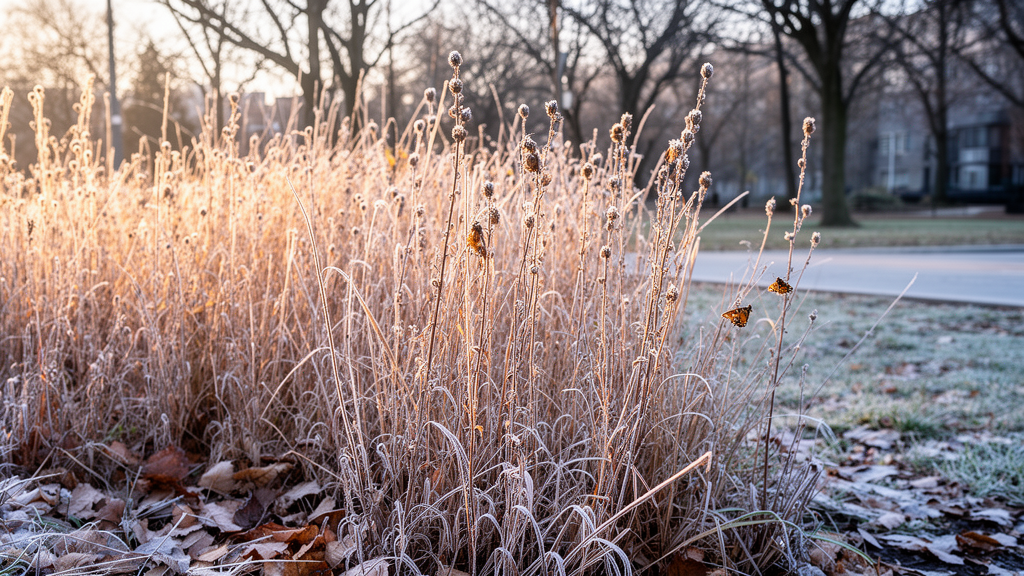
Leaving urban meadows uncut through the winter dramatically increases the number of insects that successfully hatch out the following spring, according to a two-year field experiment in the German city of Tübingen. Over the course of the study, researchers trapped and identified 13,511 insects emerging from meadow plots between mid-February and mid-June, and found that plots spared an autumn cut produced significantly more individuals and a significantly higher diversity of hatching insects than plots mown in September.
The study, conducted on public urban green spaces that had been mown twice a year for at least two years, compared halves of the same meadows: one half was cut at the end of June only, leaving the vegetation standing over winter, while the other half was cut both at the end of June and at the end of September. In early spring, the team placed square emergence traps, known as photo-eclectors, over the vegetation. These light-seeking traps funnel hatching insects into a collecting container, allowing researchers to count exactly which animals had spent the winter in each plot and in which plant structures.
The results were unambiguous. Using linear mixed models that accounted for year and weekly sampling date as random factors, the researchers found that unmown plots scored significantly higher on the Shannon diversity index (p < 0.001) and produced significantly more individual insects (p < 0.001) than autumn-mown plots. The number of species and morphotypes did not differ significantly between the two management types (p = 0.60), suggesting that the main effect of the autumn cut is on the sheer abundance of insects surviving the winter rather than on which species are present.
In total, the trapped insects belonged to 120 families, 140 taxonomically confirmed species and 324 morphotypes across four orders: true bugs (Heteroptera), hymenopterans, beetles (Coleoptera) and flies (Diptera). The unmown plots yielded 78 true bug individuals compared with just 12 on mown plots, 2,221 hymenopterans versus 869, 730 beetles versus 420, and 5,723 flies versus 3,458. Emergence rose steadily through spring, with weekly counts showing a general increase in hatching activity from February onwards, interrupted by dips the authors attribute to colder weather in May.
Beyond the simple mown-versus-unmown comparison, the experiment dissected the meadow into its structural components: flower heads, stems, tufts and leaves. Two litres of plant material from each compartment of each management type were sealed into traps with tissue-sealed bottoms to exclude animals arriving from the soil. On the autumn-mown plots, flower heads and stems were entirely absent, so these overwintering resources simply did not exist. On unmown plots, tufts supported the highest Shannon diversity of hibernating insects, while flower heads were used less than the other compartments. Significantly more individuals and species hatched from tufts and leaves on unmown plots than on the corresponding structures of mown plots.
Different insect orders showed distinct preferences for where they spent the winter. Beetles hatched in significantly greater numbers from tufts than from flower heads, a pattern the authors link to the walking rather than flying habits of many beetle species. Hymenopterans, dominated by parasitoid families such as Braconidae and Ichneumonidae, showed a tendency to hibernate in flower heads and leaves rather than stems and tufts, and their highest species diversity occurred in leaves. Flies clustered in tufts near the ground, while adult true bugs were scarce in early spring, consistent with the fact that many heteropteran species overwinter as eggs and their adults only emerge later in the season.
The study also quantified the role of the soil. Because the traps in the second experiment had open bottoms while those in the first had sealed bottoms, the researchers could infer which species had emerged from the ground. They concluded that 134 species and morphotypes, represented by 254 individuals, hibernated in the soil, whereas 338 species and morphotypes, totalling 3,530 individuals, used above-ground vegetation such as flower heads, stems, tufts and leaves. This comparison underlines that the majority of hibernating insects in these meadows depend on standing winter vegetation rather than the ground beneath it.
Particularly telling were the species found exclusively in flower heads and stems. Among the expert-confirmed species, these included true bugs such as Cardiastethus fasciiventris and Himacerus mirmicoides in flower heads, and Nabis brevis and Megalonotus antennatus in stems, alongside leaf beetles like Hispella atra, Oulema melanopus and Psylliodes napi, several rove beetles, and tephritid flies including Chaetorellia jaceae, of which 14 individuals hatched from flower heads. Because autumn mowing removes flower heads and stems altogether, the authors conclude that this single management step eliminates the entire set of insect species that depend on those structures for overwintering, a total of 1,953 individuals hatched from these compartments on the unmown plots in the study.
The findings extend a series of earlier investigations in Tübingen carried out under the Initiative Bunte Wiese, which had already shown that reduced mowing raises insect species richness and biomass during the growing season for grasshoppers, true bugs, beetles, wild bees and butterflies. The new work adds the missing piece of the life cycle: winter. As earlier entomologists noted, the population size that survives the winter largely determines abundance in summer, so protecting egg and larval habitats through the cold months is critical for maintaining insect populations year-round.
The authors propose an adapted mowing mosaic for urban green spaces and rural grasslands alike, combining three regimes: a two-cut flower concept to boost flowering plant diversity, an autumnal mowing regime to protect late-summer insects completing their larval development, and a summer mowing regime that leaves meadows standing through winter as high-quality hibernation habitat, which also benefits seed-eating birds such as finches, sparrows and yellowhammers. Mowing periods should be stretched out rather than fixed to single dates, and cut biomass should be removed to avoid over-fertilisation. Such a mosaic, the authors argue, would let insects escape, migrate and recolonise mown areas throughout the year, supporting metapopulation dynamics while still meeting the aesthetic and practical needs of urban green space management. The study was limited to four insect orders on urban meadows in a single city, and ants, springtails, aphid-relatives, butterflies and all larvae were excluded from the analysis, so the full picture of winter fauna may be even richer than these results suggest.
Subject of Research: Effects of autumn mowing versus unmown winter vegetation on insect hibernation and spring emergence in urban meadows
Article Title: Insect hibernation on urban green land: a winter-adapted mowing regime as a management tool for insect conservation
Article References: Unterweger, P. A., Klammer, J., Unger, M., & Betz, O. (2018). Insect hibernation on urban green land: a winter-adapted mowing regime as a management tool for insect conservation. BioRisk, 13, 1-29. https://doi.org/10.3897/biorisk.13.22316
Image Credits: AI Generated
Keywords: insect conservation, urban meadows, hibernation, mowing regime, emergence traps, biodiversity, grassland management, Heteroptera, Coleoptera, Diptera, Hymenoptera, Tübingen
Cite Scienmag News
Gavin Prescott. (October 26, 2026). Skipping the autumn mow lets urban meadows become winter nurseries for insects. Scienmag. https://scienmag.com/skipping-the-autumn-mow-lets-urban-meadows-become-winter-nurseries-for-insects/
Gavin Prescott. "Skipping the autumn mow lets urban meadows become winter nurseries for insects." Scienmag, 26 October 2026, https://scienmag.com/skipping-the-autumn-mow-lets-urban-meadows-become-winter-nurseries-for-insects/. Accessed 26 October 2026.
Gavin Prescott. "Skipping the autumn mow lets urban meadows become winter nurseries for insects." Scienmag. October 26, 2026. https://scienmag.com/skipping-the-autumn-mow-lets-urban-meadows-become-winter-nurseries-for-insects/


