


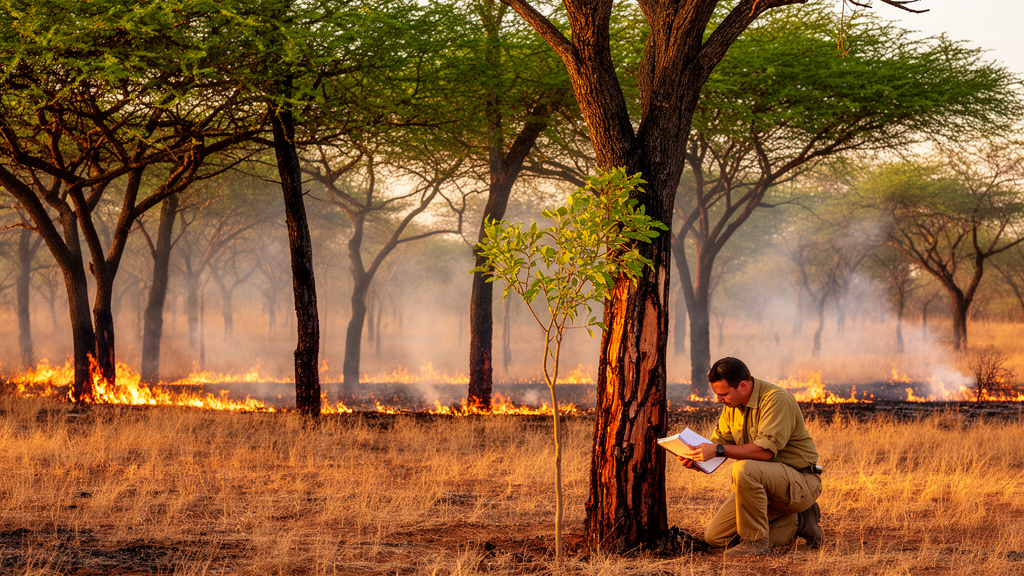
Fire has swept through the Makambu Fire Experiment in Namibia's Kavango West Region almost every year since 1959, yet the woodland trees standing there today present a picture of considerable stability. A new analysis of this decades-long experiment, published in Frontiers in Sustainable Resource Management, found that the season in which fires were set made no statistically detectable difference to tree survival, species composition, or community-level diversity. Instead, whether an individual tree lived or died depended far more on how tall it was and which species it belonged to than on whether it faced early dry season, late dry season, or late wet season burning.
The Makambu experiment was established in 1959 by what is now Namibia's Ministry of Environment, Forestry, and Tourism to investigate the long-term effects of seasonal fire on woodland vegetation, with a particular focus on basal area increment and regeneration of valuable timber species. The site lies in Zambezian Baikiaea woodlands on nutrient-poor Kalahari sands, receiving an average of 550 millimeters of rain annually, most of it between December and March. The original design was a randomized complete block layout with five blocks, each containing one-hectare plots assigned to five treatments: late wet season burns in March and April, an intensified late wet season treatment, early dry season burns in June and July, late dry season burns in October and November, and an unburned control.
Except for a two-year interruption between 2002 and 2004 caused by civil unrest in neighboring Angola, the designated plots have been burned annually under controlled conditions, typically in the morning or late afternoon under low wind. For the new study, researchers from the University of Namibia and the University of Porto surveyed 20 of the 25 permanent plots in August 2021, covering the three principal seasonal fire treatments and the unburned control; the intensified treatment plots were excluded because they are maintained as special observation plots. Within each plot, they established three 20 by 20 meter quadrats along a diagonal transect, positioned 10 meters from plot boundaries to minimize edge effects.
Every woody individual was identified to species and recorded as alive or dead, and living trees were measured for height, diameter at breast height, and canopy dimensions. The final dataset comprised 1,197 trees representing nine woody species, of which 1,054 were alive and 143 were dead. Dominant species at the site include the timber trees Pterocarpus angolensis and Guibourtia coleosperma, along with Terminalia sericea and several Combretum species.
The central result was notable: survival was 88.9 percent in burned plots and 86.2 percent in unburned plots, a difference that vanished under statistical testing. Mortality varied descriptively among treatments, with the highest rate recorded in the unburned control at 13.8 percent, followed by late dry season burning at 12.3 percent, late wet season burning at 11.3 percent, and early dry season burning at 10.1 percent, but these differences were not statistically significant. This outcome contradicted the researchers' own hypothesis that late dry season fires, which burn under drier and hotter conditions with lower fuel moisture, would inflict the greatest damage on woody vegetation.
To disentangle the factors driving survival, the team fitted a generalized linear mixed-effects model with a binomial distribution and a logit link, treating survival as a binary outcome and including plot identity as a random intercept to account for the nesting of trees within experimental plots. Multicollinearity diagnostics confirmed that all predictors could be retained, with variance inflation factors between 1.09 and 1.65. The model was statistically significant overall, correctly classifying 88.5 percent of trees, although it performed far better for living trees, correctly classifying 99.1 percent of survivors, than for dead trees, correctly classifying only 9.6 percent.
Tree height emerged as the strongest predictor: holding other variables constant, each one-unit increase in height was associated with a 26.9 percent increase in the odds of survival. Species identity also mattered significantly, and diameter at breast height showed a significant negative conditional association after accounting for the other predictors. The height effect aligned with the fire-trap hypothesis, which holds that recurrent fire disproportionately kills smaller woody individuals and constrains their escape into taller size classes.
Shorter trees sit closer to the flame zone and suffer greater exposure to lethal heat and crown scorch, while taller individuals hold their crowns above the main flames. In the categorical analysis, mortality was 18.75 percent among trees shorter than 3 meters and 21.52 percent among trees in the 3 to 5 meter class, compared with roughly 9.4 percent for trees taller than 5 meters. The authors cautioned, however, that smaller dead stems may have decomposed or been consumed by subsequent fires before the 2021 survey, potentially causing mortality among small trees to be underestimated, and that more frequent monitoring of dead-stem persistence would help quantify this potential bias.
The negative association between stem diameter and survival in the multivariable model was more puzzling, since thicker bark generally protects larger stems from fire. The researchers stressed that this should be read as a conditional statistical relationship rather than evidence that large-diameter trees are inherently fire-vulnerable. Unmeasured factors such as accumulated fire damage, internal decay, age-related structural decline, or delayed mortality from insect attack, fungal infection, and drought stress could explain the pattern.
Notably, diameter class was not significantly associated with survival in the simpler categorical analysis, even though the distribution of trees among diameter classes differed significantly between burned and unburned treatments. Species-level differences added another layer. Such differences are typically attributed to functional traits like bark thickness, bud protection, crown architecture, and resprouting capacity, although the study did not measure these traits directly, so the mechanisms remain plausible explanations rather than demonstrated causes.
At the community level, the picture was one of stability. Kruskal-Wallis tests found no significant differences among treatments in species richness, Shannon diversity, Simpson diversity, dominance, or evenness. Non-metric multidimensional scaling of Bray-Curtis dissimilarities produced a two-dimensional ordination with a stress value of 0.116, showing substantial overlap among all four treatments, and a PERMANOVA confirmed that species composition did not differ significantly among them.
A complementary PERMDISP test showed no differences in within-group dispersion, ruling out a statistical artifact. In other words, six decades of seasonally distinct annual burning had not produced a detectable restructuring of the tree community under the conditions of this experiment. The authors interpret these findings as evidence of considerable resilience in the Baikiaea woodland tree community, consistent with earlier African savanna studies showing that repeated fires can cause top-kill without altering species composition.
They emphasize that the absence of community-level differences does not mean fire is ecologically inert: individual species and height classes clearly responded differently, and repeated differences in mortality, recruitment, and regeneration could accumulate over longer periods into measurable structural change. Continued monitoring of the Makambu plots, they conclude, will be essential to determine whether the individual-level effects observed here eventually translate into shifts in woodland structure, and to guide evidence-based fire management of Namibia's economically and ecologically valuable Baikiaea woodlands.
Subject of Research: Long-term effects of seasonal fire regimes on tree mortality, structure, and diversity in Namibian Baikiaea woodlands
Article Title: Accumulated effects of seasonal fire on woodland trees: mortality, structure, and diversity at a fire experimental site in Kavango West Region, Namibia
Article References: Kasinda, E. M., Rutina, L. P., Fabiano, E. C., & Moreira, F. (2026). Accumulated effects of seasonal fire on woodland trees: mortality, structure, and diversity at a fire experimental site in Kavango West Region, Namibia. Frontiers in Sustainable Resource Management, 5, Article 1927825. https://doi.org/10.3389/fsrma.2026.1927825
Image Credits: AI Generated
DOI: 10.3389/fsrma.2026.1927825
Keywords: fire ecology, savanna, Namibia, Baikiaea woodland, tree mortality, biodiversity, fire season, species composition, tree survival, long-term experiment, Kavango West, Accumulated
Cite Scienmag News
Gavin Prescott. (October 26, 2026). Six Decades of Seasonal Fires Show Little Effect on Tree Survival in Namibian Woodland. Scienmag. https://scienmag.com/six-decades-of-seasonal-fires-show-little-effect-on-tree-survival-in-namibian-woodland/
Gavin Prescott. "Six Decades of Seasonal Fires Show Little Effect on Tree Survival in Namibian Woodland." Scienmag, 26 October 2026, https://scienmag.com/six-decades-of-seasonal-fires-show-little-effect-on-tree-survival-in-namibian-woodland/. Accessed 26 October 2026.
Gavin Prescott. "Six Decades of Seasonal Fires Show Little Effect on Tree Survival in Namibian Woodland." Scienmag. October 26, 2026. https://scienmag.com/six-decades-of-seasonal-fires-show-little-effect-on-tree-survival-in-namibian-woodland/


