


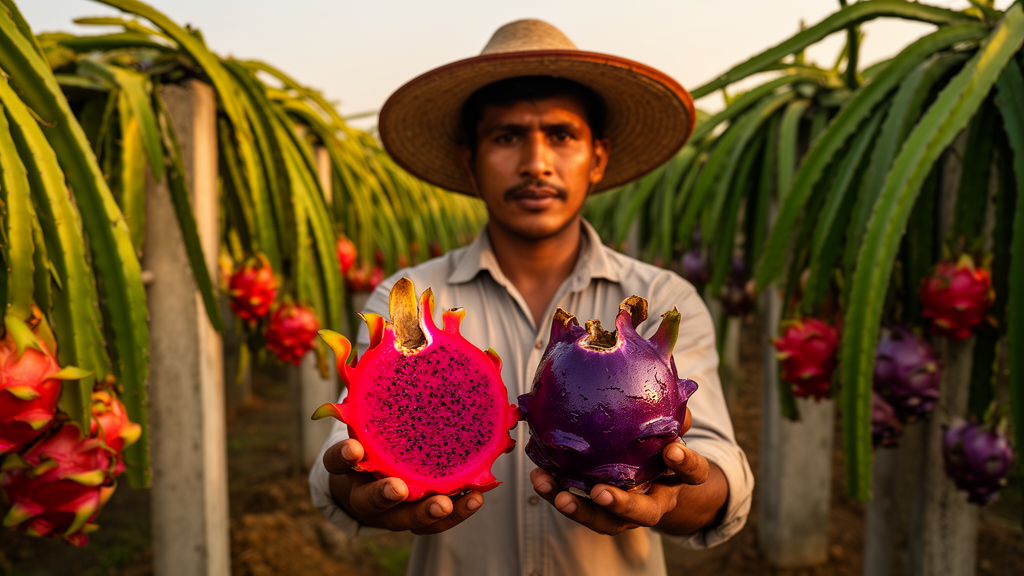
A three-year field trial in southeastern Bangladesh has identified which dragon fruit varieties thrive in the country’s medium-lowland agroecosystems, an environment traditionally reserved for rice. Researchers evaluated five commercially cultivated genotypes—Vietnamese Red, Vietnamese White, Pink Rose, Yellow Dragon, and Purple Dragon—at an orchard in Cumilla district from 2022 to 2024, measuring 26 morphological, yield, and biochemical traits. The results, published in Discover Plants, show that Vietnamese Red delivered the highest yield at 10.24 tonnes per hectare, while Purple Dragon produced the heaviest fruits at 572.78 grams with the greatest pulp weight at 434.99 grams. The findings offer the first comprehensive comparison of multiple exotic dragon fruit genotypes under these lowland conditions and provide a foundation for breeding programs targeting subtropical lowland production.
The study’s setting is significant because dragon fruit, a vine-like cactus in the family Cactaceae native to Mexico and South America, was introduced to Bangladesh relatively late. Commercial cultivation began in 2014–2015, concentrated in the northern and southwestern districts such as Jhenaidah, Jashore, Patuakhali, Rajshahi, Natore, and Chapainawabganj. The area planted expanded from just 38 hectares in 2015–2016 to 1,135 hectares in 2022–2023, driven by the fruit’s nutritional appeal, short flowering period, rapid fruiting within 14 to 16 months of planting, and a productive lifespan of roughly 20 years. Whether the crop could perform in the medium-lowlands of the southeast, where upland irrigated rice dominates and soils are silty clays with a pH between 4.7 and 5.9, remained an open question.
To answer it, the team planted well-rooted cladodes at Green Agro-farm Ltd. in Cumilla in April 2020, using a randomized complete block design with three replications and 15 experimental plants supported by T-shaped trellises. Flowers were removed during the 2020–2021 establishment period to promote vegetative growth, and data collection ran from April to November across three consecutive fruiting cycles. The researchers applied a linear mixed-effects model treating genotype, year, and their interaction as fixed effects, with plant identity and block as random effects, and supplemented the analysis with boxplots, genetic parameter estimation, Pearson’s correlation, principal component analysis, and heatmap clustering.
Analysis of variance confirmed highly significant differences among genotypes for most traits, with minimal genotype-by-year interaction, indicating that the observed differences were genetically stable rather than seasonally driven. Cladode length nearly doubled over the trial, rising from 44.26 centimeters in 2022 to 84.85 centimeters in 2024, and the number of branches per plant nearly tripled from 3.08 to 7.71 as the plants matured. Fruit weight edged upward from 373.69 grams to 399.07 grams, lifting average yield from 6.35 to 8.33 tonnes per hectare, while biochemical traits such as total soluble solids, titratable acidity, vitamin C, and sugar fractions remained consistent across years.
The genetic parameter analysis revealed which traits breeders could select reliably. Number of branches per plant, pericarpal length and width, fruit length, fruit diameter, and pulp weight all showed high genotypic and phenotypic coefficients of variation above 30 percent together with heritability exceeding 85 percent, signaling strong genetic control. Yield traits were particularly promising: pulp weight, peel weight, fruit weight, fruit length, fruit diameter, fruit number, and yield itself displayed high coefficients of variation, heritability above 88 percent, and genetic advance greater than 20 percent of the mean. Biochemical traits including sugars, soluble solids, vitamin C, and acidity also showed high heritability, whereas vegetative traits such as cladode length and width showed wider gaps between genotypic and phenotypic variation, pointing to stronger environmental influence on vegetative vigor.
Correlation analysis exposed a striking physiological trade-off. Fruit weight correlated positively with pericarpal dimensions and fruit size, with coefficients between 0.91 and 0.98, meaning larger fruits reliably accompany larger floral and pericarpal structures. Yet plants with wider pericarpal width, longer pericarpal length, and heavier fruits tended to have lower per-hectare yields, while yield rose with the number of branches per plant (r = 0.98) and fruits per plant (r = 0.95). Vietnamese Red embodied this pattern: it produced smaller fruits but achieved the highest yields through vigorous branching and abundant fruiting, reaching 46.86 branches and 68.13 fruits per plant in pooled data. Purple Dragon sat at the opposite pole, excelling in individual fruit size, pulp weight, and sweetness but yielding less overall. Similar size-versus-productivity trade-offs have been documented in apples, citrus, and pomegranate.
Biochemical profiling added a quality dimension to the comparison. Total soluble solids ranged from 9.76 to 16.58 °Brix across genotypes, reducing sugars from 6.9 to 9.8 percent, total sugars from 8.44 to 11.49 percent, titratable acidity from 0.16 to 0.32 percent, and vitamin C from 9.9 to 17.2 milligrams per 100 grams. Purple Dragon consistently recorded the highest sweetness-related traits, including pulp moisture, soluble solids, reducing sugars, and total sugars, while Vietnamese White and Yellow Dragon showed the lowest values for several of these measures. Notably, vitamin C was negatively correlated with reducing sugars (r = −0.88) and soluble solids (r = −0.84), a metabolic trade-off between sugar accumulation and ascorbate biosynthesis that has also been observed during ripening in mango and strawberry.
Multivariate analysis reinforced these genotype identities. The first two principal components explained more than 85 percent of total variance in each year—85.7 percent in 2022, 86.5 percent in 2023, and 83.9 percent in 2024. Purple Dragon clustered consistently with fruit dimensions, weights, and sweetness traits, placing it in the fruit-quality group, while Vietnamese Red aligned with vegetative and yield-associated traits including branching, dry matter, and vitamin C. Yellow Dragon grouped with floral attributes and titratable acidity, Pink Rose occupied a central position with weak associations to most traits, and Vietnamese White showed consistently lower values for pulp moisture, sugars, and acidity. The separation between genotypes grew stronger in 2023 and 2024 compared with 2022, suggesting that genotypic differences become more pronounced as plants mature.
The authors interpret the stable three-year performance as evidence that dragon fruit can diversify rice-dominated lowlands, noting that the silty clay soil and moderately acidic pH did not impede growth or yield, consistent with the crop’s crassulacean acid metabolism photosynthesis and reputation for water-use efficiency. Vietnamese Red emerges as the candidate for growers prioritizing tonnage, with annual yields around 7.66 tonnes per hectare or higher, while Purple Dragon offers premium fruit quality with soluble solids above 11 °Brix and fruit weights exceeding 497 grams. The researchers suggest that future breeding should integrate the high-yield and high-quality characteristics, potentially using marker-assisted approaches like those applied in peach, where quantitative trait loci for fruit weight, soluble solids, and yield components have been identified.
Important caveats temper these conclusions. The trial was conducted at a single location, so genotype-by-environment interactions and broader stability could not be assessed, and only five genotypes were evaluated, limiting the breeding implications of the heritability estimates. The authors themselves recommend multi-location and multi-season trials across contrasting soils and climates, along with economic, postharvest, and market evaluations, before any large-scale commercial recommendation or release of the promising genotypes. Even so, the demonstration that five exotic dragon fruit genotypes can establish and produce consistently for three years in a medium-lowland setting traditionally used for rice provides preliminary but concrete evidence that high-value horticulture can diversify these marginal agroecosystems in southeastern Bangladesh.
Subject of Research: Comparative evaluation of five dragon fruit genotypes for yield and biochemical traits in Bangladesh medium-lowlands
Article Title: Evaluation of dragon fruit (Hylocereus spp.) cultivated in the medium lowland agroecosystems based on yield traits and biochemical contents
Article References: Monshi, M. H., Mouri, M. H., Tabassum, R., Adu, B. G., Debnath, S., Hassan, J., Hossain, M. S., & Monshi, F. I. (2026). Evaluation of dragon fruit (Hylocereus spp.) cultivated in the medium lowland agroecosystems based on yield traits and biochemical contents. Discover Plants, 3(1), Article 485. https://doi.org/10.1007/s44372-026-00988-0
Image Credits: AI Generated
DOI: 10.1007/s44372-026-00988-0
Keywords: dragon fruit, Hylocereus, agroecosystems, genotype evaluation, heritability, yield traits, biochemical analysis, Bangladesh, crop diversification, plant breeding, principal component analysis, fruit quality
Cite Scienmag News
Alan Morgan. (October 26, 2026). Three-Year Trial Crowns Vietnamese Red and Purple Dragon as Top Dragon Fruit Genotypes in Bangladesh Lowlands. Scienmag. https://scienmag.com/three-year-trial-crowns-vietnamese-red-and-purple-dragon-as-top-dragon-fruit-genotypes-in-bangladesh-lowlands/
Alan Morgan. "Three-Year Trial Crowns Vietnamese Red and Purple Dragon as Top Dragon Fruit Genotypes in Bangladesh Lowlands." Scienmag, 26 October 2026, https://scienmag.com/three-year-trial-crowns-vietnamese-red-and-purple-dragon-as-top-dragon-fruit-genotypes-in-bangladesh-lowlands/. Accessed 26 October 2026.
Alan Morgan. "Three-Year Trial Crowns Vietnamese Red and Purple Dragon as Top Dragon Fruit Genotypes in Bangladesh Lowlands." Scienmag. October 26, 2026. https://scienmag.com/three-year-trial-crowns-vietnamese-red-and-purple-dragon-as-top-dragon-fruit-genotypes-in-bangladesh-lowlands/


