

Monday, October 26, 2026
Science
No Result
View All Result
  • Login
  • HOME
  • SCIENCE NEWS
  • CONTACT US
  • HOME
  • SCIENCE NEWS
  • CONTACT US
No Result
View All Result
Scienmag
No Result
View All Result
Home Science News Medicine

Rapidly Calibratable Hip Capsule Model Quantifies Capsular Restraint After Hip Replacement

October 26, 2026
in Medicine
Ophelia Keating
By Ophelia Keating Scienmag Editorial Profile - Health Services Research
Reading Time: 3 mins read
0
Rapidly Calibratable Hip Capsule Model Quantifies Capsular Restraint After Hip Replacement

Rapidly Calibratable Hip Capsule Model Quantifies Capsular Restraint After Hip Replacement

65
SHARES
587
VIEWS
Share on FacebookShare on Twitter
ADVERTISEMENT

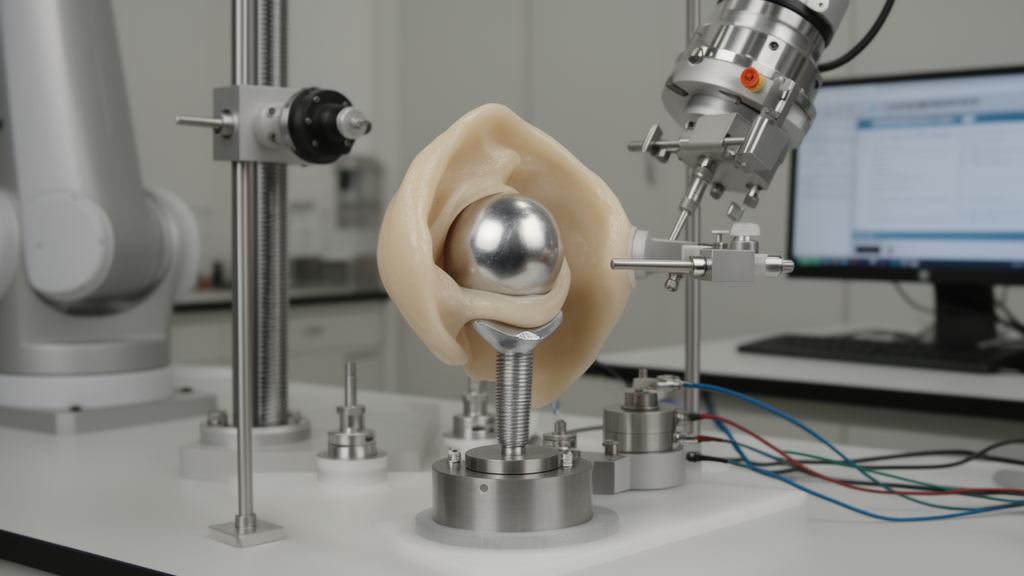
The hip capsule, a fibrous sleeve enclosing the joint, provides a passive restraining function that helps keep the hip stable after total hip arthroplasty. Restoring this function with implants has remained difficult because capsular biomechanics are complex and surgeons have lacked efficient quantitative tools for adjusting implant geometry and positioning. A study published in Annals of Biomedical Engineering on 26 October 2026 addressed this gap by developing a rapidly calibratable numerical parametric hip capsule model designed to characterize passive capsular mechanics and to quantitatively evaluate implant geometric and positioning parameters.

Methodologically, the team constructed a nonlinear spring-based model by dividing the capsule into 12 sectors described by 25 parameters, and calibrated it using experimentally measured torque–rotation data from cadaveric hips. Model accuracy was validated through comparison with finite element simulations and with experimental measurements across multiple motions. The calibrated framework was then applied to nine hip specimens to assess how femoral head size, neck length increment, and femoral stem anteversion influence capsular restraint after arthroplasty.

The reported computational performance was central to the study’s aim of practicality. Calibration took 0.74 hours per specimen, with each iteration requiring less than 1 second, and the model demonstrated strong agreement with finite element simulations, achieving an overall torque root-mean-square error of 0.21 ± 0.02 Nm. Relative to the experimental measurements, rotational root-mean-square errors ranged from 5.2° to 9.4° across the tested motions. These error values, reported by the authors as validation metrics for a numerical model, indicate close correspondence between the spring-based representation, the finite element reference simulations, and the cadaveric torque–rotation data.

The parametric analyses yielded findings relevant to implant planning. Femoral head size alone was insufficient to restore capsular restraint, whereas coordinated adjustment of neck length and stem anteversion significantly improved stability and reduced rotational hypermobility in the modeled hips. In other words, the model’s estimates suggest that no single implant dimension can reproduce the capsule’s passive restraining function, and that combined tuning of neck length and stem anteversion is associated with improved capsular restraint in this cadaveric modeling framework.

The authors conclude that the framework provides a computationally efficient and accurate hip capsule modeling tool that enables rapid calibration and quantitative evaluation of capsular mechanics, supporting personalized total hip arthroplasty planning and postoperative stability assessment. The evidence base for these conclusions is a numerical modeling study calibrated and validated against cadaveric hip experiments, so the reported performance and parametric findings apply to the modeled specimens rather than demonstrating clinical outcomes in patients. The study also involved a limited sample of nine hip specimens, and the abstract does not report intraoperative or postoperative clinical results. Within those boundaries, the work offers a quantitative approach to a long-standing challenge in joint replacement: efficiently characterizing the capsule’s passive restraint and using that characterization to guide implant parameter adjustment before surgery.

Subject of Research: Computational biomechanical modeling of hip capsular restraint in total hip arthroplasty

Article Title: A Rapidly Calibratable Parametric Hip Capsule Model for Evaluating Capsular Restraint in Total Hip Arthroplasty

Article References: Feng, T., Yew, A., Chou, S. M., Zhang, X., Zhang, Y., & Jin, Z. (2026). A Rapidly Calibratable Parametric Hip Capsule Model for Evaluating Capsular Restraint in Total Hip Arthroplasty. Annals of Biomedical Engineering. https://doi.org/10.1007/s10439-026-04416-y

Image Credits: AI Generated

DOI: 10.1007/s10439-026-04416-y

Keywords: hip capsule, total hip arthroplasty, biomechanics, spring-based model, finite element validation, cadaveric hips, torque-rotation, femoral head size, neck length, stem anteversion, joint stability, computational modeling

Cite Scienmag News

Ophelia Keating. (October 26, 2026). Rapidly Calibratable Hip Capsule Model Quantifies Capsular Restraint After Hip Replacement. Scienmag. https://scienmag.com/rapidly-calibratable-hip-capsule-model-quantifies-capsular-restraint-after-hip-replacement/


Ophelia Keating. "Rapidly Calibratable Hip Capsule Model Quantifies Capsular Restraint After Hip Replacement." Scienmag, 26 October 2026, https://scienmag.com/rapidly-calibratable-hip-capsule-model-quantifies-capsular-restraint-after-hip-replacement/. Accessed 26 October 2026.

Ophelia Keating. "Rapidly Calibratable Hip Capsule Model Quantifies Capsular Restraint After Hip Replacement." Scienmag. October 26, 2026. https://scienmag.com/rapidly-calibratable-hip-capsule-model-quantifies-capsular-restraint-after-hip-replacement/

Tags: biomechanicscadaveric hip joint data analysiscadaveric hipscapsular restraint after hip replacementcomputational efficiency in biomechanical simulationscomputational modelingfemoral head sizefinite element validationfinite element validation of hip modelship capsulehip capsule biomechanicship capsule biomechanics analysisimplant positioning impact on hip stabilityinfluence of femoral head size on joint restraintjoint stabilityneck lengthnonlinear spring-based hip modelquantitative hip joint modelingrapid calibration of biomechanical modelsspring-based modelstem anteversionsurgical planning for total hip arthroplastytorque-rotationtotal hip arthroplasty
Share26Tweet16
Previous Post

Ancient Jurassic coal seams revealed as the gas engine beneath Egypt’s Western Desert

Next Post

Dirac buffer layers reshape topological terahertz laser cavities for power and robustness

Related Posts

Simple Insulin Measures Sort New-Onset Type 2 Diabetes into Four Subtypes
Medicine

Simple Insulin Measures Sort New-Onset Type 2 Diabetes into Four Subtypes

October 26, 2026
Two Carcinogen-Resistant Mole-Rats, Two Very Different Immune Playbooks
Medicine

Two Carcinogen-Resistant Mole-Rats, Two Very Different Immune Playbooks

October 26, 2026
Elite Esports Players Tested HIIT and Cognitive Training During a Real Season
Medicine

Elite Esports Players Tested HIIT and Cognitive Training During a Real Season

October 26, 2026
Chronic Demyelination Traps Microglia in a Lysosomal Cholesterol State
Medicine

Chronic Demyelination Traps Microglia in a Lysosomal Cholesterol State

October 26, 2026
Polymeric Excipients Emerge as Key Stabilizers for Solid-State Protein Drugs
Medicine

Polymeric Excipients Emerge as Key Stabilizers for Solid-State Protein Drugs

October 26, 2026
Serum Citramalic Acid Emerges as Key Predictor of Fatty Liver Disease Trajectories
Medicine

Serum Citramalic Acid Emerges as Key Predictor of Fatty Liver Disease Trajectories

October 26, 2026
Next Post
Dirac buffer layers reshape topological terahertz laser cavities for power and robustness

Dirac buffer layers reshape topological terahertz laser cavities for power and robustness

  • Mothers who receive childcare support from maternal grandparents show more optimized

    Mothers who receive childcare support from maternal grandparents show more parental warmth, finds NTU Singapore study

    27656 shares
    Share 11059 Tweet 6912
  • University of Seville Breaks 120-Year-Old Mystery, Revises a Key Einstein Concept

    1061 shares
    Share 424 Tweet 265
  • Bee body mass, pathogens and local climate influence heat tolerance

    682 shares
    Share 273 Tweet 171
  • Researchers record first-ever images and data of a shark experiencing a boat strike

    546 shares
    Share 218 Tweet 137
  • Groundbreaking Clinical Trial Reveals Lubiprostone Enhances Kidney Function

    531 shares
    Share 212 Tweet 133
Science

Embark on a thrilling journey of discovery with Scienmag.com—your ultimate source for cutting-edge breakthroughs. Immerse yourself in a world where curiosity knows no limits and tomorrow’s possibilities become today’s reality!

RECENT NEWS

  • Olive Leaves and Almond Enzymes Offer a Route to Enriched Olive Oil, With a Catch
  • Simple Insulin Measures Sort New-Onset Type 2 Diabetes into Four Subtypes
  • Soil fungus eases lead stress in greenhouse-grown red bean plants
  • Pathological narcissism shapes neural responses to verbal violence intensity

Categories

  • Agriculture
  • Anthropology
  • Archaeology
  • Athmospheric
  • Biology
  • Biotechnology
  • Blog
  • Bussines
  • Cancer
  • Chemistry
  • Climate
  • Earth Science
  • Editorial Policy
  • Marine
  • Mathematics
  • Medicine
  • Pediatry
  • Policy
  • Psychology & Psychiatry
  • Science Education
  • Science News
  • Social Science
  • Space
  • Technology and Engineering

Subscribe to Blog via Email

Enter your email address to subscribe to this blog and receive notifications of new posts by email.

Join 5,151 other subscribers

© 2025 Scienmag - Science Magazine

Welcome Back!

Login to your account below

Forgotten Password?

Retrieve your password

Please enter your username or email address to reset your password.

Log In
No Result
View All Result
  • HOME
  • SCIENCE NEWS
  • CONTACT US

© 2025 Scienmag - Science Magazine

Discover more from Science

Subscribe now to keep reading and get access to the full archive.

Continue reading