


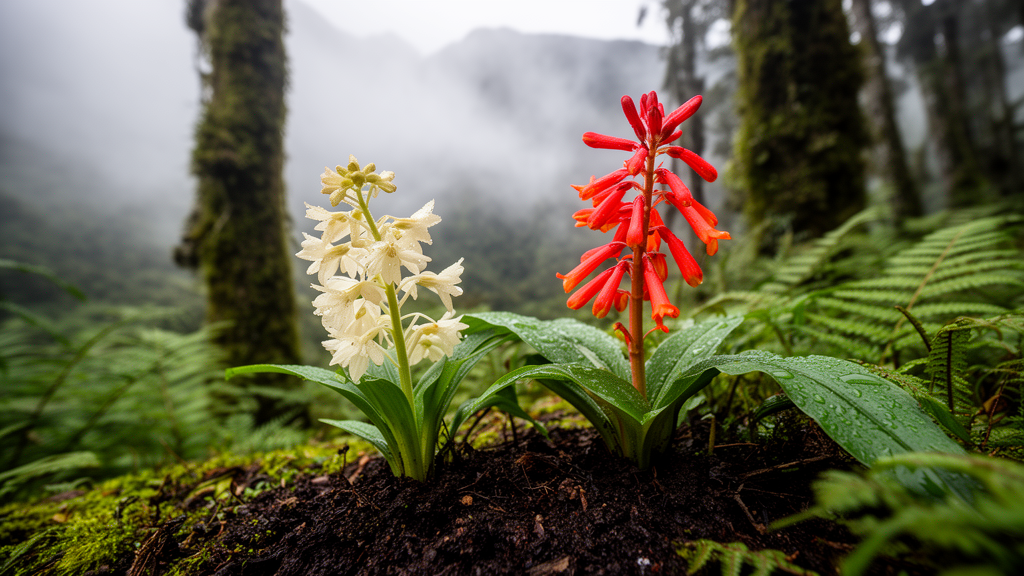
Deep in the mist-drenched montane forests of Peru’s central rainforest, botanists have identified two flowering shrubs previously unknown to science. The plants, both members of the genus Columnea in the family Gesneriaceae, were described from specimens collected in and around the Bosque de Protección Pui Pui, a protected area in the departments of Junín and Pasco. The new species, named Columnea puipuiense and Columnea valenzuelai, are endemic to this region, and their formal description raises the number of Columnea species known from Peru to 36 and the country’s Gesneriaceae tally to 227.
The Bosque de Protección Pui Pui, sometimes called the spring of the Pui Pui mountain range, is a protected natural area classified for direct use, meaning its conservation goals are explicitly combined with sustainable use of natural resources by local populations. It spans roughly 60,000 hectares and contains about 99 lagoons, aquatic ecosystems that harbor aquatic and semi-aquatic flora. The area encompasses two ecoregions: the Peruvian Yungas, with montane forest, cloud forest, and upper montane rainforest, and the Humid Puna of the Central Andes, corresponding to high-Andean grasslands. Since October 2020, the protected area has also formed part of the Bosque de Neblina-Selva Central Biosphere Reserve.
Systematic botanical exploration of the area began in 2014, and repeated surveys have already yielded several species new to science. Earlier discoveries include the orchid Brachionidium puipuiensis and two trees in the rose family, Polylepis rodolfo-vasquezii and Polylepis rocio-rojasiae. Despite this run of finds, the vegetation of the area remains poorly documented, and the research team has focused on sustained field surveys to build a more complete picture of its flora. The two new Columnea species emerged from this ongoing effort, underscoring how much of the region’s plant diversity still awaits formal recognition.
Columnea is the most diverse genus of its subfamily, with more than 220 recognized species distributed across the New World tropics, from southern Mexico to southern Peru and Bolivia, Brazil, the Guianas, and the Caribbean. Most species are epiphytic, though some grow terrestrially or as facultative epiphytes, and the genus spans a wide range of growth habits, from epiphytes with dorsiventral shoots to pendent vines with elongate shoots. The genus is distinguished from its close relatives by indehiscent fleshy berries, with only a few exceptions, including C. dielsii, C. cesarii, and C. yanachagaensis, which produce dehiscent fleshy capsules. Columnea ranges from lowland rain forests to subpáramo forests, but its greatest diversity is concentrated in the northern Andes of Colombia and Ecuador, mainly in Andean cloud forests up to 4000 meters in elevation. In Peru, the genus is mainly restricted to the eastern Andean slopes, inhabiting humid montane and cloud forests with peak diversity at mid-elevations and markedly lower representation in lowland Amazonian forests.
The first of the new species, Columnea puipuiense, is a subwoody, perennial epiphytic shrub with erect, ascending, or spreading stems up to 2 meters long. Its leaves are strongly anisophyllous, meaning each opposite pair consists of one large and one small blade, with the larger blades elliptic to lanceolate-elliptic and measuring 16 to 29, occasionally up to 30, centimeters long. The flowers are borne in reduced axillary cymes of one to two, subtended by three foliaceous bracts that often conceal the calyx. The corolla is 6.0 to 6.5 centimeters long, bilabiate and slightly curved, white to cream-white in color, with two dark purple longitudinal bands running parallel to the axis of the corolla tube for 28 to 31 millimeters. The species was collected in flower in August, October, November, and January, and with fruits in November, according to the herbarium specimens studied.
What sets Columnea puipuiense apart from its closest relatives is a distinctive combination of vegetative and floral characters. Its closest allies are C. albiflora, C. tessmannii, and C. medicinalis, which share its epiphytic habit, strongly anisophyllous leaves, and elongate tubular corolla. But the new species bears an olive-green, distinctly discolorous lower leaf surface with maroon-red coloration at the apex and margins, whereas C. albiflora usually has a uniformly pale yellowish-green underside with reddish veins and C. tessmannii generally shows violet to purple undersides. The corolla color also differs: C. tessmannii has yellow flowers, and C. medicinalis produces white, cream, or yellow flowers with orange lobes. The corolla indumentum of the new species is densely distributed along the entire length of the tube, composed of long, hyaline, uniseriate, eglandular trichomes forming a sericeous-villous covering, in contrast to the sericeous indumentum of C. albiflora and the upper-restricted indumentum of C. tessmannii. Finally, the lateral corolla lobes are completely reflexed, while the related species have spreading lobes, and the ventral lobe is narrowly ovate-triangular and patent rather than ovate, ovate-lanceolate, or lanceolate and reflexed.
Columnea puipuiense grows in primary montane forest on rocky slopes within the Bosque de Protección Pui Pui, where the substrate consists of a thin humus layer over semi-decomposed organic matter. The understory is dominated by herbaceous ferns, with associated species of Rubiaceae, Melastomataceae, and the bamboo genus Chusquea, along with slender lianas. Trees are densely covered with mosses and epiphytes, and the tree flora includes abundant Cyatheaceae tree ferns, Weinmannia of the Cunoniaceae, and Alzatea verticillata, a species characterized by a fenestrate trunk and smooth, often reddish-brown bark. The species has also been found in secondary montane forest within the buffer zone of protected areas in Pasco Department, an area considered highly vulnerable due to habitat loss and forest fragmentation. Herbarium records show the species was actually collected as early as 2004 in Oxapampa Province, with additional gatherings in 2019 and 2025, indicating that it circulated unnamed in collections for years before its formal description.
Under IUCN guidelines, Columnea puipuiense has been assessed as Near Threatened. Its extent of occurrence is 113,148 square kilometers and its area of occupancy is 12,000 square kilometers, calculated on a 2 by 2 kilometer grid, values well above the thresholds for a threatened category under IUCN Criterion B. However, the effective area of occupancy is smaller than the calculated figure because of habitat loss and fragmentation driven by agricultural expansion, road construction, and selective logging, particularly outside protected areas. Spatially explicit analyses of forest loss reveal persistent hotspots of high to extremely high deforestation in the central Peruvian forest across Huánuco, Pasco, and Junín, overlapping buffer zones of protected areas such as Parque Nacional Yanachaga Chemillén and the Bosque de Protección Pui Pui. On this basis, a continuing decline in habitat quality is inferred, and the authors highlight the importance of continued habitat monitoring.
The second new species, Columnea valenzuelai, is a suffrutescent epiphytic or terrestrial subshrub with scandent to ascending shoots reaching up to 3 meters tall. Its leaves are generally clustered toward the stem apex and are isophyllous to slightly anisophyllous, with ovate to elliptic blades of 1.5 to 13 centimeters. The flowers are solitary in the leaf axils, borne on remarkably long pendent pedicels of 6.5 to 13 centimeters, and the corolla is tubular, strongly ventricose, and uniformly yellow with a yellow limb, measuring 8.5 to 9.5 centimeters long. The species was found at 3300 to 3350 meters above sea level in the high montane forest of the protected area, growing on sandy soil rich in organic matter and peat. Flowering has been recorded in September and October, and fruits have not yet been observed. The epithet honors Luis Valenzuela Gamarra, a field botanist specializing in Orchidaceae and the Andean-Amazonian flora who has contributed extensively to the botanical knowledge of the central Peruvian rainforest.
Columnea valenzuelai is morphologically similar to C. strigosa and C. oblongifolia, sharing a suffrutescent habit, elongate scandent shoots, leaves clustered toward the stem apex, and a tubular ventricose corolla. It is nonetheless readily distinguished by its consistently yellow corolla of 8.5 to 9.5 centimeters, whereas C. strigosa displays orange to reddish-orange corollas with a yellow limb and marked size variation of 2.8 to 9.5 centimeters, and C. oblongifolia has shorter corollas of 4.0 to 6.5 centimeters that are yellow or purplish-red with a yellow limb. The nectary provides another key diagnostic feature: the new species has five free glands with the two dorsal glands enlarged, a character that is stable, while C. strigosa shows a variable nectary ranging from five free glands to two connate dorsal glands, and C. oblongifolia consistently has two connate dorsal glands. The densely tomentose ovary further separates it from the villous to sericeous ovary of C. strigosa. Ecologically, the new species is restricted to the Bosque de Protección Pui Pui in Junín Department, whereas C. strigosa has a broader Peruvian distribution across Amazonas, Cajamarca, and Cusco, and C. oblongifolia occurs in Andean cloud forests of southern Peru, particularly in Cusco Department.
The conservation outlook for Columnea valenzuelai is considerably more precarious. It has been assessed as Critically Endangered under IUCN criterion B1ab(iii), being known only from a single locality within the protected area, with an extent of occurrence of just 0.305 square kilometers and an area of occupancy of 8 square kilometers on the 2 by 2 kilometer grid. Documented forest loss within the Bosque de Protección Pui Pui totaled 314 hectares between 2001 and 2024, with persistent annual losses recently ranging from 6 to 16 hectares per year, and spatial analyses identify persistent deforestation hotspots in the central Peruvian forest that may directly affect habitat integrity. A continuing decline in the extent and quality of habitat is therefore inferred. The species grows as a climbing or scandent plant in shaded understory and along forest margins in humid premontane to montane forest. Above 3000 meters, where the species occurs, the cloud forest floristic composition changes markedly, with Asteraceae and Melastomataceae predominating, followed by Ericaceae and Myrsinaceae.
Beyond the two descriptions themselves, the study contributes to understanding the diversity and endemism of Andean Gesnerioideae and reinforces a broader point about Peru’s montane ecosystems. The morphological analyses behind the descriptions relied on dissecting stereomicroscopy, examination of herbarium specimens housed primarily at the Selva Central Oxapampa Herbarium, with duplicates distributed to other major collections, and floral measurements taken from material preserved in 50 to 70 percent ethanol. Distribution maps were generated with geographic information system software, and conservation assessments used the GeoCAT tool with the IUCN-recommended 2 square kilometer cell size. The authors argue that protected natural areas such as Pui Pui serve as refuges for many plant species still unknown to science, and that continued botanical exploration in the country’s poorly studied montane ecosystems is essential to documenting and ultimately safeguarding that hidden diversity before habitat degradation erases it.
Subject of Research: Taxonomic description of two new endemic Columnea species from the Bosque de Protección Pui Pui, Peru
Article Title: Taxonomic novelties in Columnea ( Gesneriaceae ) from Peru: Two new species from the Bosque de Protección Pui Pui
Article References: Rojas Gonzáles, R. D. P., Vásquez Martínez, R., & Pinche Shareva, E. (2026). Taxonomic novelties in Columnea (Gesneriaceae) from Peru: Two new species from the Bosque de Protección Pui Pui. PhytoKeys, 275, 47-60. https://doi.org/10.3897/phytokeys.275.187262
Image Credits: AI Generated
DOI: 10.3897/phytokeys.275.187262
Keywords: Columnea, Gesneriaceae, Peru, Bosque de Protección Pui Pui, new species, taxonomy, cloud forest, plant conservation, IUCN Red List, Andean flora, endemism, botanical exploration
Cite Scienmag News
Margaret Porter. (October 26, 2026). Two New Flowering Plant Species Emerge From Peru’s Cloud-Kissed Pui Pui Forest. Scienmag. https://scienmag.com/two-new-flowering-plant-species-emerge-from-perus-cloud-kissed-pui-pui-forest/
Margaret Porter. "Two New Flowering Plant Species Emerge From Peru’s Cloud-Kissed Pui Pui Forest." Scienmag, 26 October 2026, https://scienmag.com/two-new-flowering-plant-species-emerge-from-perus-cloud-kissed-pui-pui-forest/. Accessed 26 October 2026.
Margaret Porter. "Two New Flowering Plant Species Emerge From Peru’s Cloud-Kissed Pui Pui Forest." Scienmag. October 26, 2026. https://scienmag.com/two-new-flowering-plant-species-emerge-from-perus-cloud-kissed-pui-pui-forest/


