


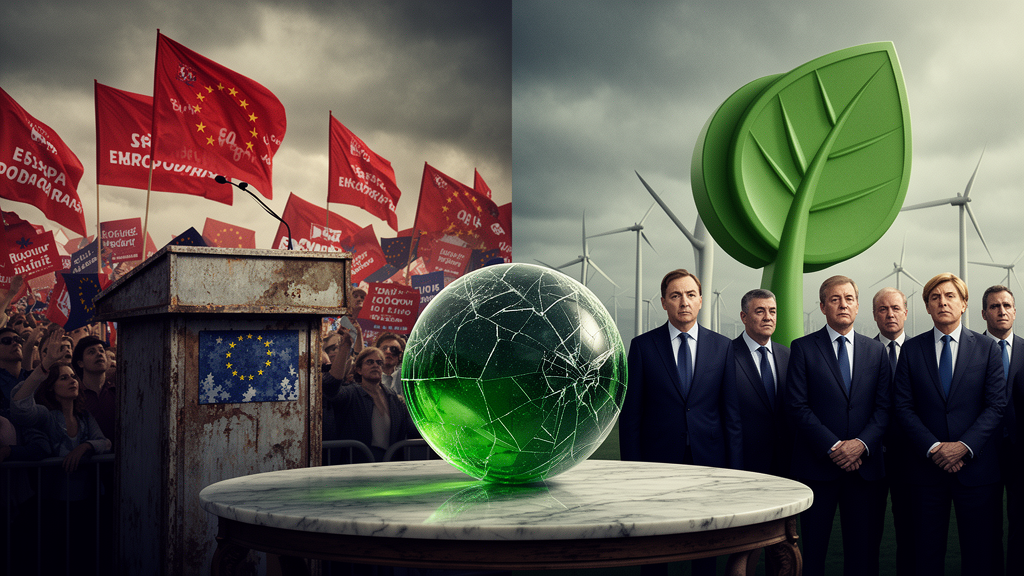
The European Green Deal, unveiled by the European Commission under President Ursula von der Leyen in December 2019, promised to make Europe the first climate-neutral continent by 2050 through a complete overhaul of EU legislation aligned with the Paris Agreement: decarbonisation, circular economy, energy-efficient building renovation, biodiversity protection and green innovation. Yet a new open-access analysis published in Discover Global Society argues that the Deal now faces a strategic challenge from an unexpected quarter. Igor Piliaiev, through interdisciplinary and comparative methods drawing on political ecology, neo-cleavage theory and case study, contends that Trumpism — the ideology, movement and governance tools associated with Donald Trump — has evolved since the start of his second presidency into a systemic project for transforming the world order in its value-based, geopolitical, geoeconomic and geocultural foundations, with the European Union’s ecological agenda squarely in its sights.
The external pressure is unambiguous. The Trump administration questions the scientific consensus on the anthropogenic nature of global warming that the UN and EU rely upon. In April 2025, Trump issued an executive order to stop any “burdensome and ideologically motivated ‘climate change’ or energy policies that threaten American energy dominance.” At the UN General Assembly in September 2025 he called climate change the “greatest con job ever perpetrated on the world” and claimed “the carbon footprint is a hoax.” In Davos in January 2026 he branded the green agenda the “Green New Scam,” targeting EU wind energy with the assertion that “every time that goes around, you lose $1000,” and arguing that Germany now generates 22% less electricity than in 2017 while prices are 64% higher. The official date of the US exit from the Paris Agreement is 27 January 2026, achieved through immediate diplomatic notification that disregarded the agreement’s one-year withdrawal procedure.
The domestic US challenge to climate science is equally technical. In July 2025, a Climate Working Group of five American climate-sceptic scientists, established at Trump’s behest, delivered a report to Energy Secretary Chris Wright that was released as an official Department of Energy document. It questions the predominantly anthropogenic nature of global warming, points to scientifically underestimated positive effects of CO2 on agriculture, and asserts that “U.S. policy actions are expected to have undetectably small direct impacts on the global climate.” Piliaiev characterises this as a systemic challenge to the entire global and European green order based on the Paris Agreement, dramatically increasing the ability of traditionalist and radical right forces in Europe to influence the global climate agenda.
Global corporate momentum has visibly ebbed. In October 2025 the Net-Zero Banking Alliance, created in April 2021 to align bank loan and investment portfolios with net-zero emissions by 2050, officially dissolved after Wall Street participants withdrew under pressure from the Trump administration, followed by leading institutions from Canada, Japan, Australia, the United Kingdom and Switzerland. The alliance had at its peak represented over 40% of global banking assets and included more than 70 European banks. Membership in the UN Environment Programme’s Forum for Insurance Transition, established in April 2024 to replace the disbanded Net-Zero Insurance Alliance, shrank from over 50 to 24 leading insurance organisations by early May 2026, with 79% headquartered in Western Europe and the Commonwealth. As of May 2026, no company from Germany, France, Italy or North America had joined the UN Global Compact’s climate initiatives.
The substance of corporate climate commitments is also in doubt. Simon Dietz and Nikolaus Hastreiter of the London School of Economics tracked climate management practices and emissions at nearly 2,000 large, almost entirely publicly listed companies, selected principally from high-emission sectors such as energy, steel, cement, chemicals and transport. They found “little evidence of large or immediate reductions in emissions or of broad shifts in climate governance” following adoption of long-term net-zero commitments, and the emissions effect of those commitments proved statistically insignificant. As Dietz admitted: “We can’t rule out the possibility statistically that the effect is zero.” Sustainable development initiatives are thus no longer based on a global consensus but are regionalising, with the lion’s share of financing and assets under management based in Western Europe and Commonwealth states — a trend that worsens the infrastructure for the Green Deal’s implementation.
Within the EU, Piliaiev introduces the term Euro-Trumpism to describe the powerful growth of influence of parties and movements oriented towards Trump’s model of national reconstruction and world order on principles of right-wing conservative neo-nationalism, scepticism toward international institutions, and a Realpolitik hierarchy of military, economic and financial power. A European Council on Foreign Relations survey conducted in May 2025 across 12 European countries indicates that Trump is transforming political and geopolitical identity in Europe itself. Public polarization over the green agenda sits at the core of a new transnational cultural cleavage, alongside European integration, immigration, gender equality and minority rights. Following the June 2024 European elections, the rise of right-wing groups such as Patriots for Europe and Europe of Sovereign Nations could complicate the passage of new climate legislation.
The case of Germany’s Alternative for Germany party illustrates the mechanism. The AfD doubled its representation in the February 2025 parliamentary elections, winning 152 of 630 Bundestag seats — the second largest faction after the CDU/CSU’s 164. The party acknowledges the climate is changing but denies human influence, arguing instead that change is entirely natural. Its 2021 election program claimed rising carbon dioxide concentration is beneficial, contributing to the “greening” of the Earth. The AfD opposes the Energiewende, seeks repeal of the German Renewable Energy Act of 2014 and the Renewable Energy Heating Act of 2009, wants to stop bioenergy subsidies and limit the “uncontrolled expansion of wind energy,” while rejecting the Green Deal and warning against Europe’s deindustrialisation. Its programmatic goals coincide, in principle and many details, with the second Trump administration’s environmental policy.
Germany’s own institutional record reveals the Green Deal’s fragility from within. The three-party “traffic light” coalition of SPD, Greens and FDP collapsed in November 2024, with Green Deal investments perhaps the main stumbling block: Finance Minister Christian Lindner argued that new climate-oriented economic restrictions would further reduce Germany’s competitiveness. In November 2023 the Federal Constitutional Court declared unconstitutional the coalition’s attempt to reinvest Pandemic Relief Fund resources in environmental projects, viewing it as circumvention of the debt brake. Earlier, the landmark 2021 Neubauer v. Germany ruling had forced amendments establishing carbon neutrality by 2045 instead of 2050. But the major April 2024 revision of the Federal Climate Change Act abolished strict annual emissions budgets and mandatory immediate action programmes for individual sectors, and the German Advisory Council on Environment cautioned this could result in unclear responsibilities and undermine the legislation’s efficiency. Climate litigation, as Jannika Jahn of the Max Planck Institute observes, is “not suitable for enforcing concrete political measures” — all corporate lawsuits in Germany, which accounts for 23.7% of the EU’s net greenhouse gas emissions, have failed so far.
The dominoes are falling across the EU. In the Czech Republic, elections on 3–4 October 2025 brought to power the national-conservative ANO party of billionaire Andrej Babiš, who calls himself a Trumpist. On 16 December 2025 the new Czech cabinet rejected the ETS-2 emissions trading system, which extends carbon quota trading from 2027 to buildings, road transport and small industry, with Babiš declaring the government “unequivocally refused to transpose” it into Czech law. Earlier that month, the EU Council and European Parliament attained a preliminary accord to weaken the climate regulation targeting a 90% reduction in greenhouse gas emissions by 2040 and to postpone ETS-2 implementation by one year, to 2028 — concessions Babiš called inadequate, insisting on “a complete withdrawal from the system.” In May 2026, Poland’s nationalist-conservative President Karol Nawrocki submitted a motion for a referendum on EU climate policy, arguing that the Green Deal and ETS mean higher energy prices, declining competitiveness and the collapse of agricultural production.
Piliaiev’s conclusion is that the Green Deal faces a deeper ontological schism within Western civilization. Neoliberal globalism, which adopted Deep Ecology’s principles — Arne Naess’s ecocentric philosophy asserting that nature has its own rights, now recognised in Ecuador’s 2008 constitution, Bolivia’s 2010 laws and Spain’s 2022 recognition of the Mar Menor lagoon as a legal entity — appeals to ecological egalitarianism, while Trumpism restores financial, political and social hierarchy as a fundamental public value. The EU’s own ambivalence compounds the risk: the European People’s Party has refused to ban internal combustion engine cars by 2035, opposed the Nature Restoration Law, and the Commission withdrew its Sustainable Use of Pesticides Regulation after von der Leyen conceded the proposal “has become a symbol of polarization.” A January 2024 ECFR survey found most Europeans would prefer lower electricity bills to emissions reductions. With Germany lowering its 2030 electricity consumption forecast from 750 to 600–700 TWh in September 2025, Chancellor Friedrich Merz admitting the welfare state “can no longer be financed,” and Germany’s Economic Policy Uncertainty Index rising more than sevenfold since 2019, Piliaiev judges a Green Deal revision before the end of the EU’s institutional cycle in 2029 highly likely. He further recommends a systemic, critical look at Ukraine’s gradual CO2 taxation and transition to the EU Carbon Border Adjustment Mechanism, arguing the mechanism is unlikely to meet the interests of Ukraine’s post-war reconstruction, particularly heavy industry, and that Ukraine has every reason to seek exemptions for its exporters in EU accession negotiations.
Subject of Research: The impact of Trumpism upon the European Green Deal
Article Title: The impact of Trumpism upon the European Green Deal
Article References: Piliaiev, I. (2026). The impact of Trumpism upon the European Green Deal. Discover Global Society, 4(1), Article 283. https://doi.org/10.1007/s44282-026-00607-z
Image Credits: AI Generated
DOI: 10.1007/s44282-026-00607-z
Keywords: impact, Trumpism, upon, European, Green, Deal, scientific research
Cite Scienmag News
Courtney Benton. (October 26, 2026). Trumpism and the Rise of Euro-Trumpism Threaten the European Green Deal. Scienmag. https://scienmag.com/trumpism-and-the-rise-of-euro-trumpism-threaten-the-european-green-deal/
Courtney Benton. "Trumpism and the Rise of Euro-Trumpism Threaten the European Green Deal." Scienmag, 26 October 2026, https://scienmag.com/trumpism-and-the-rise-of-euro-trumpism-threaten-the-european-green-deal/. Accessed 26 October 2026.
Courtney Benton. "Trumpism and the Rise of Euro-Trumpism Threaten the European Green Deal." Scienmag. October 26, 2026. https://scienmag.com/trumpism-and-the-rise-of-euro-trumpism-threaten-the-european-green-deal/


