


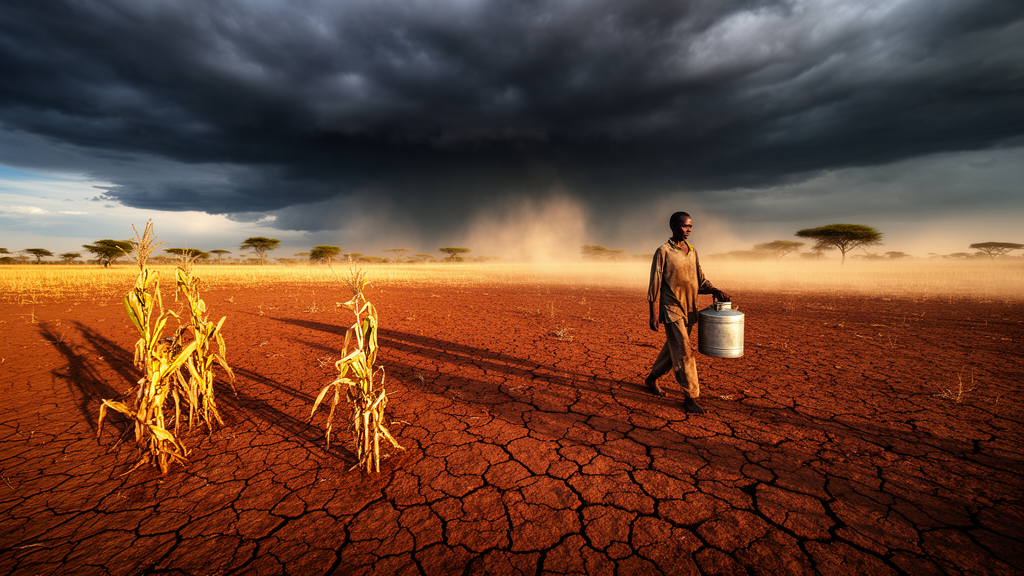
Africa’s drought future is not uniform, and a new modeling study explains why. Using 31 climate models from the Coupled Model Intercomparison Project Phase 6 (CMIP6), researchers assessed how drought frequency, duration, and intensity across the continent could change at global warming levels of 1.5 °C, 2 °C, and 3 °C above pre-industrial conditions, under three emissions pathways. The analysis, published in Climate Dynamics, identifies the Mediterranean fringe, Southern Africa, and Madagascar as robust drought hotspots, while Central Africa shows a consistent decrease in drought occurrence.
The team measured drought with the Standardized Precipitation Evapotranspiration Index (SPEI), which combines precipitation deficits with atmospheric evaporative demand, and flagged severe drought when the three-month index fell below −1.5. Across all scenarios and warming levels, drought frequency and duration are projected to increase over the Mediterranean region and southern Africa, including Madagascar. In northern Africa, covering parts of Morocco, Algeria, and Tunisia, and in southern Africa, including Namibia, Botswana, Zimbabwe, South Africa, and Mozambique, drought frequency rises by roughly 0.2, 0.4, and 0.6 events per year at 1.5 °C, 2 °C, and 3 °C respectively under the moderate SSP2-4.5 scenario. Drought duration in these regions lengthens by about 0.5, 1, and 2 months at the successive warming levels, with the signal becoming most robust at 3 °C.
Central Africa moves in the opposite direction. Drought frequency there declines by approximately 0.15, 0.3, and 0.4 events per year at the three warming levels under SSP2-4.5, and by up to about 0.6 events per year under the very high emissions SSP5-8.5 scenario at 3 °C. Drought intensity generally increases across the continent, reaching roughly 0.14 at 1.5 °C and 2 °C and about 0.28 at 3 °C, particularly over parts of the eastern Sahara and the West African coast, but these intensity changes are mostly not robust because of high disagreement among models.
The spatial footprint of drought expands substantially with warming. Historically, less than 20 percent of the land area in any of the studied subregions was affected by drought. By the end of the century, the drought-affected share averages about 21 percent over the Mediterranean, Southern Africa, and Madagascar under SSP2-4.5, rises to roughly 30 percent in the first two regions and 25 percent in Madagascar under SSP3-7.0, and reaches about 36 percent across all three regions under SSP5-8.5. Central Africa, in contrast, sees its drought-affected area shrink to around 10 percent by 2100.
A key question is when the human-driven drought signal will become distinguishable from natural climate swings. The study’s Time of Emergence analysis, which compares the forced signal against background variability, finds that drought frequency and intensity emerge earlier than drought duration. Under SSP2-4.5, the stronger “unusual” emergence threshold for drought frequency is crossed as early as 2012 over the Mediterranean, 2021 over Southern Africa, and 2032 over Madagascar, while drought duration emerges later, in 2026, 2031, and 2049 respectively. In Central Africa, unusual drought frequency does not emerge until 2067, and unusual duration does not emerge within the 21st century. Emergence generally occurs earlier under the higher emissions scenarios.
Uncertainty in the projections is dominated by differences among climate models rather than by emissions scenarios or natural variability. Model uncertainty accounts for more than 60 percent of the total variance across all regions and drought metrics by the end of the century, reflecting divergent model representations of precipitation, evapotranspiration, and land-atmosphere interactions. Internal variability contributes most strongly to near-term projections but falls below 10 percent of the variance by 2100, while scenario uncertainty generally grows after mid-century and contributes less than 5 percent of the variance for drought frequency and duration, and about 10 percent for intensity.
To uncover the physical mechanisms, the researchers decomposed precipitation changes during drought events into dynamic components, tied to atmospheric circulation and moisture transport, and thermodynamic components, tied to atmospheric moisture content and evaporation. The regional contrasts are striking. Over the Mediterranean, drought intensification is driven primarily by a weakening vertical thermodynamic contribution, linked to mid-tropospheric drying, enhanced subsidence associated with a poleward-expanding subtropical jet and Hadley circulation, and strengthened land-atmosphere feedback as soil moisture declines. Over Southern Africa, the dominant driver is reduced evaporation, as drying soils constrain evapotranspiration and the recycling of local moisture into rainfall. Over Madagascar, drought intensification reflects a combination of reduced evaporation and weakened vertical dynamic contributions tied to stronger large-scale subsidence.
Central Africa again stands apart. Although the ensemble mean points to fewer droughts there, the precipitation response during drought events shows no robust model agreement, varying in sign and magnitude across scenarios. A robust signal does appear in the moisture budget, however: a strong and intensifying decrease in the horizontal thermodynamic term with rising warming levels, partly offset by changes in horizontal dynamics. The region’s background climate shifts toward a wetter state, with column-wide moistening, enhanced moisture flux convergence, and increased soil moisture, which helps explain the projected decline in drought occurrence even as the details remain uncertain.
The socioeconomic stakes are large. At 3 °C of warming, more than 200 million people and roughly USD 30 billion in GDP are projected to be exposed to drought across the Mediterranean, Southern Africa, and Madagascar. Population exposure over the Mediterranean peaks at about 260 million under SSP2-4.5 and exceeds 280 million under the higher emissions scenarios, while Southern Africa averages about 160 million exposed people and Madagascar about 20 million. Decomposition shows that changes in population exposure are driven mainly by the climate effect, contributing roughly 55 to 60 percent over the Mediterranean, whereas GDP exposure is dominated by the GDP effect. Limiting warming to 1.5 °C could avoid approximately 70 percent of these drought impacts relative to 3 °C, with avoided impacts on drought frequency reaching about 30 percent at 2 °C and 70 percent at 3 °C over the hotspot regions, although parts of Central Africa would see reduced benefits or even negative avoided impacts.
The authors note methodological caveats. The temperature-based Hargreaves formulation used to estimate potential evapotranspiration omits radiation, humidity, and wind effects, but sensitivity tests with the more complete Penman-Monteith formulation and with the precipitation-only Standardized Precipitation Index confirm the same regional patterns of increasing drought over the Mediterranean, Southern Africa, and Madagascar and decreasing drought over Central Africa, albeit with differences in magnitude. The dominance of model uncertainty, the researchers conclude, underscores the need for continued improvements in climate-model representations of the hydrological cycle and for multi-model ensembles when informing region-specific adaptation planning across Africa.
Subject of Research: Projected changes in African drought characteristics, their dynamic and thermodynamic drivers, uncertainty, and socioeconomic exposure under different global warming levels
Article Title: Dynamic and thermodynamic drivers of regional drought changes in Africa under different global warming levels
Article References: Raji, I. A., & Akinsanola, A. A. (2026). Dynamic and thermodynamic drivers of regional drought changes in Africa under different global warming levels. Climate Dynamics, 64(11), Article 479. https://doi.org/10.1007/s00382-026-08439-y
Image Credits: AI Generated
DOI: 10.1007/s00382-026-08439-y
Keywords: drought, Africa, CMIP6, climate change, SPEI, moisture budget, global warming levels, time of emergence, model uncertainty, socioeconomic exposure, Mediterranean, Southern Africa
Cite Scienmag News
Sloane Callahan. (October 26, 2026). Africa’s Drought Hotspots Face Sharper Future as Warming Reshapes Rainfall Drivers. Scienmag. https://scienmag.com/africas-drought-hotspots-face-sharper-future-as-warming-reshapes-rainfall-drivers/
Sloane Callahan. "Africa’s Drought Hotspots Face Sharper Future as Warming Reshapes Rainfall Drivers." Scienmag, 26 October 2026, https://scienmag.com/africas-drought-hotspots-face-sharper-future-as-warming-reshapes-rainfall-drivers/. Accessed 26 October 2026.
Sloane Callahan. "Africa’s Drought Hotspots Face Sharper Future as Warming Reshapes Rainfall Drivers." Scienmag. October 26, 2026. https://scienmag.com/africas-drought-hotspots-face-sharper-future-as-warming-reshapes-rainfall-drivers/


