


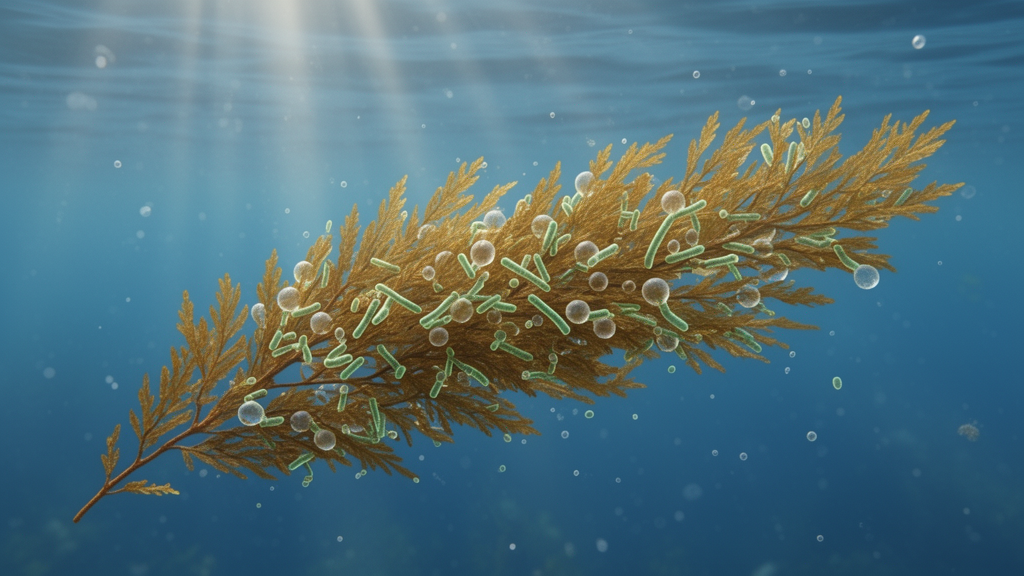
Floating mats of pelagic Sargassum drifting through the Gulf Stream off Cape Hatteras, North Carolina, carry one of the most active nitrogen-fixing communities in the ocean, yet the factors that govern how much nitrogen these communities actually deliver have remained poorly resolved. A new study published in Frontiers in Marine Science draws on eight years of shipboard collections, from 2016 to 2024, to link measured nitrogen fixation rates directly to the identity and abundance of the algae and microbes living on the seaweed’s fronds. The central result is striking: the abundance of specific epiphytic cyanobacteria, particularly the filamentous genera Dichothrix and unidentified Oscillatoriales, was the strongest statistical predictor of nitrogen fixation, while none of the eleven physical and chemical variables the team measured showed a significant relationship with the process.
The research team, led by Claire Johnson of the University of North Carolina at Chapel Hill together with colleagues at East Carolina University and the U.S. Food and Drug Administration, conducted twenty cruises to the western edge of the Gulf Stream within an area of roughly 78 by 47 kilometers. They sampled only where Sargassum formed patches or mats at least one meter across, collecting seawater from within the mats and harvesting fronds with dip nets. Back at the laboratory, or in some cases directly on the ship’s deck, they measured gross nitrogen fixation using the acetylene reduction method, in which samples are incubated with acetylene gas and the resulting ethylene, produced by the nitrogenase enzyme, is quantified by gas chromatography.
Nitrogen fixation is a cornerstone of ocean productivity. Biological fixation is estimated to contribute more than 160 teragrams of reactive nitrogen to the oceans each year, and in nutrient-starved surface waters this input can make the difference between a barren sea and a flourishing food web. Pelagic Sargassum is a particularly compelling case because its attached diazotrophs, organisms capable of converting atmospheric nitrogen into biologically usable forms, can fix more than 3,500 micromoles of nitrogen per square meter of Sargassum per day. Previous estimates suggest nitrogen fixation could supply up to 143 percent of the Sargassum community’s nitrogen requirement, raising the possibility that these epiphytes are what fuel the seaweed’s dramatic recent expansion across the North Atlantic.
To identify what controls the process, the researchers compiled a modeling dataset of 26 observations from 18 cruises, pairing each nitrogen fixation rate with microscopic counts of epiphytic microalgae and eleven abiotic variables, including sea surface temperature and salinity from the HYCOM ocean model, dissolved ammonia, nitrate and nitrite, orthophosphate, dissolved organic carbon, and the carbon and nitrogen content of Sargassum tissue. Rates in this dataset ranged from zero to 65.29 micromoles of nitrogen per gram of dry Sargassum per hour, with a mean of 9.628. Dissolved inorganic nutrient concentrations were low, and the ratio of dissolved inorganic nitrogen to soluble reactive phosphorus averaged 57.15, well above the Redfield ratio of 16, indicating strongly phosphorus-starved conditions.
Canonical correspondence analysis, an ordination technique that relates community composition to environmental gradients, revealed that nitrogen fixation rate was the only individually significant variable explaining the structure of the epiphytic microalgal community, accounting for 9.05 percent of the variation when taxa were identified to their lowest taxonomic level and 19.53 percent when grouped by algal class. Cyanobacteria and diatoms together typically made up about 81 percent of the epiphytic community, and filamentous diazotrophic cyanobacteria dominated the cyanobacterial fraction, comprising 84 to 100 percent of it wherever it occurred. Samples dominated by diatoms, cryptophytes and small flagellates clustered at the low end of the nitrogen fixation gradient.
Generalized additive models, flexible statistical models capable of capturing nonlinear relationships, confirmed the pattern. Dichothrix abundance alone explained 32.1 percent of the deviance in nitrogen fixation rate, and when the number of cyanobacterial taxa present was added, the best-performing model explained 46.5 percent. Unidentified Oscillatoriales filaments were the second-best predictor, explaining 25.1 percent of deviance on their own. Intriguingly, the models suggested that nitrogen fixation peaked in communities with only three to four cyanobacterial taxa present, hinting that simpler cyanobacterial consortia may fix nitrogen more productively than more diverse ones, a finding the authors note has not been reported before and whose mechanism requires further study.
The study also documented the first report of an epiphytic bloom of Trichodesmium, a cyanobacterial genus famous as an open-ocean nitrogen fixer but not typically thought of as living on seaweed. During a September 2020 cruise, the team encountered Trichodesmium cells unmistakably attached to Sargassum at a concentration of 1.235 times ten to the fifth cells per gram, an order of magnitude higher than any epiphyte recorded on any other date. That sample also produced the highest nitrogen fixation rates ever measured in the study, averaging 77.63 and reaching 159.0 micromoles per gram per hour, alongside anomalously high ammonia, phosphate and organic carbon concentrations. Because conditions were so atypical, the observation was excluded from the statistical models, but it illustrates the extreme variability of the system.
Perhaps the most consequential finding for the broader field concerns methodology. On twelve cruises, the team ran paired acetylene reduction assays, one set started immediately aboard the ship and a second set roughly 24 hours later in the laboratory after transport. Field rates were higher than laboratory rates on every single occasion, with a Wilcoxon signed-rank test confirming the difference was significant. On average, field rates were nearly 23 times higher than laboratory rates, ranging from at least two times to as much as 250 times higher. The authors suggest that transporting Sargassum in closed containers allows dissolved organic carbon released by the decaying algae to accumulate, favoring heterotrophic bacteria over the cyanobacteria that appear to drive fixation, and may disrupt the healthy microbial partnership, a dysbiosis phenomenon better known from coral studies.
This result carries a warning for interpreting earlier work. Because laboratory-based assays systematically understate the process, previously published estimates of reactive nitrogen inputs from Sargassum’s epiphytes, including a recent six-year laboratory dataset, should be treated as conservative lower bounds. The finding also reinforces the study’s conclusion that cyanobacterial diazotrophs, rather than non-cyanobacterial diazotrophs such as Vibrio, dominate fixation in Gulf Stream Sargassum communities, since oxygen-sensitive heterotrophic diazotrophs would be unlikely to thrive as conditions shift during transport, whereas cyanobacteria possess specialized adaptations, including heterocysts and filament architecture, that protect their nitrogenase enzyme from oxygen.
The study also characterized the microbiomes of toxin-producing epiphytic dinoflagellates, including Coolia, Gambierdiscus and Prorocentrum, whose abundance rose alongside nitrogen fixation rates. Metagenomic analysis revealed that these dinoflagellates associate with nitrogen-fixing cyanobacteria and bacteria, including species shown to enhance plant growth through nitrogen fixation pathways on land. The authors caution that their microscopy-based methods could not detect non-cyanobacterial diazotrophs, that temperature and salinity varied too little in the Gulf Stream to reveal any limiting effects, and that gene presence alone cannot prove activity. Even so, by directly tying a quantified biogeochemical process to the organisms performing it, the work offers a template for future microbial ecology and a foundation for improving nitrogen budgets in a rapidly changing North Atlantic.
Subject of Research: Controls on nitrogen fixation by epiphytic diazotroph communities associated with pelagic Sargassum in the Gulf Stream
Article Title: Factors influencing nitrogen fixation in epiphytic diazotroph communities associated with pelagic Sargassum
Article References: Johnson, C., Dubbs, L. L., Wolny, J. L., Wang, V., & Ott, B. M. (2026). Factors influencing nitrogen fixation in epiphytic diazotroph communities associated with pelagic Sargassum. Frontiers in Marine Science, 13, 1860964. https://doi.org/10.3389/fmars.2026.1860964
Image Credits: AI Generated
DOI: 10.3389/fmars.2026.1860964
Keywords: nitrogen fixation, pelagic Sargassum, cyanobacteria, diazotrophs, Gulf Stream, epiphytes, dinoflagellates, marine nitrogen cycle, acetylene reduction assay, microbiome, Factors, influencing
Cite Scienmag News
Violet Maxwell. (October 26, 2026). Cyanobacteria hitchhiking on Sargassum drive nitrogen fixation in the Gulf Stream. Scienmag. https://scienmag.com/cyanobacteria-hitchhiking-on-sargassum-drive-nitrogen-fixation-in-the-gulf-stream/
Violet Maxwell. "Cyanobacteria hitchhiking on Sargassum drive nitrogen fixation in the Gulf Stream." Scienmag, 26 October 2026, https://scienmag.com/cyanobacteria-hitchhiking-on-sargassum-drive-nitrogen-fixation-in-the-gulf-stream/. Accessed 26 October 2026.
Violet Maxwell. "Cyanobacteria hitchhiking on Sargassum drive nitrogen fixation in the Gulf Stream." Scienmag. October 26, 2026. https://scienmag.com/cyanobacteria-hitchhiking-on-sargassum-drive-nitrogen-fixation-in-the-gulf-stream/


