


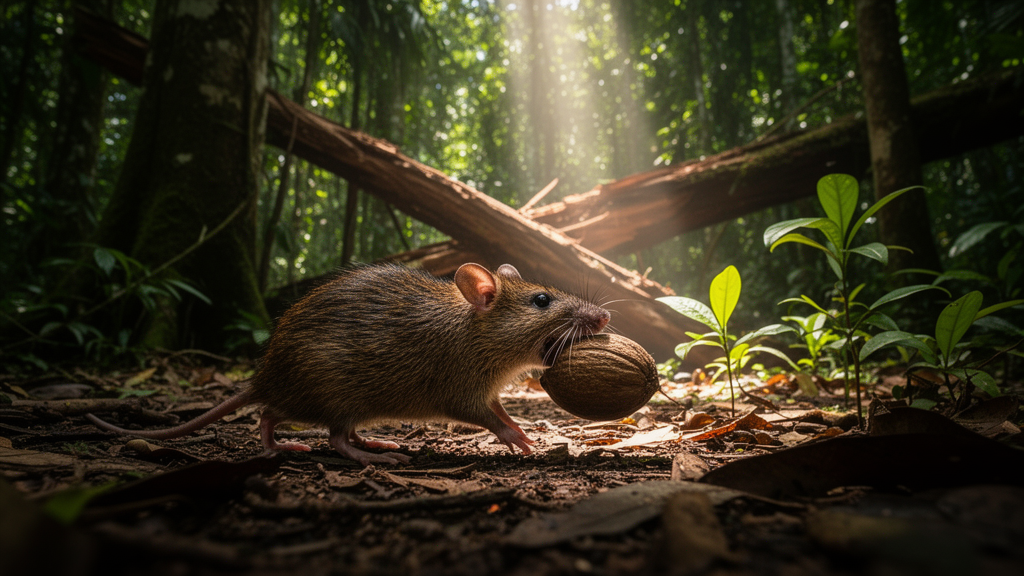
In a lowland second-growth forest in Soberania National Park, Central Panama, small terrestrial rodents moved seeds of the palm Attalea butyracea into and toward tree-fall gaps far more often than chance would predict. Over two wet-season field campaigns, researchers tracked 155 seeds that had been carried away from experimental stations and deposited intact on the ground, and found that 114 of them ended up inside or toward the gaps. The finding, reported in a field study of 28 tree-fall gaps, provides the first direct verification of a hypothesis that had previously only been suggested: that small mammals such as the Central American spiny rat (Proechimys semispinosus) act as directed dispersers, nonrandomly delivering seeds into the high-light microhabitats where light-demanding plants recruit most successfully.
Directed dispersal is a concept with real consequences for tropical forest regeneration. When an animal carries a seed not at random but to a site that happens to offer better germination and growth conditions, the plant gains fitness beyond the simple benefit of being moved away from its parent. Tree-fall gaps, created when a large tree topples and opens the canopy, typically combine stronger sunlight, altered moisture and temperature regimes, and reduced competition from larger plants. For light-demanding species, these gaps can be the decisive recruitment sites, and areas with gaps generally support higher plant species richness than closed forest. More than 66 percent of Neotropical canopy tree seeds are dispersed by animals that consume their fruits, so the foraging decisions of fruit-eating mammals can shape the spatial template of the next forest generation.
Most attention in Neotropical seed-dispersal research has gone to larger mammals such as agoutis and monkeys. Yet smaller terrestrial rodents, whose combined abundance and biomass can exceed those of larger species, especially in disturbed forests, have received far less study. The Central American spiny rat is often the most abundant terrestrial rodent in lowland forests of the northern Neotropics, including the study area, and earlier work had already established it as a scatter hoarder of large seeds and documented its association with tree-fall gaps. What remained untested was whether that association translates into directional seed movement into gaps, a possibility raised but never verified by prior research.
The study focused on Attalea butyracea, a common palm of lowland northern Neotropical forests that is particularly abundant in disturbed areas. It grows up to 20 meters tall and reliably produces one to four large infructescences each year. Its fruits, which range from 4.5 to 8.5 centimeters long and 3 to 4.5 centimeters in diameter, rely almost exclusively on animal dispersal, though the seeds are also frequent victims of bruchid beetles and seed-eating rodents. Because the palm is light-demanding, seeds that land in canopy gaps should, in principle, enjoy better prospects than those deposited under closed canopy.
To follow the seeds, the researchers built a tracking system around thread bobbins. They collected fresh A. butyracea fruits, drilled a small hole in each seed with a 1.2-millimeter drill bit, and wired the seed to an industrial sewing bobbin wrapped in waterproof surgical tape. Five such seeds were placed at each of three stations per gap: one at the geometric center of the gap, one within a meter of the gap edge, and one in intact forest ten meters from the edge. The stations were protected by semipermeable exclosures made from live traps wired open, which barred mammals heavier than roughly one kilogram, such as adult Central American agoutis, while still admitting spiny rats. Red-tailed squirrels could not be excluded, but they are less abundant and typically carry seeds into trees rather than dropping them in gaps, and other local rodents are too small to move palm seeds at all. When an animal removed a seed, the unspooling thread revealed the exact pathway and final deposition point.
The exclosures were checked daily for a combined total of 49 days across two wet seasons, June through August of 2012 with 13 gaps and 2013 with 15 gaps. Only seeds moved and deposited intact on the ground counted as successful dispersals; seeds destroyed, eaten, or carried above ground were excluded, as were 116 removals deposited less than 0.30 meters from the station. That filtering left 155 tracked dispersal events, typically ending with seeds buried under leaf litter.
The directional pattern was striking at the gap center and edge but absent deeper in the forest. Of the 75 seeds removed from gap-center stations, 72, or 96.0 percent, stayed within the gap and only three, or 4.0 percent, were carried out. At edge stations, 33 of 57 dispersals, 57.9 percent, went toward or into the gap, 13, or 22.8 percent, went parallel to it, and 11, or 19.3 percent, moved away. A chi-square test comparing these directions against a random expectation of 25 percent toward, 25 percent away, and 50 percent parallel showed strong nonrandom movement toward the gap at edge stations (chi-square = 33.84, d.f. = 2, P < 0.0001). At intact-forest stations ten meters out, however, the directions did not differ from random expectations (chi-square = 4.31, d.f. = 2, P = 0.116), with 9 of 23 seeds, 39.1 percent, moving toward the gap, 12, or 52.2 percent, moving parallel, and 2, or 8.7 percent, moving away. Dispersal distances themselves showed no significant differences among gaps (P = 0.143), between years (P = 0.745), or among station locations (P = 0.051).
The researchers interpret the pattern through the lens of optimal foraging theory, which holds that animals should forage in ways that raise net energy intake while lowering predation risk. Tree-fall gaps are structurally complex, full of fallen debris and dense recruiting vegetation that offers cover from predators. A spiny rat carrying a heavy palm fruit from the gap edge into that tangle pays a transport cost but gains a safer place to consume or cache the seed. Once cached and forgotten, the seed sits in exactly the high-light environment where germination and seedling growth are most likely to succeed. The absence of directionality at the ten-meter stations fits the same logic: in young second-growth forest, the understory itself is full of protective structure, so a rodent ten meters from a gap has no reason to haul its cargo all the way to the gap when equally safe cover lies closer in some other direction.
The authors caution that the setting shapes the conclusion. The work was conducted in young second-growth forest, and the outcome might differ in old-growth forest, where intact-forest ground cover is sparser and the structural contrast between gap interior and surrounding understory would be sharper. Whether the directed movement actually translates into higher germination and recruitment of A. butyracea in gaps remains a question for future research, as does the generality of the mechanism across Neotropical forests of different ages. Still, the study demonstrates that small mammals nonrandomly disperse seeds into tree-fall gaps when seeds start within or near them, a directed dispersal pathway that could influence the spatial distribution of plant species and, ultimately, the regeneration of disturbed tropical forests.
Subject of Research: Directed seed dispersal by spiny rats into tree-fall gaps in a Panamanian tropical forest
Article Title: Influence of tree-fall gaps on directional seed dispersal by small mammals in Central Panama
Article References: Phillips-Lewis, A. B., Lambert, T. D., & Adler, G. H. (2023). Influence of tree-fall gaps on directional seed dispersal by small mammals in Central Panama. Neotropical Biology and Conservation, 18(1), 73-82. https://doi.org/10.3897/neotropical.18.e97653
Image Credits: AI Generated
DOI: 10.3897/neotropical.18.e97653
Keywords: seed dispersal, tree-fall gaps, spiny rats, Proechimys semispinosus, Attalea butyracea, Panama, tropical forest regeneration, optimal foraging, rodents, second-growth forest, directed dispersal, ecology
Cite Scienmag News
Drew Townsend. (October 26, 2026). Spiny Rats Steer Palm Seeds into Tree-Fall Gaps in Panama Forest. Scienmag. https://scienmag.com/spiny-rats-steer-palm-seeds-into-tree-fall-gaps-in-panama-forest/
Drew Townsend. "Spiny Rats Steer Palm Seeds into Tree-Fall Gaps in Panama Forest." Scienmag, 26 October 2026, https://scienmag.com/spiny-rats-steer-palm-seeds-into-tree-fall-gaps-in-panama-forest/. Accessed 26 October 2026.
Drew Townsend. "Spiny Rats Steer Palm Seeds into Tree-Fall Gaps in Panama Forest." Scienmag. October 26, 2026. https://scienmag.com/spiny-rats-steer-palm-seeds-into-tree-fall-gaps-in-panama-forest/


