


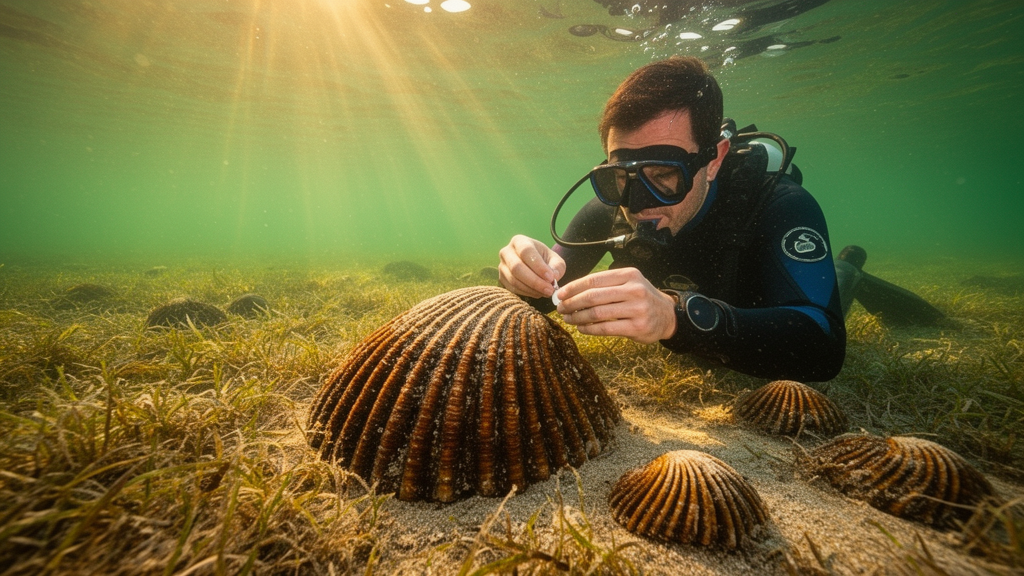
One of the last strongholds of the Mediterranean’s most iconic bivalve is hiding in plain sight along the French coast. A new genome-wide study, published in Frontiers in Genetics, shows that the fan mussel Pinna nobilis population of the Thau lagoon has retained nearly all of the genetic diversity that has been lost from open-sea populations devastated by mass mortality events, and that it carries traces of ancient interbreeding with its sister species Pinna rudis concentrated in genes linked to immunity and stress response. The findings position this semi-enclosed lagoon as a potential genetic reservoir for a species that has virtually disappeared from much of the open Mediterranean over the past decade.
Pinna nobilis is the largest bivalve endemic to the Mediterranean, living more than 45 years and reaching up to 1.2 meters in length. It anchors vertically in soft sediments, often in Posidonia oceanica meadows, and as a filter feeder capable of processing up to 2,500 liters of water per day it improves water quality and provides habitat for associated species. Its larvae drift in the water column for up to 20 days before settling, and genetic and oceanographic evidence indicates connectivity among distant western Mediterranean populations. Since mass mortality events began sweeping through the basin, however, open-sea abundances have collapsed dramatically, while some lagoon and semi-enclosed populations have persisted, in some cases at high densities. The mechanisms behind this spatial contrast remain unresolved, but the die-offs are expected to erode allelic and haplotypic diversity, shift the distribution of rare variants and shrink effective population sizes.
To assess what the surviving lagoon populations still hold, the research team sampled 334 adult Pinna specimens between 2021 and 2025, taking small non-lethal mantle biopsies from 301 individuals across ten sites in the Thau lagoon and 33 individuals in the nearby Diane lagoon. They added 45 previously generated sequences from open-sea animals in Spain, Italy and Greece, including two Pinna rudis and five first-generation hybrids, for a total of 379 individuals. Illumina paired-end sequencing targeting roughly 10-fold genome coverage, aligned to a P. nobilis-specific reference genome, yielded more than 100 million nuclear variants, of which about 50 million biallelic SNPs survived quality filtering. The team then analyzed both maternally inherited mitochondrial genomes and biparentally inherited nuclear SNPs to reconstruct diversity, structure and demographic history.
The mitochondrial results were striking. Across the 16S rRNA gene and a concatenated set of protein-coding genes, haplotype diversity was uniformly high, ranging from 0.932 to 1.000, while nucleotide diversity remained low, and Thau mirrored the diversity previously documented in open-sea populations. Synonymous substitutions far outnumbered non-synonymous ones, indicating strong purifying selection. Comparisons with historical sequences deposited in public databases before 2018 revealed, however, that the number of 16S rRNA haplotypes detected has fallen by 54 percent, and cox1 haplotypes by 33 percent, a pattern consistent with erosion of mitochondrial diversity, although differences in sampling periods and spatial coverage mean these percentages cannot be attributed solely to the recent mass mortalities. The study also reports the first evidence of mitochondrial heteroplasmy in P. nobilis: a single individual out of 379 carried both P. nobilis and P. rudis mitogenomes across the entire mitochondrial genome. Meanwhile, all five confirmed first-generation hybrids retained only P. nobilis mitochondria, pointing to asymmetric inheritance, likely involving P. nobilis oocytes and P. rudis sperm.
The nuclear genome told an equally encouraging story. Based on 194,964 putatively neutral SNPs, observed heterozygosity was high and remarkably uniform across all groups, averaging 0.154, and inbreeding coefficients were low and mostly negative, indicating a slight excess of heterozygosity. Within the Thau lagoon, pairwise differentiation among sites was extremely low and not significant, meaning the population is effectively panmictic, likely because the lagoon’s wind-driven hydrodynamics circulate larvae throughout despite limited exchange with the open sea. Between Thau and the open-sea populations, differentiation was significant but shallow, with FST values below 0.014. Thau was genetically closer to Spain than to Italy or Greece, and the strongest differentiation, with Greece, fits the west-east structure previously reported for the species, with the boundary lying east of the Sicilian Strait. The significant, if modest, differentiation suggests Thau is a partially isolated genetic unit.
Demographic reconstructions revealed a turbulent deep history. Bayesian analysis of mitochondrial markers dated a past expansion to roughly 800,000 years ago in Diane and open-sea populations and about 500,000 years ago in Thau, while protein-coding genes placed the same event near 250,000 years ago, together bracketing a mid-to-late Pleistocene expansion. Genome-wide SNPs analyzed with SMC++ resolved more recent dynamics: effective population size rose between roughly 200,000 and 20,000 years ago, then declined sharply before a rapid post-bottleneck expansion between about 30,000 and 3,000 years ago. The combined picture is a mid-Pleistocene expansion, a late-Pleistocene bottleneck and a post-glacial recovery. The authors caution that absolute dates depend on mutation rate assumptions not yet calibrated for this long-lived species, so the sequence of events is more reliable than the timing.
The admixture analyses produced one of the study’s most intriguing findings. Global clustering with ADMIXTURE identified five first-generation hybrids and about seven percent of samples with detectable P. rudis ancestry above 2.9 percent, with marked geographic asymmetry: only 2.3 percent of Thau individuals were admixed, compared with 15 percent in Diane, 50 percent in Italy and 25 percent in Spain. Admixed Thau animals clustered near the lagoon’s open-sea connection. But local ancestry inference with RFMix told a different story: every P. nobilis individual carried short P. rudis-like tracts, averaging about 609 candidate admixed regions per individual, roughly two percent of the genome. Of 269 introgression hotspots, 62.5 percent appeared in all three populations and hotspot frequencies were strongly correlated across regions, a pattern the authors argue is more consistent with a shared historical introgression event and long-term persistence of introgressed haplotypes than with incomplete lineage sorting, given that the two species diverged roughly two million years ago.
What makes these introgressed tracts biologically interesting is what they contain. Genes within hotspots shared by more than 18 percent of individuals were enriched for innate immune recognition and signaling, including Toll-like receptors, TRAF3-like adaptors and scavenger receptors, as well as apoptosis and autophagy regulators, cell adhesion and extracellular matrix genes, and proteostasis factors such as heat-shock proteins and ubiquitin ligases. Selection scans in Thau independently flagged 111 candidate regions containing 255 coding sequences, including stress, immune and transporter genes, plus two genes under recent positive selection involved in collagen modification and prostaglandin signaling. The authors are careful, however, not to overclaim: because nearly all individuals ultimately succumbed to infection during the mass mortality events, any protective effect of introgressed alleles is likely modest, polygenic and context dependent, and the study did not directly compare resistant and susceptible individuals or test the phenotypic effects of individual alleles.
The conservation implications are immediate. With the parasite Haplosporidium pinnae still detectable in the open sea and picornaviruses also implicated in declines, remaining wild populations are now largely confined to lagoons and other paralic environments. Thau retains substantial diversity at both mitochondrial and nuclear levels, and its admixture profile encompasses variation also found in Diane and the open sea, making it a plausible source for restoring depleted populations, whether through natural larval dispersal or carefully evaluated translocation. The authors stress that the detected selection signatures cannot be attributed to the recent disease outbreaks, since Thau largely escaped them, and that linking genomic variation to individual infection outcomes, comparing survivors, susceptible animals and those with delayed disease progression, will be essential to determine whether the candidate introgressed and selected variants actually contribute to disease tolerance. For now, the message is clear: a sheltered French lagoon may hold much of what this endangered species needs to survive.
Subject of Research: Population genomics and conservation of the endangered Mediterranean fan mussel Pinna nobilis in the Thau lagoon
Article Title: Genome-wide diversity and Pinna rudis admixture reveal Thau lagoon as a conservation reservoir for the collapsing fan mussel Pinna nobilis
Article References: Foulquié, M., Bunet, R., Vázquez Luis, M., Giantsis, I. A., Scarpa, F., Sanna, D., Alvarez Perez, E., Casu, M., Prévot, J.-M., Vicente, N., & Coupé, S. (2026). Genome-wide diversity and Pinna rudis admixture reveal Thau lagoon as a conservation reservoir for the collapsing fan mussel Pinna nobilis. Frontiers in Genetics, 17, Article 1970183. https://doi.org/10.3389/fgene.2026.1970183
Image Credits: AI Generated
DOI: 10.3389/fgene.2026.1970183
Keywords: Pinna nobilis, fan mussel, Thau lagoon, conservation genetics, genomic diversity, introgression, Pinna rudis, mass mortality events, mitochondrial heteroplasmy, local adaptation, Mediterranean, bivalve
Cite Scienmag News
Juliet Wilcox. (October 26, 2026). French lagoon harbors a genetic lifeline for the collapsing Mediterranean fan mussel. Scienmag. https://scienmag.com/french-lagoon-harbors-a-genetic-lifeline-for-the-collapsing-mediterranean-fan-mussel/
Juliet Wilcox. "French lagoon harbors a genetic lifeline for the collapsing Mediterranean fan mussel." Scienmag, 26 October 2026, https://scienmag.com/french-lagoon-harbors-a-genetic-lifeline-for-the-collapsing-mediterranean-fan-mussel/. Accessed 26 October 2026.
Juliet Wilcox. "French lagoon harbors a genetic lifeline for the collapsing Mediterranean fan mussel." Scienmag. October 26, 2026. https://scienmag.com/french-lagoon-harbors-a-genetic-lifeline-for-the-collapsing-mediterranean-fan-mussel/


