


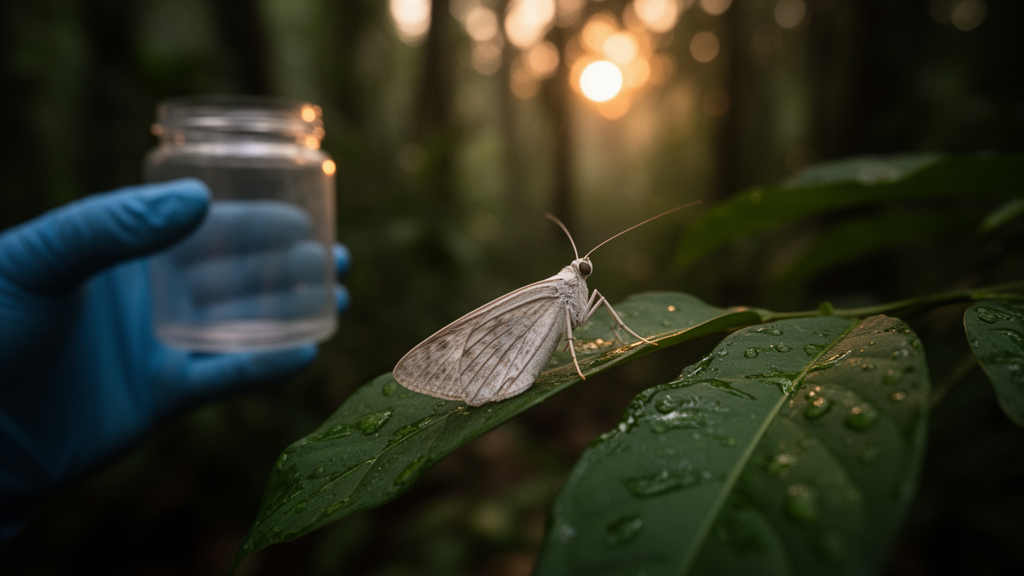
A moth so rare that Japan lists it as Vulnerable has been found far from its only known home. Three specimens of Eulocastra sasakii, a small owlet moth described in 1985 and until now regarded as endemic to Japan, have been identified among noctuid material collected in Cambodia. The discovery, published in a taxonomic study of the genus Eulocastra, marks the first record of both the species and the genus from the Indochina Peninsula, and it forces entomologists to rethink what they know about the distribution and ecology of an insect that appears on national and prefectural Red Data assessments across Japan.
The genus Eulocastra Butler was established on the Australian species E. fasciata by monotypy, and most of its species are distributed from Africa to Eurasia, with only E. chrysarginea and E. ecphaea occurring elsewhere. In East Asia, four species have been recorded: E. excisa, E. latifasciata, E. sasakii and E. shibaharai. Of these, three, all except E. excisa, were known only from Japan. E. latifasciata, described from Japan in 1911, remains particularly poorly known and has not been recorded since its original description, although Solis in 1992 subsequently treated it in the genus Lepidogma in the Pyralidae without supporting discussion. Following the more recent treatment by Kishida, the new study retains E. latifasciata in Eulocastra.
The story of the Cambodian specimens begins in 2011, when collectors working at Seima took two males and one female of a small, cream-and-grey moth. The individuals were preserved and later examined during a broader study of noctuid moths. Their external appearance agreed closely with E. sasakii, and dissection of the genitalia of both sexes supported the identification. The Cambodian material includes a male and female registered under catalogue number INU-12214, collected on 9 November 2011, and a second male, CYBG-0245, collected on 30 June 2011. All voucher specimens are held in the private insect collection of the author.
Eulocastra sasakii has a troubled taxonomic history that illustrates how easily a rare species can slip through the cracks. The moth first surfaced in Akita Prefecture, Japan, in 1982, when a single female was reported under the provisional name Eublemma sp. Sugi described it as a new species in 1985 on the basis of that female and an additional male. Although Sugi had female specimens in hand, only the male genitalia were illustrated and described. The female genitalia remained unknown until now, a gap that the new Cambodian female has finally closed with the first description and illustration of that sex.
The species is small and delicately patterned. The fore-wing measures 6 to 7 millimetres in males and 7 millimetres in females, giving a wingspan of 13 to 15 millimetres. The ground colour of the fore-wing is creamy-white with a dark grey basal area, a black interrupted sub-basal line curved inward, a dark grey medial band whose distal half is paler than the proximal half and which bears a black discal dot, and three separated dark grey subterminal patches, large at the costa and small and indistinct at the tornus. The postmedial line is dim and does not reach the subcostal vein, the terminal line is black and dotted, and the hind-wing is uniformly creamy-ivory. The antennae are filiform in both sexes, and the head and thorax range from creamy to metallic dark brownish-grey with two very faint greyish bands.
The genitalia provide the decisive diagnostic characters. In the male, the valvae are asymmetrical and tongue-shaped, with a wavy, sclerotised costal margin bearing a median protrusion with a cluster of setae, and the right valva carries a well-sclerotised, axe-shaped ampullar process connected to the costal protrusion. The harpe is broad and flattened, tapering to an acute apex, the vinculum is broadly V-shaped, and the arched aedeagus bears a single spear-shaped cornutus, while the eighth tergite carries a reversed Y-shaped sclerotised plate and the eighth sternite a rectangular marginal plate. In the female, described for the first time in this study, the ostium bursae is well-sclerotised, subtriangular, laterally folded and twisted at its base with a small asymmetrical curved process, the posterior third of the tubular ductus bursae is sclerotised and twisted, and the ovate corpus bursae lacks a signum. The authors note that the ostium and ductus are naturally twisted, though they were partially flattened during slide preparation to clarify their structure.
These characters separate E. sasakii from its East Asian relatives. It differs from E. shibaharai not only in the fore-wing pattern, with a distinct medial band and a non-uniformly suffused distal half, but also in the male genitalia, particularly the asymmetrical valva and strongly developed ampullar process, in contrast to the symmetrical valva and weakly developed processes of that species. It differs from E. excisa in the more distinctly defined medial band with a relatively straight inner margin, the subterminal markings separated into distinct patches rather than forming a broad continuous dark area, and the uniformly pale hind-wing. Comparisons with E. neoexcisa rest on the distinct undulate postmedial line, the distinct continuous subterminal line, and several genitalic differences including a strongly sclerotised distal portion of the valva, a large triangular ampullar process, an elongate triangular harpe with a blunt apex and an aedeagus with a small process on the carina. The authors caution that genitalic comparisons with some congeners remain limited, because the female genitalia of E. shibaharai have not been described and those of E. excisa are insufficiently documented.
The Cambodian record carries conservation weight. Within Japan, E. sasakii is regarded as rare and is listed as Vulnerable, Category II, by the Ministry of the Environment of Japan. Prefectural assessments add further designations: near-threatened in Aichi, Mie and Gifu Prefectures, endangered in Akita Prefecture, and notable species in Fukui Prefecture under that prefecture’s own classification system. The species has been recorded in Japan from Aichi, Akita, Fukui, Gifu and Mie, spanning Central and Northern Honshu, where it is rarely observed or collected. A population in Southeast Asia, if confirmed, would mean the species occurs in both the Palaearctic and Oriental Regions rather than being confined to a handful of Japanese prefectures.
The finding also poses an ecological puzzle. Until now, the only known host plant of E. sasakii has been Molinia japonica, a grass distributed in temperate regions of East Asia, including Korea, Japan, Eastern Siberia and parts of eastern China. That plant is not known to occur in the Indochina Peninsula, including Cambodia. The occurrence of the moth in a region well outside the known range of its documented host suggests that the species may utilise alternative host plants in Southeast Asia, although the authors stress that this hypothesis remains to be tested. In Japan, the host plant has also been referred to as Moliniopsis japonica by the Ministry of the Environment, though the study follows the usage of Molinia japonica.
The identification rests on morphology alone, and the authors are careful about its limits. Attempts to extract DNA from the examined specimens failed, likely because the material was collected approximately fifteen years ago and no usable sequences could be obtained. The Cambodian specimens are consistent with E. sasakii based on genital morphology, but additional material and molecular data are required to confirm whether the Cambodian population is conspecific with the Japanese population. Given that the study is based on a limited number of specimens, further sampling across both the Oriental and eastern Palaearctic Regions will be essential to clarify the distribution, host plant associations and intraspecific variation of the species. One more mystery hangs over the genus: Sugi noted in 1990 that E. sasakii closely resembles externally E. quintana, described from India, but the type specimen of E. quintana has never been located and no subsequent specimens or detailed morphological information are available beyond the original description and illustration, so a detailed genitalic comparison remains unfeasible at present. Future discovery and examination of fresh material or type holdings of E. quintana will be needed to settle the species boundaries and phylogenetic relationships between these allied taxa. For now, the Cambodian moths stand as a reminder that even a species catalogued as endangered in one country may be quietly flying, unrecognised, in another, and that the first description of female genitalia, decades after the species was named, can still reshape a map.
Subject of Research: First record of the noctuid moth Eulocastra sasakii from the Indochina Peninsula, with the first description of its female genitalia
Article Title: First record of the genus Eulocastra Butler, 1886 ( Lepidoptera , Noctuidae ) from the Indochina Peninsula, with notes on the distribution and host associations of Eulocastra sasakii Sugi, 1985
Article References: Cha, Y.-B. (2026). First record of the genus Eulocastra Butler, 1886 (Lepidoptera, Noctuidae) from the Indochina Peninsula, with notes on the distribution and host associations of Eulocastra sasakii Sugi, 1985. Biodiversity Data Journal, 14, Article e214068. https://doi.org/10.3897/bdj.14.e214068
Image Credits: AI Generated
Keywords: Eulocastra sasakii, Noctuidae, Lepidoptera, Cambodia, Indochina Peninsula, endangered species, female genitalia, host plants, Molinia japonica, taxonomy, distribution, Japan
Cite Scienmag News
Margaret Porter. (October 26, 2026). Rare Japanese Moth Turns Up in Cambodia, Redrawing Its Known Range. Scienmag. https://scienmag.com/rare-japanese-moth-turns-up-in-cambodia-redrawing-its-known-range/
Margaret Porter. "Rare Japanese Moth Turns Up in Cambodia, Redrawing Its Known Range." Scienmag, 26 October 2026, https://scienmag.com/rare-japanese-moth-turns-up-in-cambodia-redrawing-its-known-range/. Accessed 26 October 2026.
Margaret Porter. "Rare Japanese Moth Turns Up in Cambodia, Redrawing Its Known Range." Scienmag. October 26, 2026. https://scienmag.com/rare-japanese-moth-turns-up-in-cambodia-redrawing-its-known-range/


