


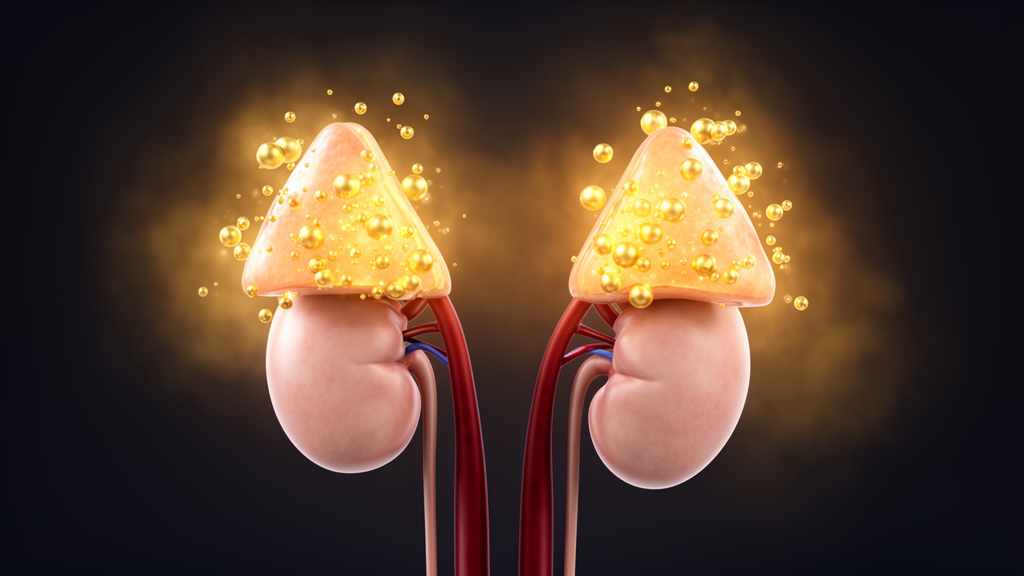
Mild autonomous cortisol secretion, or MACS, has long been treated as a biochemical curiosity: a slightly elevated cortisol reading after a dexamethasone suppression test in a patient with an adrenal lump discovered by chance, but none of the dramatic features of full-blown Cushing’s syndrome. A comprehensive narrative review published in Frontiers in Endocrinology argues that this dismissive framing no longer holds. Drawing together evidence from large observational cohorts, meta-analyses and a growing set of randomized surgical trials, the authors portray MACS as a heterogeneous, multisystem disorder linked to hypertension, diabetes, fatty liver disease, skeletal fragility, muscle weakness, frailty, disturbed sleep and altered mood — and, ultimately, to higher mortality.
The scale of the problem is considerable. Adrenal incidentalomas, benign-appearing adrenal masses found on imaging performed for unrelated reasons, are detected in 1.4 to 7 percent of adults, rising to roughly 10 percent in people over 70. Between 19 and 50 percent of these lesions are associated with MACS, defined by current European guidelines as serum cortisol above 50 nmol/L (1.8 µg/dL) after a 1 mg overnight dexamethasone suppression test, together with suppressed or low-normal morning ACTH confirming that the pituitary no longer controls the secretion. Patients with MACS tend to be older, more often women, and to carry larger and more frequently bilateral adrenal masses than those with non-functioning tumors. Progression to overt Cushing’s syndrome is rare, occurring in fewer than 1 percent of cases, which is precisely why the condition’s systemic toll has been easy to overlook.
The cardiovascular evidence is among the strongest. A meta-analysis of 17,156 patients found hypertension significantly more prevalent in MACS than in non-functioning adrenal tumors, and a meta-analysis of 5,921 patients demonstrated substantially higher all-cause, comorbidity-adjusted mortality in MACS, with a hazard ratio of 1.54. In a systematic review of six studies, new cardiovascular events occurred in 16.7 percent of MACS patients versus 6.7 percent of controls, and cardiovascular mortality reached 22.6 percent versus 2.5 percent. A multicenter retrospective study of 3,656 patients across 28 centers reported increased mortality with cortisol autonomy, and patients with MACS showed higher blood pressure, more myocardial infarctions, strokes and coronary revascularizations, along with increased carotid intima-media thickness and a lower ankle-brachial index, suggesting early atherosclerosis. In the prospective ITACA cohort, MACS was also associated with left-ventricular hypertrophy and diastolic dysfunction, pointing to direct cardiac remodeling.
Metabolic derangement follows a similar pattern. Glucose metabolism disorders affect roughly 15 to 40 percent of MACS patients, and meta-analytic data indicate a 44 percent higher risk of type 2 diabetes compared with non-functioning tumors, with individual studies reporting diabetes prevalence of 28 to 43 percent in MACS versus 7 to 29 percent in controls. Dyslipidemia, present in 26 to 67 percent of patients, carries a significantly elevated relative risk of 1.29. The liver appears particularly affected: in a cross-sectional study of 262 patients, fatty liver disease was found in 57 percent of MACS patients versus 26.2 percent of controls, with a correspondingly lower liver-to-spleen attenuation ratio. Mechanistically, cortisol drives hepatic glucose production through gluconeogenic enzymes, impairs insulin signaling in peripheral tissues, inhibits pancreatic beta-cell insulin secretion, and promotes lipolysis that floods the liver with free fatty acids.
Bone and muscle emerge as quieter but consequential targets. In a cohort of 444 patients, MACS was linked to a more than fivefold higher prevalence of vertebral fractures in both women and men, even after excluding hypogonadism, and a large study by Pal and colleagues found vertebral fractures in 45 percent of MACS patients. Bone mineral density at the lumbar spine and femoral neck is lower in MACS, and trabecular bone score, a measure of bone quality that densitometry alone may miss, deteriorates as well. Muscle studies add a functional dimension: patients with MACS show reduced muscle mass, strength and quality, particularly in women, with lower biceps and quadriceps strength despite comparable muscle mass, implying dysfunction without overt sarcopenia. Encouragingly, a randomized study of 53 patients found that adrenalectomy reduced new vertebral fractures to 4.8 percent versus 25 percent with conservative care, and an interventional study showed improved handgrip strength after surgery while conservative management was followed by decline.
Beyond the classic cardiometabolic spectrum, the review highlights consequences that are only now being mapped. Frailty, assessed with a dedicated 47-variable index, was present in 42 percent of MACS patients in a prospective validation study, compared with 22 percent of those with non-functioning tumors and 4 percent of referent subjects, and correlated with handgrip strength and six-minute walk performance. Sleep suffers too: using the Pittsburgh Sleep Quality Index, MACS patients reported shorter sleep duration, longer latency, lower efficiency and worse daytime function than controls, with obstructive sleep apnea present in 45 percent versus 19 percent. Mood disturbances, anxiety and reduced interest are more common than in non-functioning tumor patients, while cognitive findings remain inconsistent — some studies report better verbal fluency and executive function in MACS, others worse working memory and more mild cognitive impairment. Evidence on testosterone suppression in men and on gut microbiome changes is preliminary, with no study yet directly characterizing microbial composition in MACS.
Diagnosis remains the weak link. The 1 mg overnight dexamethasone suppression test is the cornerstone, but its interpretation is undermined by assay variability, medications that induce dexamethasone metabolism, poor adherence, elevated cortisol-binding globulin and renal failure; in one cohort, inadequate dexamethasone levels explained 22 percent of positive results. Late-night salivary cortisol has sensitivity of only 23 to 40 percent in MACS because circadian rhythm is often preserved, and urinary free cortisol performs even worse. Supportive markers such as low ACTH and DHEA-S improve accuracy, and emerging tools — hair cortisone with 94 percent specificity, late-night salivary cortisone with 90 percent sensitivity and 91 percent specificity, urinary steroid metabolomics, and blood-count-based inflammatory indices — are promising but investigational, several reported only in conference abstracts without independent validation.
Treatment is where the field is changing fastest. Recent randomized trials have strengthened the case for surgery in selected patients: a Swedish five-center trial of 43 patients found improved blood pressure and reduced antihypertensive medication use in 75 percent of adrenalectomy patients versus 44 percent of conservatively managed patients, while the European CHIRACIC trial and the multicenter COAR study showed significant improvements in blood pressure, glucose and weight control after surgery. But surgery carries its own burden: postoperative adrenal insufficiency from suppression of the remaining adrenal gland affected 54.5 percent of patients in one large series, with recovery averaging about four months and sometimes exceeding a year. Pharmacological options, including low-dose evening metyrapone and, more speculatively, glucocorticoid receptor antagonists and GLP-1-based metabolic therapies, are emerging in early trials but remain non-standardized, with access varying widely between countries.
The review’s central message is that MACS deserves structured, individualized assessment rather than passive observation. The authors propose a practical algorithm: characterize the lesion, confirm cortisol autonomy with attention to confounders, systematically evaluate cortisol-related comorbidities, discuss adrenalectomy multidisciplinarily for unilateral disease with clinically important or progressive complications, and monitor hypothalamic-pituitary-adrenal recovery after surgery. Prospective studies are still needed to define meaningful endpoints, refine diagnostic thresholds and identify which patients benefit most from intervention — with some evidence suggesting younger women with higher post-dexamethasone cortisol carry the greatest mortality risk. Until then, the review concludes, MACS should be recognized as a clinically meaningful disorder rather than a borderline biochemical finding, because for many patients it is mild only by definition.
Subject of Research: Clinical consequences, diagnosis and management of mild autonomous cortisol secretion in adrenal incidentalomas
Article Title: MACS: mild by definition, challenging by nature
Article References: Bluszcz, G., Roszkowska, Z., Domański, J., Sharabi, A., Rapiejko, J., Małek, J., Ambroziak, U., & Bobrowicz, M. (2026). MACS: mild by definition, challenging by nature. Frontiers in Endocrinology, 17, Article 1957127. https://doi.org/10.3389/fendo.2026.1957127
Image Credits: AI Generated
DOI: 10.3389/fendo.2026.1957127
Keywords: mild autonomous cortisol secretion, adrenal incidentaloma, Cushing's syndrome, cortisol, dexamethasone suppression test, cardiometabolic risk, hypertension, osteoporosis, frailty, adrenalectomy, metyrapone, endocrinology
Cite Scienmag News
Ophelia Keating. (October 26, 2026). Mild by Name Only: The Hidden Burden of Subtle Cortisol Excess. Scienmag. https://scienmag.com/mild-by-name-only-the-hidden-burden-of-subtle-cortisol-excess/
Ophelia Keating. "Mild by Name Only: The Hidden Burden of Subtle Cortisol Excess." Scienmag, 26 October 2026, https://scienmag.com/mild-by-name-only-the-hidden-burden-of-subtle-cortisol-excess/. Accessed 26 October 2026.
Ophelia Keating. "Mild by Name Only: The Hidden Burden of Subtle Cortisol Excess." Scienmag. October 26, 2026. https://scienmag.com/mild-by-name-only-the-hidden-burden-of-subtle-cortisol-excess/


