


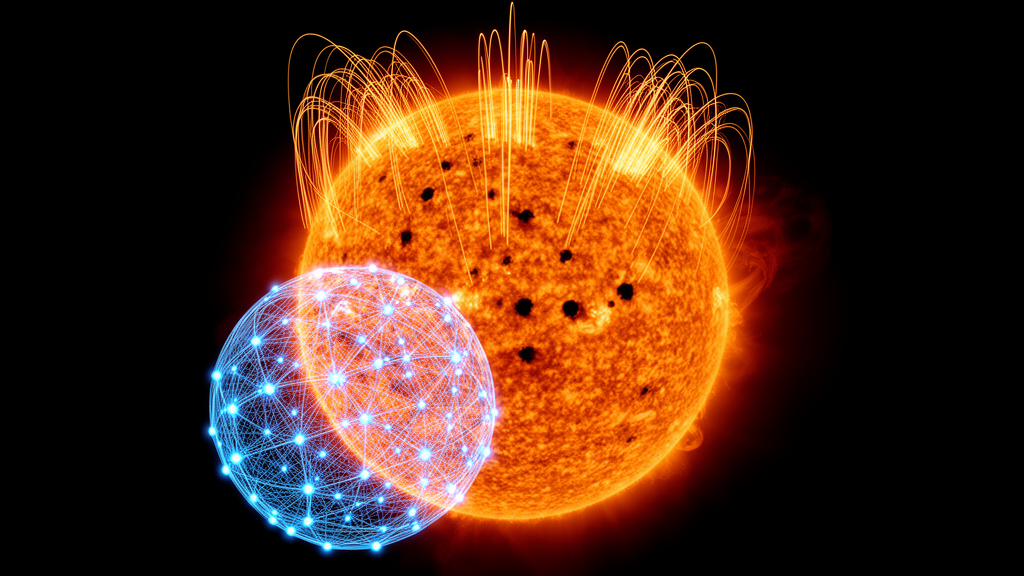
A hybrid deep learning model built by researchers at Kunming University of Science and Technology can forecast whether a solar active region will unleash a C-class or M-class flare within the next 24 hours, reaching True Skill Statistic scores of 0.861 and 0.844 on the two tasks under a strict active-region-isolated five-fold cross-validation. The architecture, described in Frontiers in Astronomy and Space Sciences, couples a ConvNeXtV2 vision network that reads the spatial structure of solar magnetograms with a Transformer–temporal convolutional network that tracks how the magnetic field evolves in time. The team reports that the model performs at least as well as the strongest baselines retrained on the same data and the same folds, while cautioning that the margins over the next best architecture are comparable to the fold-to-fold variability itself.
The motivation is grounded in one of the most dramatic space weather events on record. In March 1989, a coronal mass ejection associated with a strong solar flare triggered a severe geomagnetic storm that caused a large-scale collapse of the Hydro-Québec power grid in Canada, leaving nearly six million residents without electricity for nine hours, while also producing satellite anomalies and interruptions of shortwave communications. Solar flares are violent energy-release events in the solar atmosphere whose intense electromagnetic radiation and energetic particles can reach near-Earth space within a short time, threatening satellites, radio communications, navigation services, and ground-based power infrastructure. Accurate flare prediction is therefore considered essential for space weather early warning and for the safe operation of both space-based and ground-based systems.
Flare forecasting has evolved through three generations of methods. Early studies relied on statistical analysis of active region properties, after which machine learning algorithms such as support vector machines, artificial neural networks, k-nearest neighbors, random forests, and ensemble methods were introduced. These conventional approaches, however, depend heavily on hand-crafted feature engineering and can hardly discover deep-level information embedded in magnetic field data automatically. Physics-based modeling, meanwhile, is constrained by the current understanding of flare triggering mechanisms and by available computational capability, and cannot yet fully describe the nonlinear evolution and multi-scale characteristics of complex active region magnetic fields. Deep learning changed the picture: convolutional neural networks learn spatial features directly from magnetograms, but observational studies indicate that the magnetic field of an active region often undergoes drastic evolution before eruption, with magnetic free energy continuously accumulating near the polarity inversion line. A CNN captures only the spatial distribution of the field and cannot model its dynamic evolution over time, a limitation that motivated recurrent and spatiotemporal fusion schemes, including CNN–LSTM hybrids, 3D CNNs, and the CNN–TCN framework.
The new model improves the spatial stage of that framework by replacing the conventional CNN with ConvNeXtV2, a modern convolutional architecture that introduces a fully convolutional masked autoencoder pre-training framework together with a global response normalization mechanism. These design elements markedly enhance the representation of complex spatial structures and global contextual information while preserving the intrinsic local inductive bias and computational efficiency of convolutional networks. Conventional CNNs extract features through local convolution operations whose receptive fields are limited by kernel size, making it difficult to characterize the large-scale structures, complex spatial distributions, and long-range spatial correlations of active region magnetic fields. ConvNeXtV2 has been validated in image classification, object detection, semantic segmentation, remote sensing interpretation, and medical image analysis, tasks that, like solar magnetogram analysis, require simultaneous acquisition of local morphology, spatial distribution, and large-scale structural features from complex two-dimensional images.
Because labeled flare samples are scarce, the ConvNeXtV2 encoder is first pre-trained under the SimCLR contrastive learning paradigm using only unlabeled magnetograms from the training folds. Two augmented views of the same magnetogram form a positive pair, while all remaining views in the batch serve as negatives, and the NT-Xent loss drives the encoder to learn representations that are invariant to augmentation and highly discriminative. Augmentations that would alter the intensity distribution, such as color jittering, are deliberately avoided because magnetogram pixel values correspond to magnetic field strength in physical units. After pre-training, the frozen encoder maps each single-channel magnetogram to a 128-dimensional spatial feature vector, which is concatenated along the feature dimension with 16 physical magnetic field parameters from the SHARP data product, covering properties such as total unsigned flux, current helicity, magnetic free energy proxies, and shear angle, to form a multimodal temporal feature matrix of 15 time steps.
The second stage centers on the hybrid Transformer–TCN network. The Transformer encoder, configured with two stacked layers and four parallel attention heads, captures long-range global temporal dependencies through self-attention, which can directly establish associations between arbitrary time steps via attention weights rather than enlarging the temporal receptive field layer by layer with fixed kernel sizes and dilation rates. This adaptive capability is well matched to the markedly nonlinear, non-stationary, multi-scale evolution of active region magnetic fields, in which different evolutionary stages contribute differently to the eventual eruption. The TCN, formed by two residual blocks with a kernel size of 3 and dilation factors of 1 and 2, extracts locally continuous variation patterns through causal dilated convolutions. A temporal attention pooling layer computes weights for each time step, reinforcing the discriminative segments, and its weights possess a degree of interpretability that can be used to trace the key time steps on which the model focused. Attention, average, and max pooling are applied in parallel and fused before a fully connected classifier outputs the binary flare probability.
The data come from the Space-Weather HMI Active Region Patch product of the Helioseismic and Magnetic Imager on board the Solar Dynamics Observatory, covering 2010 to 2019, with flare labels drawn from the NOAA flare catalog based on GOES soft X-ray classifications. The team constructed 3,120 prediction intervals from magnetogram sequences of 15 frames each, resampled at 96 minutes so that the input spans the 22.4 hours ending at each issue time, while the label window is the disjoint following 24 hours. The issue times lie on a fixed clock grid defined by elapsed time alone and are unrelated to the times at which flares happen to occur, so no sample is selected, discarded, or re-weighted on the basis of flare occurrence. Because the issue times are spaced exactly 24 hours apart while the input windows span 22.4 hours, no magnetogram frame is used by more than one sample, and a single flare onset can never serve as the target of two different samples. Samples near the solar limb, multi-active-region fields, and intervals with data gaps longer than one hour were removed to improve reliability.
The validation protocol is designed to prevent the subtle leakage that plagues flare forecasting studies. Magnetograms of the same active region recorded at adjacent times are highly similar, so random partitioning by individual magnetogram would place near-duplicate samples in both training and test sets and overestimate performance. Instead, the 3,120 intervals were grouped by NOAA active region number, and each region, with all of its intervals and magnetograms, was assigned as a whole to one of five folds. All preprocessing statistics were computed from the training folds only, hyperparameters were fixed a priori at commonly adopted values, and the decision threshold was set at the positive-class prevalence of the training folds rather than tuned on any evaluation data. Training used a skill-score-aware composite loss combining a class-balanced focal loss with differentiable soft True Skill Statistic and soft Heidke Skill Score terms, guiding the model toward improving positive-class detection, reducing false alarms, and enhancing forecast skill relative to random prediction.
The results place the model at the top of a competitive field. Compared under identical conditions with reimplemented versions of ML, 3D CNN, CNN-TCN, and SwinTCN-Att, the proposed model attained the highest TSS on both tasks, with margins of 0.024 on the C-class task and 0.044 on the M-class task over the next best model, values of the same order as the fold-to-fold standard deviations of 0.021 and 0.041. The authors therefore do not interpret these margins as evidence that one architecture is superior to another, presenting the model as competitive with, rather than demonstrably superior to, the strongest recent baselines. Its distinguishing feature is attaining the highest TSS on both tasks within a single framework that combines masked-autoencoder pre-training, global self-attention, and dilated convolution, with a decision threshold fixed a priori. A step-wise ablation showed that each added component, the ConvNeXtV2 encoder, the Transformer, the SimCLR pre-training, and the composite loss, moved TSS in the same direction on both tasks, with individual increments between 0.012 and 0.022, while removing either input modality alone reduced performance, confirming that the multimodal fusion is essential.
The authors emphasize that the current evaluation is limited to a short-term setting and should not be interpreted as evidence of predictive capability at substantially longer lead times, such as two to five days before onset. The present M-class task combines M- and X-class flares into one positive category and thus does not constitute an independent evaluation of X-class flare prediction, and the M-class task in fact requires discriminating strong flares from moderate C-class activity, which is intrinsically harder than separating flaring from non-flaring intervals. Future work will investigate skill degradation at lead times of roughly 48, 72, and 96 hours, and will explore a dedicated X-class task, potentially incorporating more complete estimates of magnetic helicity, accumulated free energy, and polarity-inversion-line properties, together with extreme-ultraviolet and radio observations. For now, the study offers a further option for short-term solar flare forecasting, one that characterizes both the magnetic field structure of active regions and its dynamic evolution within a single end-to-end framework.
Subject of Research: Short-term solar flare forecasting with a hybrid ConvNeXtV2 and transformer–temporal convolutional network
Article Title: Short-term solar flare forecasting with a hybrid ConvNeXtV2 and transformer–temporal convolutional network
Article References: Zheng, M., Xiong, X., & Li, H. (2026). Short-term solar flare forecasting with a hybrid ConvNeXtV2 and transformer–temporal convolutional network. Frontiers in Astronomy and Space Sciences, 13, Article 1999089. https://doi.org/10.3389/fspas.2026.1999089
Image Credits: AI Generated
DOI: 10.3389/fspas.2026.1999089
Keywords: solar flares, space weather, deep learning, ConvNeXtV2, Transformer, temporal convolutional network, magnetograms, SHARP, SDO/HMI, forecasting, Short-term, solar
Cite Scienmag News
Blake Davidson. (October 26, 2026). AI Model Reads Solar Magnetic Fields to Predict Flares 24 Hours Ahead. Scienmag. https://scienmag.com/ai-model-reads-solar-magnetic-fields-to-predict-flares-24-hours-ahead/
Blake Davidson. "AI Model Reads Solar Magnetic Fields to Predict Flares 24 Hours Ahead." Scienmag, 26 October 2026, https://scienmag.com/ai-model-reads-solar-magnetic-fields-to-predict-flares-24-hours-ahead/. Accessed 26 October 2026.
Blake Davidson. "AI Model Reads Solar Magnetic Fields to Predict Flares 24 Hours Ahead." Scienmag. October 26, 2026. https://scienmag.com/ai-model-reads-solar-magnetic-fields-to-predict-flares-24-hours-ahead/


