

Sunday, October 25, 2026
Science
No Result
View All Result
  • Login
  • HOME
  • SCIENCE NEWS
  • CONTACT US
  • HOME
  • SCIENCE NEWS
  • CONTACT US
No Result
View All Result
Scienmag
No Result
View All Result
Home Science News Technology and Engineering

Cold-sprayed graphene sensor detects pulse in one-person test

October 25, 2026
in Technology and Engineering
Denise Maddox
By Denise Maddox Scienmag Editorial Profile - Mechanical Engineering
Reading Time: 2 mins read
0
Cold-sprayed graphene sensor detects pulse in one-person test

Cold-sprayed graphene sensor detects pulse in one-person test

65
SHARES
587
VIEWS
Share on FacebookShare on Twitter
ADVERTISEMENT

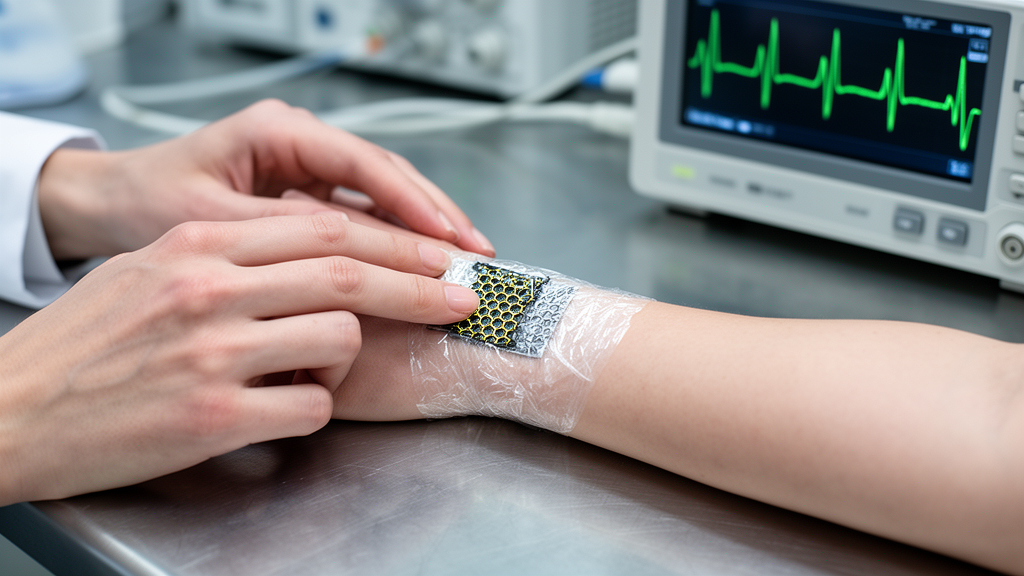
Researchers from Virginia Commonwealth University and Florida International University have developed a cold-spray technique that deposits graphene nanoplatelets directly onto a flexible pressure sensor, producing a device that adhered to human skin and detected a wrist pulse. The peer-reviewed study involved laboratory experiments and testing on one human subject. Its results demonstrate an early wearable-sensor fabrication advance, not validated performance for continuous health monitoring or clinical use.

The researchers created a wearable pressure sensor made from polydimethylsiloxane, or PDMS, a soft, stretchable polymer that molds to the surface on which it is applied. In the proposed process, cold spray applies graphene nanoplatelets directly to the PDMS to provide durable adhesion onto human skin. Unlike conventional adhesion methods that require heating or the addition of chemicals and binders, the cold-spray method enables dry adhesion at room temperature.

The researchers reported that this approach also avoids tampering with the sensor’s other materials during application. “The sensor can be made by spraying the sensing material [graphene] directly onto a flexible surface, without glue or several complicated steps,” said Arvind Agarwal, Ph.D., chair and professor in VCU’s Department of Mechanical and Nuclear Engineering. The team evaluated the sensor through a series of experiments.

It reacted to a press-and-release sequence in 29 milliseconds and continued working after more than 5,000 presses. In testing with the single human participant, it was also able to pick up the person’s wrist pulse. These observations showed strong adhesion, mechanical robustness under repeated pressing, rapid response and the ability to register a bodily pulse under the tested conditions.

The release did not establish how the sensor would perform across a wider population, under different movement or environmental conditions, or during prolonged real-world use. Wearable sensors offer potential benefits for health monitoring, human-machine interaction and flexible electronics, but their fabrication often relies on costly, multistep processes with limited scalability. The researchers describe their method as a potential route to simpler, scalable manufacturing.

Putting graphene directly onto a flexible surface removes glue and several complicated steps from the bonding sequence, while dry, room-temperature application distinguishes it from approaches requiring heat, chemicals or binders. Whether the technique can support continuous physiological monitoring or customized health care was not established by the reported study. The work was published in ACS Applied Electronic Materials as “Cold-Spray Enabled Scalable Manufacturing of Flexible Graphene-Based Wearable Sensors.”

Subject of Research: Cold-spray fabrication of a graphene-based wearable pressure sensor for attachment to human skin

Article Title: VCU research propels wearable technology that could enhance health monitoring

Article References: VCU research propels wearable technology that could enhance health monitoring. Original publication (Bibliographic details unavailable.)

Image Credits: AI Generated

DOI: Not provided

Keywords: wearable sensors, cold spray, graphene nanoplatelets, polydimethylsiloxane, pressure sensing, human skin, flexible electronics, scalable manufacturing, research, propels, wearable, technology

Cite Scienmag News

Denise Maddox. (October 25, 2026). Cold-sprayed graphene sensor detects pulse in one-person test. Scienmag. https://scienmag.com/cold-sprayed-graphene-sensor-detects-pulse-in-one-person-test/

Denise Maddox. "Cold-sprayed graphene sensor detects pulse in one-person test." Scienmag, 25 October 2026, https://scienmag.com/cold-sprayed-graphene-sensor-detects-pulse-in-one-person-test/. Accessed 25 October 2026.

Denise Maddox. "Cold-sprayed graphene sensor detects pulse in one-person test." Scienmag. October 25, 2026. https://scienmag.com/cold-sprayed-graphene-sensor-detects-pulse-in-one-person-test/


Tags: cold sprayflexible electronicsgraphene nanoplateletshuman skinpolydimethylsiloxanepressure sensingpropelsResearchscalable manufacturingTechnologywearablewearable sensors
Share26Tweet16
Previous Post

Objective fitness gains did not track self-perception in female undergraduates

Next Post

Lab study finds mixed-acid corrosion varies by metal and organic acid

Related Posts

Lab study finds mixed-acid corrosion varies by metal and organic acid
Technology and Engineering

Lab study finds mixed-acid corrosion varies by metal and organic acid

October 25, 2026
Simple Machine Learning Model Predicts Fluorinated Gas Capture in Ionic Liquids
Technology and Engineering

Simple Machine Learning Model Predicts Fluorinated Gas Capture in Ionic Liquids

October 25, 2026
Fe-Biomass Carbon Aerogels Combine Conductive and Magnetic Properties
Technology and Engineering

Fe-Biomass Carbon Aerogels Combine Conductive and Magnetic Properties

October 25, 2026
Deep Learning Model Reaches 98.39% Accuracy in Cotton Leaf Disease Classification
Technology and Engineering

Deep Learning Model Reaches 98.39% Accuracy in Cotton Leaf Disease Classification

October 25, 2026
Latent acoustic profiles reveal patterns in music popularity across release cohorts
Technology and Engineering

Latent acoustic profiles reveal patterns in music popularity across release cohorts

October 25, 2026
New algorithm halves the cost of quaternion matrix multiplication
Technology and Engineering

New algorithm halves the cost of quaternion matrix multiplication

October 25, 2026
Next Post
Lab study finds mixed-acid corrosion varies by metal and organic acid

Lab study finds mixed-acid corrosion varies by metal and organic acid

  • Mothers who receive childcare support from maternal grandparents show more optimized

    Mothers who receive childcare support from maternal grandparents show more parental warmth, finds NTU Singapore study

    27656 shares
    Share 11059 Tweet 6912
  • University of Seville Breaks 120-Year-Old Mystery, Revises a Key Einstein Concept

    1061 shares
    Share 424 Tweet 265
  • Bee body mass, pathogens and local climate influence heat tolerance

    682 shares
    Share 273 Tweet 171
  • Researchers record first-ever images and data of a shark experiencing a boat strike

    546 shares
    Share 218 Tweet 137
  • Groundbreaking Clinical Trial Reveals Lubiprostone Enhances Kidney Function

    531 shares
    Share 212 Tweet 133
Science

Embark on a thrilling journey of discovery with Scienmag.com—your ultimate source for cutting-edge breakthroughs. Immerse yourself in a world where curiosity knows no limits and tomorrow’s possibilities become today’s reality!

RECENT NEWS

  • Lab study finds mixed-acid corrosion varies by metal and organic acid
  • Cold-sprayed graphene sensor detects pulse in one-person test
  • Objective fitness gains did not track self-perception in female undergraduates
  • VPS13A-knockdown cells show iron-linked vesicles and oxidative vulnerability

Categories

  • Agriculture
  • Anthropology
  • Archaeology
  • Athmospheric
  • Biology
  • Biotechnology
  • Blog
  • Bussines
  • Cancer
  • Chemistry
  • Climate
  • Earth Science
  • Editorial Policy
  • Marine
  • Mathematics
  • Medicine
  • Pediatry
  • Policy
  • Psychology & Psychiatry
  • Science Education
  • Science News
  • Social Science
  • Space
  • Technology and Engineering

Subscribe to Blog via Email

Enter your email address to subscribe to this blog and receive notifications of new posts by email.

Join 5,151 other subscribers

© 2025 Scienmag - Science Magazine

Welcome Back!

Login to your account below

Forgotten Password?

Retrieve your password

Please enter your username or email address to reset your password.

Log In
No Result
View All Result
  • HOME
  • SCIENCE NEWS
  • CONTACT US

© 2025 Scienmag - Science Magazine

Discover more from Science

Subscribe now to keep reading and get access to the full archive.

Continue reading