

Sunday, October 25, 2026
Science
No Result
View All Result
  • Login
  • HOME
  • SCIENCE NEWS
  • CONTACT US
  • HOME
  • SCIENCE NEWS
  • CONTACT US
No Result
View All Result
Scienmag
No Result
View All Result
Home Science News Cancer

HPV E6/E7 proteins linked to aggressive features in Sudanese prostate cancer

October 25, 2026
in Cancer
Nathaniel Bowman
By Nathaniel Bowman Scienmag Editorial Profile - Precision Oncology
Reading Time: 2 mins read
0
HPV E6/E7 proteins linked to aggressive features in Sudanese prostate cancer

HPV E6/E7 proteins linked to aggressive features in Sudanese prostate cancer

65
SHARES
587
VIEWS
Share on FacebookShare on Twitter
ADVERTISEMENT

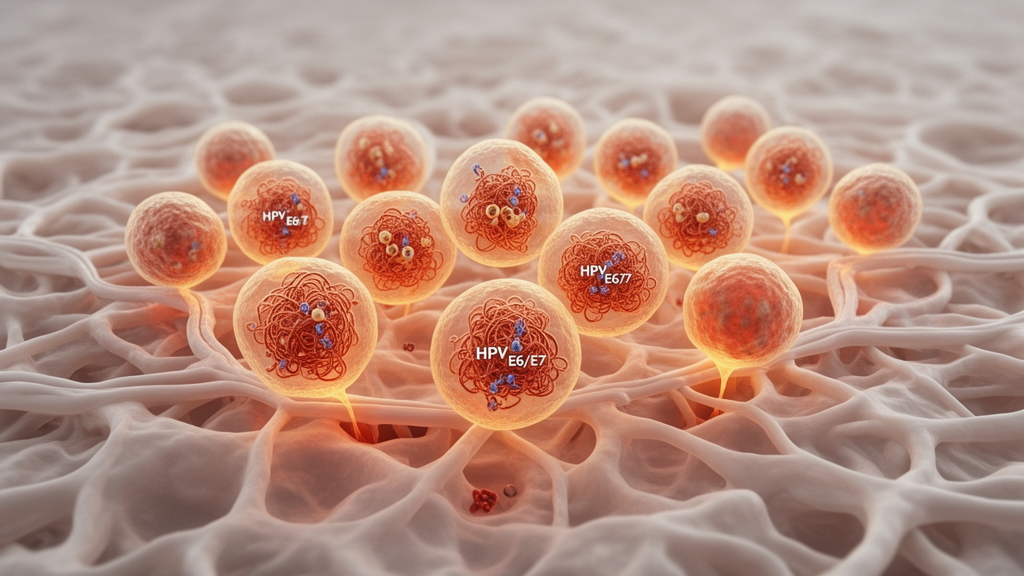
Immunohistochemical staining was positive in 48% of the 50 prostate cancer specimens and 18% of the 50 benign controls, a statistically significant difference (p = 0.0026). Among the cancer cases, positive staining was also associated with higher International Society of Urological Pathology Grade Groups and more advanced pathological stage, but not with serum prostate-specific antigen concentrations. The study examined 100 formalin-fixed, paraffin-embedded prostate tissue specimens: 50 from histologically confirmed prostate cancer and 50 from benign prostatic hyperplasia.

The investigators assessed high-risk HPV E6/E7 protein expression using monoclonal antibodies and evaluated the staining with a semi-quantitative H-score system. Their statistical analysis included chi-square tests, Mann–Whitney U tests, logistic regression and odds-ratio calculations. Prostate cancer tissue had over four times the odds of HPV E6/E7 positivity compared with benign tissue, yielding an odds ratio of 4.21 and a 95% confidence interval of 1.69–10.43.

Analysis of the malignant tumors showed that positive E6/E7 immunoreactivity was significantly associated with higher ISUP Grade Groups (p = 0.0035) and advanced tumor stage (p = 0.004). Multivariable logistic regression showed that higher tumor grade and pathological stage remained independently associated with HPV E6/E7 immunoreactivity after adjustment for PSA. In contrast, the researchers found no significant association between positive staining and serum PSA levels.

The authors cautioned that protein immunoreactivity alone cannot confirm an active HPV infection or establish that the virus caused the development of a prostate tumor. The retrospective design and the geographically specific Sudanese cohort also constrain how broadly the observed associations can be applied. The findings consequently identify a relationship between detectable viral oncoproteins and more severe pathological characteristics in the sampled tissues, rather than demonstrating a causal role for HPV in prostate cancer.

The results add to an unresolved question about the role of HPV in prostate cancer. Although HPV is a known cause of several epithelial cancers, its connection with prostate cancer has not been definitively established, and evidence may vary among populations. Within this cohort, high-risk HPV E6/E7 protein positivity was both more common in malignant tissue than in benign prostatic hyperplasia and associated with higher grade and more advanced stage.

The researchers proposed future studies incorporating molecular HPV detection, viral genotyping and RNA-based analysis to determine whether viral material and transcription are present and to clarify the biological relationship between HPV and prostate tumors.

Subject of Research: Association of high-risk HPV E6/E7 protein expression with prostate cancer grade and stage in a Sudanese cohort

Article Title: Immunohistochemical detection of high-risk human papillomavirus E6/E7 oncoproteins is associated with aggressive clinicopathological features in prostate cancer: a Sudanese cohort study

Article References: Elimam, A., Hadad, I., Mohammed, E., Cacciatore, S., & Ahmed, D. (2026). Immunohistochemical detection of high-risk human papillomavirus E6/E7 oncoproteins is associated with aggressive clinicopathological features in prostate cancer: a Sudanese cohort study. BMC Cancer. https://doi.org/10.1186/s12885-026-16916-0

Image Credits: AI Generated

DOI: 10.1186/s12885-026-16916-0

Keywords: high-risk HPV, prostate cancer, Sudanese cohort, E6 oncoprotein, E7 oncoprotein, immunohistochemistry, tumor grade, pathological stage, benign prostatic hyperplasia, viral oncology, Immunohistochemical, detection

Cite Scienmag News

Nathaniel Bowman. (October 25, 2026). HPV E6/E7 proteins linked to aggressive features in Sudanese prostate cancer. Scienmag. https://scienmag.com/hpv-e6-e7-proteins-linked-to-aggressive-features-in-sudanese-prostate-cancer/


Nathaniel Bowman. "HPV E6/E7 proteins linked to aggressive features in Sudanese prostate cancer." Scienmag, 25 October 2026, https://scienmag.com/hpv-e6-e7-proteins-linked-to-aggressive-features-in-sudanese-prostate-cancer/. Accessed 25 October 2026.

Nathaniel Bowman. "HPV E6/E7 proteins linked to aggressive features in Sudanese prostate cancer." Scienmag. October 25, 2026. https://scienmag.com/hpv-e6-e7-proteins-linked-to-aggressive-features-in-sudanese-prostate-cancer/

Tags: aggressive prostate cancer featuresbenign prostatic hyperplasiacorrelation between HPV and tumor gradedetectionE6 oncoproteinE7 oncoproteinhigh-risk HPVhigh-risk HPV in prostate tumorsHPV and prostate cancer aggressivenessHPV and prostate cancer stagingHPV E6/E7 expression and pathological stageHPV E6/E7 proteins in prostate cancerHPV involvement in prostate carcinogenesisImmunohistochemicalimmunohistochemical detection of HPVimmunohistochemistryimmunohistochemistry in prostate tissuepathological stageprostate cancerprostate cancer biomarkersSudanese cohortSudanese prostate cancer studytumor gradeviral oncology
Share26Tweet16
Previous Post

Northern India dry-seeded rice trial links genotype and nitrogen splitting to yield

Next Post

Concrete Autoencoder Framework Sharpens Intrusion Detection for SDN-IoT Networks

Related Posts

CAR T cells shrink lymphoma everywhere, but survival depends on location
Cancer

CAR T cells shrink lymphoma everywhere, but survival depends on location

October 25, 2026
Living with and beyond advanced cancer: understanding patient needs and experiences
Cancer

Living with and beyond advanced cancer: understanding patient needs and experiences

October 25, 2026
Surgery and radiotherapy linked to longer survival in grade 4 brain tumors
Cancer

Surgery and radiotherapy linked to longer survival in grade 4 brain tumors

October 25, 2026
Antibody-Drug Conjugate Cuts Death Risk by 54% in Relapsed Small-Cell Lung Cancer
Cancer

Antibody-Drug Conjugate Cuts Death Risk by 54% in Relapsed Small-Cell Lung Cancer

October 25, 2026
Meta-analysis links serum TK1 to prostate cancer and tumor grade
Cancer

Meta-analysis links serum TK1 to prostate cancer and tumor grade

October 25, 2026
B7-H3 antibody-drug conjugate cuts death risk 54% in relapsed small-cell lung cancer
Cancer

B7-H3 antibody-drug conjugate cuts death risk 54% in relapsed small-cell lung cancer

October 25, 2026
Next Post
Concrete Autoencoder Framework Sharpens Intrusion Detection for SDN-IoT Networks

Concrete Autoencoder Framework Sharpens Intrusion Detection for SDN-IoT Networks

  • Mothers who receive childcare support from maternal grandparents show more optimized

    Mothers who receive childcare support from maternal grandparents show more parental warmth, finds NTU Singapore study

    27656 shares
    Share 11059 Tweet 6912
  • University of Seville Breaks 120-Year-Old Mystery, Revises a Key Einstein Concept

    1061 shares
    Share 424 Tweet 265
  • Bee body mass, pathogens and local climate influence heat tolerance

    682 shares
    Share 273 Tweet 171
  • Researchers record first-ever images and data of a shark experiencing a boat strike

    546 shares
    Share 218 Tweet 137
  • Groundbreaking Clinical Trial Reveals Lubiprostone Enhances Kidney Function

    531 shares
    Share 212 Tweet 133
Science

Embark on a thrilling journey of discovery with Scienmag.com—your ultimate source for cutting-edge breakthroughs. Immerse yourself in a world where curiosity knows no limits and tomorrow’s possibilities become today’s reality!

RECENT NEWS

  • Concrete Autoencoder Framework Sharpens Intrusion Detection for SDN-IoT Networks
  • HPV E6/E7 proteins linked to aggressive features in Sudanese prostate cancer
  • Northern India dry-seeded rice trial links genotype and nitrogen splitting to yield
  • Social activities linked to better cognition across 24 countries

Categories

  • Agriculture
  • Anthropology
  • Archaeology
  • Athmospheric
  • Biology
  • Biotechnology
  • Blog
  • Bussines
  • Cancer
  • Chemistry
  • Climate
  • Earth Science
  • Editorial Policy
  • Marine
  • Mathematics
  • Medicine
  • Pediatry
  • Policy
  • Psychology & Psychiatry
  • Science Education
  • Science News
  • Social Science
  • Space
  • Technology and Engineering

Subscribe to Blog via Email

Enter your email address to subscribe to this blog and receive notifications of new posts by email.

Join 5,151 other subscribers

© 2025 Scienmag - Science Magazine

Welcome Back!

Login to your account below

Forgotten Password?

Retrieve your password

Please enter your username or email address to reset your password.

Log In
No Result
View All Result
  • HOME
  • SCIENCE NEWS
  • CONTACT US

© 2025 Scienmag - Science Magazine

Discover more from Science

Subscribe now to keep reading and get access to the full archive.

Continue reading