

Sunday, October 25, 2026
Science
No Result
View All Result
  • Login
  • HOME
  • SCIENCE NEWS
  • CONTACT US
  • HOME
  • SCIENCE NEWS
  • CONTACT US
No Result
View All Result
Scienmag
No Result
View All Result
Home Science News Technology and Engineering

Body tissue links miniature implants to wearable health devices

October 25, 2026
in Technology and Engineering
Denise Maddox
By Denise Maddox Scienmag Editorial Profile - Mechanical Engineering
Reading Time: 3 mins read
0
Body tissue links miniature implants to wearable health devices

Body tissue links miniature implants to wearable health devices

65
SHARES
587
VIEWS
Share on FacebookShare on Twitter
ADVERTISEMENT

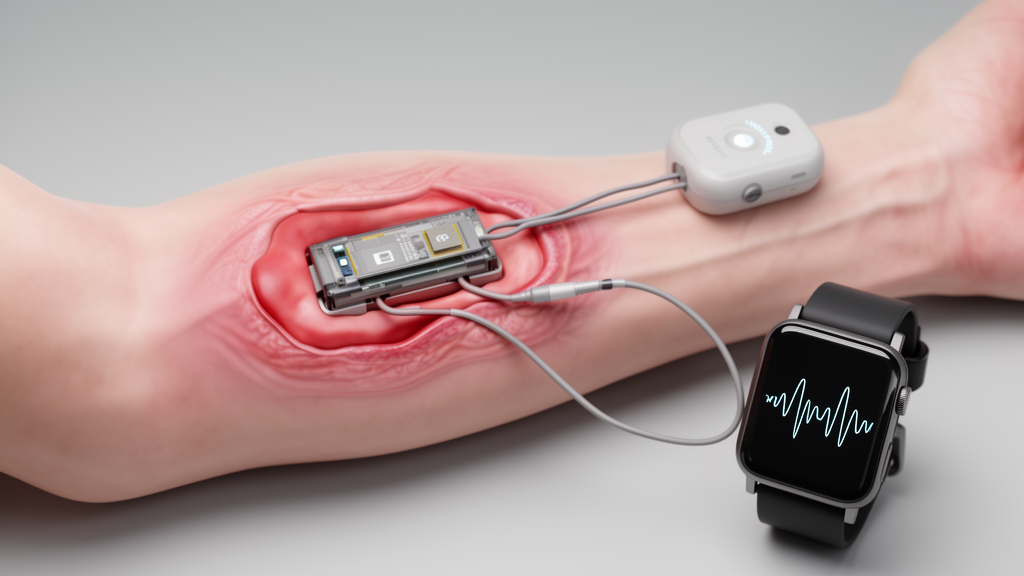
Georgia Institute of Technology engineers have developed a low-power wireless network that uses the electrical conductivity of body tissue to connect miniature implants with each other and with wearable devices. The system, called the Smart Wireless Autonomous Networking System, or SWANS, allows sensors placed in one part of the body to transmit a signal that activates an actuator elsewhere, potentially enabling a device to deliver medicine or stimulate a nerve without a physical connection between the components. The peer-reviewed work was described in Science on September 24, 2026.

Conventional wireless technologies such as Bluetooth and near-field communication perform poorly through the body, according to study senior author Alex Abramson, an assistant professor in Georgia Tech’s School of Chemical and Biomolecular Engineering. Such signals also require comparatively large antennas and substantial power, which can force implants to be physically larger than desired. SWANS instead uses tissue’s natural ionic conductivity as the communication pathway, transmitting small electrical pulses between devices that may be separated, differently positioned or implanted at widely separated locations.

Each implant can be programmed to respond to pulses distinguished by specific voltage and duration, allowing the network to activate selected devices selectively. Multiple implants can also be coordinated so that readings from several sensors produce a common trigger for an actuator. The system is intended primarily for modest amounts of information, such as the presence or absence of a biological signal or a yes-or-no instruction. More demanding data processing and larger exchanges occur in an external wearable hub, which coordinates the readings and commands sent through the body.

In an animal experiment, the researchers demonstrated coordinated movement of a rat’s two limbs through a network of sensors and neural interfaces. Sensors detected movement of the animal’s front paw, then autonomously triggered another device that stimulated and contracted a muscle in the hind leg, reproducing part of the pattern associated with natural walking. This was a preclinical demonstration in one rat rather than a test of a complete therapy in people. The investigators also developed implants smaller than 3 millimeters, small enough to pass through a syringe, using passive components that consume essentially no power while idle and activate when a triggering pulse arrives.

Power efficiency could support long implant lifetimes: the team estimated that an actuator triggered once per day could operate for about a year before replacement. In their experiments, the small electrical pulses produced no detectable damage in the tissue samples examined. The authors said the architecture could eventually be used to coordinate sensors and actuators throughout the body, including devices located deep within the stomach. Such possibilities remain development goals rather than demonstrated clinical capabilities, and the release did not report safety or performance trials in humans. Abramson and first author Ramy Ghanim nevertheless described the system as a step toward more coordinated bioelectronic medicine, in which a therapy could be delivered when and where it is needed.

Subject of Research: A body-tissue wireless network coordinating implantable sensors, actuators and wearable devices

Article Title: Engineers connect health wearables and implants using the body as the network

Article References: Engineers connect health wearables and implants using the body as the network. Original publication (Bibliographic details unavailable.)

Image Credits: AI Generated

DOI: Not provided

Keywords: implantable bioelectronics, wirebody networking, wearable devices, body tissue conductivity, neural interfaces, medical implants, low-power electronics, distributed sensors, bioelectronic medicine, rat motor control, Engineers, connect

Cite Scienmag News

Denise Maddox. (October 25, 2026). Body tissue links miniature implants to wearable health devices. Scienmag. https://scienmag.com/body-tissue-links-miniature-implants-to-wearable-health-devices/

Denise Maddox. "Body tissue links miniature implants to wearable health devices." Scienmag, 25 October 2026, https://scienmag.com/body-tissue-links-miniature-implants-to-wearable-health-devices/. Accessed 25 October 2026.

Denise Maddox. "Body tissue links miniature implants to wearable health devices." Scienmag. October 25, 2026. https://scienmag.com/body-tissue-links-miniature-implants-to-wearable-health-devices/


Tags: bioelectric signal transmissionBioelectronic Medicinebody tissue conductivitybody tissue wireless communicationconnectdistributed sensorsEngineersimplant-to-wearable device connectivityimplantable bioelectronicsimplantable sensors for health monitoringionic conductivity in medical implantslow-power electronicslow-power wireless medical sensorsmedical implantsminiature implantable health devicesneural interfacesrat motor controlremote activation of medical devicesSWANS medical implant technologytissue conductivity-based networkingwearable deviceswirebody networkingwireless health monitoring systemswireless nerve stimulation technology
Share26Tweet16
Previous Post

Culturally adapted tinnitus therapy shows promise in small Malaysian pilot

Next Post

Flavonoids, not just diterpenoids, give South African medicinal spurflowers their chemical identities

Related Posts

Shed receptor protein offers new clues to hyperemesis gravidarum
Technology and Engineering

Shed receptor protein offers new clues to hyperemesis gravidarum

October 25, 2026
Simulations Show Smarter Backup Planning Cuts Cost and Delay at the Edge
Technology and Engineering

Simulations Show Smarter Backup Planning Cuts Cost and Delay at the Edge

October 25, 2026
860 °C solution treatment optimizes aging response in Ti–5Cu alloy
Technology and Engineering

860 °C solution treatment optimizes aging response in Ti–5Cu alloy

October 25, 2026
Industrial Waste Cement Blend Locks Away CO2 and Rebuilds Its Own Binding Gel
Technology and Engineering

Industrial Waste Cement Blend Locks Away CO2 and Rebuilds Its Own Binding Gel

October 25, 2026
Frequency-aware transformer spots AI-generated fake voices and shows its reasoning
Technology and Engineering

Frequency-aware transformer spots AI-generated fake voices and shows its reasoning

October 25, 2026
Mamba-based model tames noisy urban traffic prediction with frequency-domain filtering
Technology and Engineering

Mamba-based model tames noisy urban traffic prediction with frequency-domain filtering

October 25, 2026
Next Post
Flavonoids, not just diterpenoids, give South African medicinal spurflowers their chemical identities

Flavonoids, not just diterpenoids, give South African medicinal spurflowers their chemical identities

  • Mothers who receive childcare support from maternal grandparents show more optimized

    Mothers who receive childcare support from maternal grandparents show more parental warmth, finds NTU Singapore study

    27656 shares
    Share 11059 Tweet 6912
  • University of Seville Breaks 120-Year-Old Mystery, Revises a Key Einstein Concept

    1061 shares
    Share 424 Tweet 265
  • Bee body mass, pathogens and local climate influence heat tolerance

    682 shares
    Share 273 Tweet 171
  • Researchers record first-ever images and data of a shark experiencing a boat strike

    546 shares
    Share 218 Tweet 137
  • Groundbreaking Clinical Trial Reveals Lubiprostone Enhances Kidney Function

    531 shares
    Share 212 Tweet 133
Science

Embark on a thrilling journey of discovery with Scienmag.com—your ultimate source for cutting-edge breakthroughs. Immerse yourself in a world where curiosity knows no limits and tomorrow’s possibilities become today’s reality!

RECENT NEWS

  • Flavonoids, not just diterpenoids, give South African medicinal spurflowers their chemical identities
  • Body tissue links miniature implants to wearable health devices
  • Culturally adapted tinnitus therapy shows promise in small Malaysian pilot
  • Ethical governance turns AI tools into sustainability gains for Gulf firms

Categories

  • Agriculture
  • Anthropology
  • Archaeology
  • Athmospheric
  • Biology
  • Biotechnology
  • Blog
  • Bussines
  • Cancer
  • Chemistry
  • Climate
  • Earth Science
  • Editorial Policy
  • Marine
  • Mathematics
  • Medicine
  • Pediatry
  • Policy
  • Psychology & Psychiatry
  • Science Education
  • Science News
  • Social Science
  • Space
  • Technology and Engineering

Subscribe to Blog via Email

Enter your email address to subscribe to this blog and receive notifications of new posts by email.

Join 5,151 other subscribers

© 2025 Scienmag - Science Magazine

Welcome Back!

Login to your account below

Forgotten Password?

Retrieve your password

Please enter your username or email address to reset your password.

Log In
No Result
View All Result
  • HOME
  • SCIENCE NEWS
  • CONTACT US

© 2025 Scienmag - Science Magazine

Discover more from Science

Subscribe now to keep reading and get access to the full archive.

Continue reading