


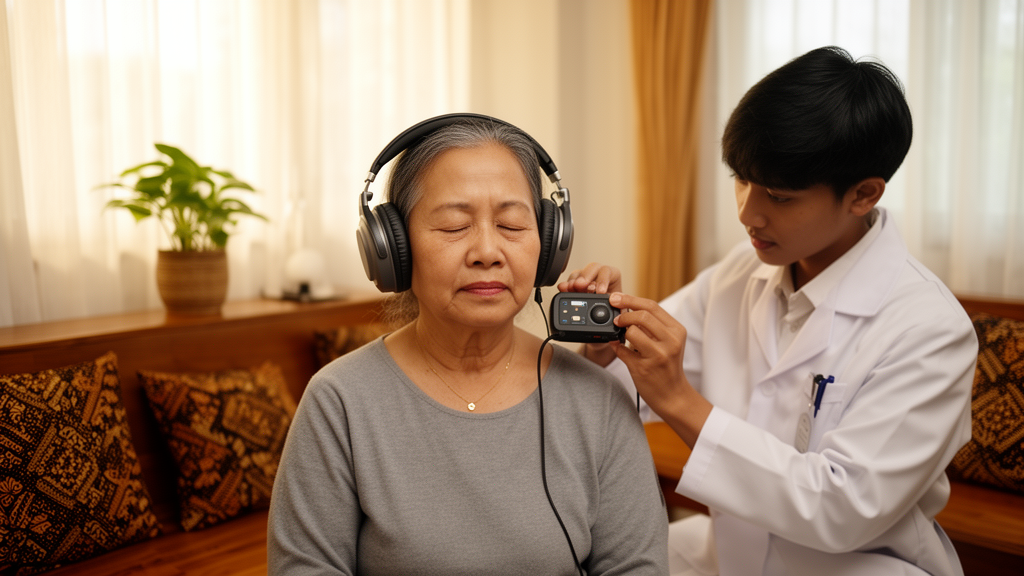
Researchers in Malaysia have culturally adapted a British-developed, psychologically informed tinnitus intervention for local use and put it through an early test with ten adults with chronic tinnitus. The study, published in BMC Psychology, reports that the adapted manualised programme achieved perfect face and content validity ratings from expert reviewers, and that a small single-arm pilot showed favourable preliminary patterns on tinnitus-specific distress, while measures of depression, anxiety and stress did not change significantly.
Tinnitus disorder carries a substantial psychological component, yet it has traditionally been managed by audiologists rather than mental health specialists. Because specialist providers able to meet tinnitus patients’ psychological needs are scarce, interest has grown in psychologically informed interventions delivered by audiologists themselves, an approach explored mainly in Western countries so far. Such programmes have remained limited in low- and middle-income countries, which motivated the Malaysian team to adapt an existing UK-developed intervention rather than build one from scratch.
The work unfolded in three stages. First, the team translated and culturally adapted the intervention guided by established adaptation frameworks. Second, seven audiologists reviewed the adapted materials using face and content validity indices. Every face-validity item, and all sixty chapter-domain content-validity assessments, achieved an index of 1.00, indicating unanimous agreement that the adapted content was appropriate and relevant for Malaysian adults with tinnitus.
The third stage was a single-arm convergent mixed-methods pilot involving ten adults with chronic tinnitus. Each participant received three individual sessions over approximately one month, delivered by a trained audiologist. The researchers measured outcomes with the Tinnitus Functional Index and the Depression Anxiety Stress Scales-42 at baseline, immediately after the intervention, and again at three-month follow-up. Missing outcomes were handled using baseline observation carried forward, with completer sensitivity analyses run alongside.
In the analysis including all enrolled participants, the mean Tinnitus Functional Index score fell from 59.50 at baseline to 40.20 after the intervention and 36.80 at three-month follow-up, with a statistically significant effect of time (p = .011). By contrast, scores for depression, anxiety and stress on the DASS-42 did not change significantly over the study period. The authors present these as preliminary outcome patterns from a pilot, not evidence of treatment efficacy.
Acceptability was explored among the completers through semi-structured interviews guided by the Theoretical Framework of Acceptability. Feedback was generally favourable, although some participants described the effort involved in practising the intervention’s strategies. Of the ten participants enrolled, six completed the intervention and all follow-up assessments. The four who discontinued provided no observed post-baseline outcome data and no acceptability data at all, a gap the researchers flag as a real limitation, since the views of people who drop out may differ sharply from those who stay.
The study’s limitations are substantial and the authors state them plainly. The sample was small, the design was single-arm with no control group, and discontinuation reached 40 percent. Without a comparison condition, natural fluctuation in tinnitus distress, regression to the mean and attention effects cannot be ruled out as explanations for the observed score changes. The absence of acceptability data from those who discontinued further restricts what can be concluded about how the intervention is received across the full enrolled group.
Even so, the researchers argue the findings justify the next step: a controlled feasibility evaluation of the adapted intervention in Malaysia. The perfect validity indices suggest the cultural adaptation process produced materials that expert audiologists judged fully appropriate for the local context, and the pilot’s outcome patterns, alongside generally positive acceptability among completers, indicate the approach is workable enough to test more rigorously. For now, the results stand as an early-stage signal that audiologist-delivered, psychologically informed care for tinnitus distress can be translated across cultures and delivered outside the Western settings where it was first developed.
Subject of Research: Cultural adaptation and pilot evaluation of an audiologist-delivered psychological intervention for tinnitus-related distress in Malaysia
Article Title: Cultural adaptation, expert validation, and mixed-methods pilot evaluation of a psychologically informed, audiologist-delivered, manualised intervention for tinnitus-related distress in Malaysia
Article References: Sadali, M. A., Ishak, W. S., Ahmad, M., MacDonald, C., & Hoare, D. J. (2026). Cultural adaptation, expert validation, and mixed-methods pilot evaluation of a psychologically informed, audiologist-delivered, manualised intervention for tinnitus-related distress in Malaysia. BMC Psychology. https://doi.org/10.1186/s40359-026-05463-9
Image Credits: AI Generated
DOI: 10.1186/s40359-026-05463-9
Keywords: tinnitus, audiology, cultural adaptation, psychological intervention, pilot study, Malaysia, Tinnitus Functional Index, DASS-42, mixed methods, acceptability, content validity, Cultural
Cite Scienmag News
Glenn Wilkins. (October 25, 2026). Culturally adapted tinnitus therapy shows promise in small Malaysian pilot. Scienmag. https://scienmag.com/culturally-adapted-tinnitus-therapy-shows-promise-in-small-malaysian-pilot/
Glenn Wilkins. "Culturally adapted tinnitus therapy shows promise in small Malaysian pilot." Scienmag, 25 October 2026, https://scienmag.com/culturally-adapted-tinnitus-therapy-shows-promise-in-small-malaysian-pilot/. Accessed 25 October 2026.
Glenn Wilkins. "Culturally adapted tinnitus therapy shows promise in small Malaysian pilot." Scienmag. October 25, 2026. https://scienmag.com/culturally-adapted-tinnitus-therapy-shows-promise-in-small-malaysian-pilot/


