


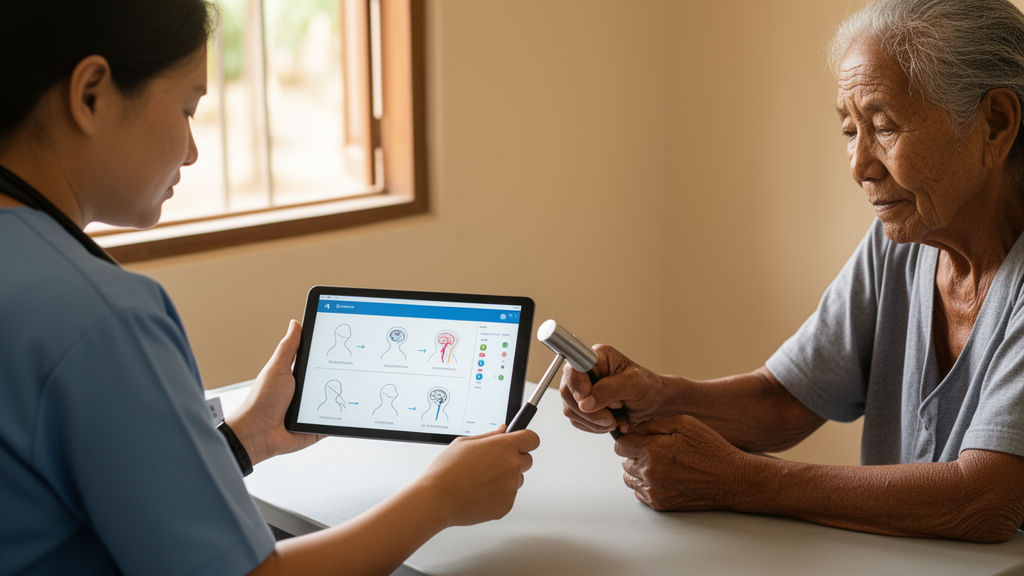
Neurological disorders affect an estimated 3.4 billion people worldwide, with a reported uncertainty range of 3.20 to 3.62 billion cases, making them a major contributor to the global burden of disease. Yet studying their risk factors outside clinics remains difficult, particularly in low-resource settings where neurologists are scarce. A team of researchers has now developed and internally validated a digital instrument designed to address that bottleneck: the NeuroEpiTool, a smartphone-based neurological examination that can be administered and interpreted by health professionals with no specialist neurological training. The tool’s first version was tested in Italy and Benin across a spectrum of conditions including multiple sclerosis, stroke, epilepsy, and Parkinson’s disease, and the results suggest that non-neurologists using the tool can reach agreement with neurologists that ranges from moderate to strong on most of its core tests.
The motivation behind the project stems from a persistent gap in neuroepidemiology. While eHealth technologies have transformed clinical care, tools built specifically for research on neurological signs and symptoms remain rare. Most existing digital assessments target a single disorder or a narrow domain, such as motor function, cognition, or coordination, rather than capturing the breadth of the nervous system. Reviews of eHealth software and hardware for neurological assessment have called for a unified instrument covering a wide range of signs and symptoms. Moreover, the field has concentrated on individual-level clinical applications, including diagnosis, therapy guidance, classification, and symptom monitoring, often overlooking the potential of digital tools to gather data at population scale, which is what cohort studies exploring causal relationships require.
The developers of the NeuroEpiTool approached these challenges through the lens of implementation science. They aligned the tool’s design with the CeHRes roadmap, a framework that emphasises engaging stakeholders from the earliest stages of development, incorporating continuous feedback, conducting usability testing, and planning structured implementation strategies with real-world adoption in mind. Maintenance strategies were prioritised to maximise long-term sustainability, a response to the documented problem that only a fraction of the many eHealth tools under constant development are successfully implemented, effective, and durable. The tool’s practical requirements are deliberately modest: a smartphone, a pen, and an internet connection, making it feasible for deployment in settings where specialist equipment and personnel are unavailable.
Conceptually, the NeuroEpiTool occupies a distinctive position. It is not intended to diagnose or classify individual patients. Instead, it prioritises sensitivity, capturing signs and symptoms across a wide range of neurological disorders so that patterns can be explored at the population level. The tool adapts a digital neurological examination into a structured flow of numbered sections, each corresponding to a neurological test, moving from anamnestic questions through upper and lower limb assessments to a final questions section. One section explicitly prompts the assessor to confirm that the participant is comfortable being touched. Complementary tests are triggered only when earlier tests suggest potential impairment, mirroring real-world clinical reasoning while keeping the assessment efficient.
To validate the instrument, the researchers conducted an internal validation study with 80 participants: 29 in Italy and 51 in Benin. The participants had a mean age of 53.6 years and an average of 13.1 years of education. Their diagnoses reflected the diversity the tool is meant to handle: 24 participants had multiple sclerosis, 18 had experienced stroke, 5 had epilepsy, 3 had Parkinson’s disease, 15 had other conditions including migraines, vestibular disorders, essential tremor, and dementia, and 13 had no neurological impairment. The central question was whether a neurologist and a non-neurologist health professional, both using the NeuroEpiTool, would reach the same conclusions. Agreement was quantified with Cohen’s kappa, a statistic in which values below 0.20 indicate no agreement, 0.21 to 0.39 minimal agreement, 0.40 to 0.59 weak agreement, 0.60 to 0.79 moderate agreement, and 0.80 or above strong agreement.
The reliability results were largely encouraging. Three tests achieved strong agreement: the 30-second chair stand test with a kappa of 0.82, superficial sensitivity testing with a kappa of 0.83, and visual field assessment with a kappa of 0.80, all statistically significant. Three further tests showed moderate agreement: walking on a line at 0.69, the cognitive assessment at 0.74, and the facial nerve examination at 0.60. The pronator’s drift of the upper limbs reached 0.57, the nose-index test 0.51, and the eye movement test 0.54, placing these in the weak agreement range. Interestingly, the 30-second chair stand, one of the strongest performers, is not typically part of a routine neurological examination, yet the data indicate it is highly reliable and readily performed by non-neurologists.
The complementary tests told a more cautious story. The pronator’s drift of the lower limbs yielded a kappa of 0.26 with a p value of 0.26 across only 19 participants, and deep sensitivity testing of the lower limbs reached 0.39 with a p value of 0.06 among 23 participants, while deep sensitivity of the upper limbs had insufficient data with just one participant. The researchers attributed the weak and non-significant results largely to the limited data available, since these tests were only administered to a small subset. Some inconsistencies between assessors also emerged in interpretation: in the upper limb pronator’s drift, the neurologist noted one arm falling while the non-neurologist observed pronation, both recognising impairment but describing it differently. Such discrepancies may stem from symptom fluctuation, as some neurological disorders, particularly those involving motor symptoms and fatigue, can manifest differently within the same day.
The weaker performance of the eye movement and nose-index tests may reflect overdiagnosis by non-neurologists, who sometimes flagged minor asymmetries as impairments. The study’s authors caution that these two tests require significant expertise and formal training to interpret, so non-neurologists should apply them cautiously. This pattern echoes earlier literature: a study comparing neurologists with physiotherapists found low inter-rater agreement for the pronator’s drift, nose-index, and pupil symmetry tests, and eye-related assessments appear particularly challenging for non-specialists. By contrast, the tandem gait test has shown high agreement in previous research, aligning with the performance of the walking-on-a-line test here. Prior work on the Unified Parkinson’s Disease Rating Scale motor exam described moderate to substantial agreement between neurologists and nurses, and a stroke assessment study using the Oxfordshire Community Stroke Project classification reported fair to moderate agreement between nurses and neurologists. Together with the new findings, this body of evidence supports the premise that, with appropriate training, non-neurologist health professionals can fairly rate and interpret neurological signs and symptoms.
Convergent validity and usability assessments rounded out the evaluation. Both neurologists, one in Italy and one in Benin, agreed that the NeuroEpiTool resembled a standard neurological examination, rating it as somewhat agree on a Likert-type scale. They judged that the tool provided, on average, a fair picture of participants’ neurological status, while noting that very slight symptoms might go undetected, particularly in conditions such as multiple sclerosis or epilepsy, and that visual impairment could represent a weakness, although the tool accounts for uncorrected visual and hearing impairments on its front page. The neurologists highlighted the value of the anamnestic questions, which capture relevant information even when a participant shows no signs at the time of assessment. On usability, the System Usability Scale average was 81.88 with a standard deviation of 10.87, indicating high overall usability. Individual scores ranged from 72.5 for the nurse in Benin to 97.5 for the neurologist in Italy, with the psychologist in Italy scoring 80.0 and the neurologist in Benin 77.5. The authors suggest the differences may reflect greater familiarity among neurologists, higher digital literacy in the Global North, and possibly the influence of the French translation used in Benin.
The study’s limitations deserve attention. Assessors were often not blinded to participants’ diagnoses, since data collection took place primarily during neurologist consultations. The researchers did not measure the assessors’ prior experience with eHealth or their digital literacy, which may have shaped the usability scores. The sample was relatively small, limiting the data for some tests, and the tool’s use in two languages, English and French, may have hindered fully fair comparisons. Misclassification remains possible for items with lower agreement, but because the NeuroEpiTool is designed as a research instrument rather than a clinical one, identifying potential impairment takes priority over guiding diagnosis, meaning occasional false positives are preferable to missed impairments; anyone flagged should subsequently undergo a standard neurological examination by a trained neurologist. Looking ahead, the team calls for validating the tool in large-scale cohort studies, formally assessing its sensitivity against a standard neurological examination, and exploring its use by other trained personnel such as epidemiologists for exposure-outcome research. The tool’s source code is publicly available on GitHub, and the instrument itself is freely accessible online, positioning it as a potential workhorse for the population-level neurological research that clinical settings alone cannot deliver.
Subject of Research: Development and internal validation of a digital neurological examination tool for neuroepidemiological research
Article Title: The NeuroEpiTool—A digital tool to ascertain neurological outcomes in population-based studies
Article References: Ferreira, V. R., Malinovski, S., Belcheva, Z., Tuna, D., Bouwes, W., Ragonese, P., Houeze, R., Madonia, F., Assessou, I., Mohsen, F., Preux, P.-M., Gnonlonfoun, D. D., Adjien, C. K., van Zutphen, T., Metting, E., & Gallo, V. (2026). The NeuroEpiTool—A digital tool to ascertain neurological outcomes in population-based studies. iScience, 29(11), Article 117977. https://doi.org/10.1016/j.isci.2026.117977
Image Credits: AI Generated
DOI: 10.1016/j.isci.2026.117977
Keywords: NeuroEpiTool, neuroepidemiology, eHealth, digital health, inter-rater reliability, Cohen's kappa, neurological examination, population-based studies, low-resource settings, usability, Global South, cohort studies
Cite Scienmag News
Denise Maddox. (October 25, 2026). Digital NeuroEpiTool lets non-specialists assess neurological signs in population studies. Scienmag. https://scienmag.com/digital-neuroepitool-lets-non-specialists-assess-neurological-signs-in-population-studies/
Denise Maddox. "Digital NeuroEpiTool lets non-specialists assess neurological signs in population studies." Scienmag, 25 October 2026, https://scienmag.com/digital-neuroepitool-lets-non-specialists-assess-neurological-signs-in-population-studies/. Accessed 25 October 2026.
Denise Maddox. "Digital NeuroEpiTool lets non-specialists assess neurological signs in population studies." Scienmag. October 25, 2026. https://scienmag.com/digital-neuroepitool-lets-non-specialists-assess-neurological-signs-in-population-studies/


