


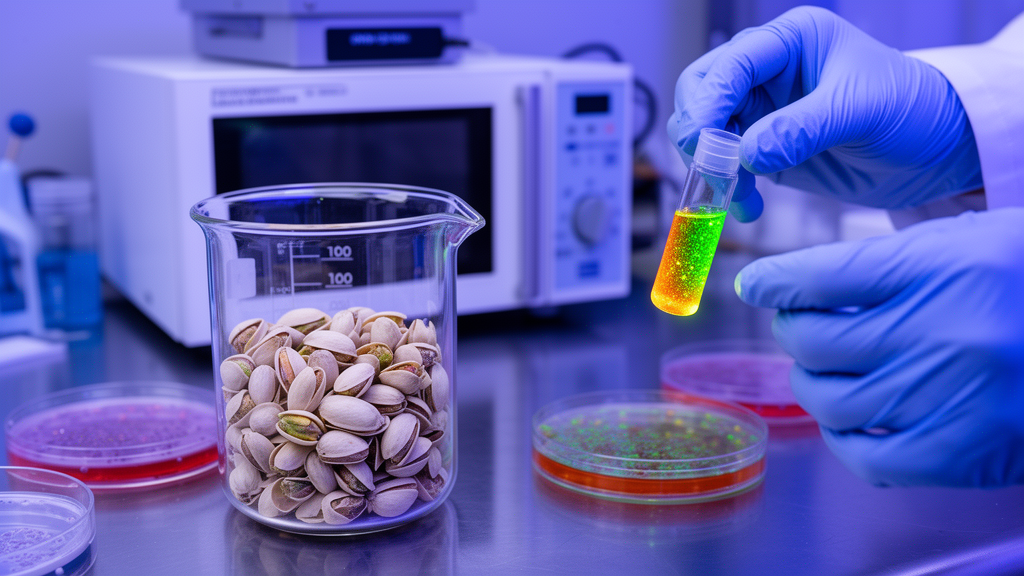
Researchers have converted pistachio shell waste into fluorescent carbon dots using a rapid microwave-assisted method that takes just five minutes, and the resulting nanomaterial displays a striking combination of laboratory-tested properties: strong radical-scavenging activity, high compatibility with normal fibroblast cells, dose-dependent toxicity toward neuroblastoma cells, and the ability to suppress the growth and biofilm formation of both Escherichia coli and Staphylococcus aureus. The work, published as a full experimental study, positions an underutilized agro-industrial residue as a renewable precursor for multifunctional carbon nanomaterials.
The synthesis itself is deliberately simple. Pistachio shells collected from local agricultural waste were washed, dried at 70 degrees Celsius for twelve hours, and ground into powder. One gram of the powder was dispersed in fifty milliliters of deionized water, stirred for thirty minutes, and then subjected to microwave irradiation at 300 watts and 90 degrees Celsius for only five minutes. After filtration, centrifugation, passage through a 0.22 micrometer membrane, dialysis, and freeze-drying, the purified carbon dots were recovered with a mass yield of 85.0 plus or minus 0.8 percent relative to the starting biomass. Three independently prepared batches showed comparable recovery and photoluminescence, providing preliminary evidence of reproducibility, although the authors note this figure reflects purified product recovery rather than an absolute carbon-conversion yield because volatile losses and removed water-soluble components were not separately quantified.
The green credentials of the process were assessed with the Eco-Scale approach, which scored the synthesis at 86.5, corresponding to an excellent green process at laboratory scale. The favorable score stems from the renewable waste-derived precursor, the aqueous reaction medium, the absence of additional chemical reagents, and the short reaction time, with a nominal microwave energy input of 90 kilojoules per batch. The authors are careful to caution that laboratory success does not guarantee industrial scalability: enlarging the batch could alter microwave penetration, temperature uniformity, heat and mass transfer, and reactor geometry, while the dialysis and freeze-drying purification steps would also demand attention during scale-up.
Characterization revealed the structural identity of the material. High-resolution transmission electron microscopy showed quasi-spherical dots averaging roughly five nanometers in diameter, with lattice fringes spaced at about 0.21 nanometers corresponding to the (100) plane of graphitic carbon. Nitrogen adsorption measurements yielded a specific surface area of approximately 27 square meters per gram and a total pore volume of about 0.08 cubic centimeters per gram, with pores predominantly in the mesoporous range of two to fifty nanometers. Fourier transform infrared spectroscopy and X-ray photoelectron spectroscopy confirmed an oxygen-rich surface, with an elemental composition of 62.44 percent carbon and 37.56 percent oxygen and clear signatures of hydroxyl, carbonyl, and carboxyl functionalities that explain the dots’ hydrophilicity and aqueous dispersibility.
Raman spectroscopy added a picture of a structurally hybrid material. The spectrum displayed the characteristic D band at 1313 inverse centimeters, associated with disordered sp2 carbon at defects and edges, and the G band at 1597 inverse centimeters, arising from ordered graphitic domains. The intensity ratio of the two bands was 1.0025, indicating a defect-rich framework in which graphitic and amorphous regions coexist. X-ray diffraction showed a broad peak near 24 degrees assigned to the (002) plane of graphitic carbon, with an interlayer spacing of roughly 0.37 nanometers, larger than that of crystalline graphite, consistent with turbostratic layers and structural disorder introduced by the oxygen-containing functionalities.
Optically, the carbon dots emit blue fluorescence with a maximum near 450 nanometers under 380 nanometer excitation, and the emission shifts progressively to longer wavelengths as the excitation wavelength increases, a hallmark of a distribution of emissive states rather than a single radiative transition. The fluorescence quantum yield was approximately 17.2 percent, and time-correlated single-photon counting gave an average fluorescence lifetime of about 3.6 nanoseconds. The dots retained roughly 93 percent of their initial fluorescence after 360 minutes at pH 7.4 and about 89 percent in serum-containing medium at 37 degrees Celsius, indicating stability under physiologically relevant conditions. Fluorescence varied across a pH range of two to twelve, supporting the involvement of ionizable surface groups in the emission process, although the authors acknowledge that contributions from the conjugated carbon core cannot be fully excluded.
The biological testing produced a nuanced profile. In radical-scavenging assays, the dots achieved half-maximal inhibitory concentrations of 38.40 plus or minus 0.30 micrograms per milliliter against DPPH radicals and 35.10 plus or minus 0.90 micrograms per milliliter against ABTS radicals. At a fixed concentration of 100 micrograms per milliliter, they scavenged 92.2 plus or minus 1.7 percent of DPPH and 94.3 plus or minus 1.2 percent of ABTS radicals, close to but below the performance of ascorbic acid and butylated hydroxytoluene on an inhibitory-concentration basis, which the authors describe as moderate-to-effective rather than superior to the reference antioxidants. The activity is plausibly attributed to the cooperative contribution of oxygenated surface groups and the partially graphitized framework, since pistachio biomass is known to contain phenolic compounds and the spectroscopic data cannot separate the individual contributions.
In cell experiments, the dots proved remarkably benign toward normal cells yet toxic toward cancer cells. When L929 mouse fibroblasts were exposed to concentrations up to 100 micrograms per milliliter for 24 hours, viability remained at approximately 97 percent, and the cells retained their characteristic spindle-like morphology. By contrast, neuroblastoma Neuro-2a cells showed a concentration-dependent decline in viability, falling from about 97 percent at 5 micrograms per milliliter to roughly 79, 65, and 59 percent at 10, 20, and 30 micrograms per milliliter respectively, with the highest concentration significantly different from the untreated control. A comparison with pyrrolidine dithiocarbamate, a known cytotoxic compound that reduced viability to about 54 percent, confirmed substantial antiproliferative activity for the dots, although the two treatments differed statistically.
Mitochondrial and oxidative-stress measurements added mechanistic context while respecting the limits of the data. Pretreatment with the dots at 20 and 30 micrograms per milliliter attenuated hydrogen-peroxide-induced intracellular reactive oxygen species in Neuro-2a cells, reducing fluorescence from 5.7-fold above control to 3.9-fold and 1.9-fold respectively, results confirmed by fluorescence microscopy. Mitochondrial membrane potential, measured with rhodamine 123, was largely preserved at 20 micrograms per milliliter, with 94.53 percent relative fluorescence, but dropped to 83.48 percent at 30 micrograms per milliliter, comparable to the depolarization seen with the reference compound. The authors emphasize that these experiments demonstrate protection under an exogenous oxidative challenge and an association between the dots and mitochondrial perturbation at higher concentrations, but they do not establish whether mitochondrial changes are a primary event or a downstream consequence, nor do they identify the precise mechanism of neuroblastoma cell death.
Antimicrobial testing rounded out the profile. Growth of E. coli was significantly suppressed at all tested concentrations down to 0.05 milligrams per milliliter, and viable counts showed complete inhibition at concentrations of 0.1 milligrams per milliliter and above. Staphylococcus aureus proved more resistant, requiring 0.4 milligrams per milliliter for complete inhibition of colony formation, a difference the authors attribute plausibly to the thicker peptidoglycan layer of Gram-positive bacteria, while noting that direct measurements of membrane damage and bacterial reactive oxygen species were not performed. Biofilm formation was inhibited at 0.2 milligrams per milliliter for E. coli and 0.4 milligrams per milliliter for S. aureus, with the higher biofilm-inhibitory concentrations relative to growth inhibition consistent with the known tolerance of biofilm populations. Because the dots are metal-free, they avoid concerns associated with metal-ion release, and the authors propose that oxidative stress and cell-envelope interactions may underlie the antibacterial effect, framing these as proposed interpretations pending direct visualization studies. Overall, the study demonstrates the potential of pistachio shell waste as a sustainable precursor for multifunctional carbon nanomaterials and calls for further mechanistic work, including apoptosis markers and future in vivo investigations, to establish biological efficacy and safety.
Subject of Research: Microwave-assisted synthesis of pistachio shell-derived carbon dots with antioxidant, anticancer-related, and antibacterial properties
Article Title: Microwave-assisted green synthesis of pistachio shell-derived carbon dots for antioxidant, anticancer, and antibacterial applications
Article References: Nair, R. V., Ramya, E. M., Khamari, B., Parvathy, J., & Pillai, S. (2026). Microwave-assisted green synthesis of pistachio shell-derived carbon dots for antioxidant, anticancer, and antibacterial applications. Results in Chemistry, 31, Article 104001. https://doi.org/10.1016/j.rechem.2026.104001
Image Credits: AI Generated
DOI: 10.1016/j.rechem.2026.104001
Keywords: carbon dots, pistachio shell, microwave synthesis, biomass valorization, antioxidant, neuroblastoma, antibacterial, biofilm, green chemistry, nanomaterials, fluorescence, reactive oxygen species
Cite Scienmag News
Bethany Barker. (October 25, 2026). Pistachio shells turned into glowing carbon dots with antioxidant and antibacterial power in five minutes. Scienmag. https://scienmag.com/pistachio-shells-turned-into-glowing-carbon-dots-with-antioxidant-and-antibacterial-power-in-five-minutes/
Bethany Barker. "Pistachio shells turned into glowing carbon dots with antioxidant and antibacterial power in five minutes." Scienmag, 25 October 2026, https://scienmag.com/pistachio-shells-turned-into-glowing-carbon-dots-with-antioxidant-and-antibacterial-power-in-five-minutes/. Accessed 25 October 2026.
Bethany Barker. "Pistachio shells turned into glowing carbon dots with antioxidant and antibacterial power in five minutes." Scienmag. October 25, 2026. https://scienmag.com/pistachio-shells-turned-into-glowing-carbon-dots-with-antioxidant-and-antibacterial-power-in-five-minutes/


