


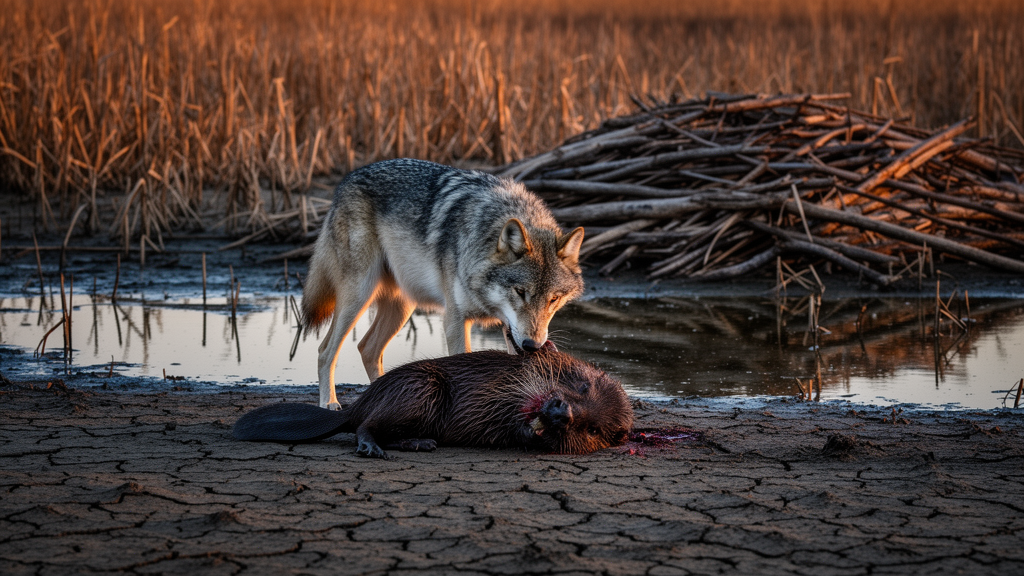
Camera traps in Białowieża Forest, Poland, have recorded a wolf killing an adult Eurasian beaver (Castor fiber) on land, and the footage captures something rarer still: the apparent end of an entire beaver colony. The attack took place at 21:20 on 29 December 2024, a few metres from the water’s edge on the colony’s primary foraging trail. Before that evening, the beavers had kept using the same trail even though wolves had repeatedly visited it in the preceding weeks. After the kill, no beaver activity was detected on any camera for the rest of the monitoring period, which ran until 20 March 2025, and follow-up terrestrial surveys in July, August and December 2025 and July 2026 found no fresh cut stems, trails or other feeding signs within 200 m of the dam. The pond remained abandoned as of summer 2026, at least 18 months after the predation event.
The video sequence documents the attack in unusual detail. Earlier that day, beaver activity on the trail had totalled 46 detections, each detection being a distinct five-minute interval in which beavers appeared. When the wolf struck, the camera was triggered as the beaver fled down the trail toward the river. The wolf intercepted it by approaching perpendicular to the trail, grabbed it by the neck and dragged it away from the water. The beaver briefly escaped twice, but the wolf recaptured it, first by biting its side and then its leg, before pulling it out of the camera’s frame; the moment of killing occurred outside the camera’s view. Later that night, a wolf walked past the camera at 21:37, and at 22:19 a wolf carried the beaver carcass past with its tail clearly visible. At 23:26, on a separate camera positioned further from the water, a wolf was recorded carrying what appeared to be the beaver pelt in its mouth.
The behaviour preceding the kill is what makes the observation scientifically striking. Over the 53 days before the predation event, wolves visited the foraging trail on 4 days, rising to 5 once the camera at the lodge was included, and one visit on 10 December 2024 involved a group of four wolves. Despite this, beavers were active on the trail on 33 of those 53 days, or 62% of the time, averaging 4.9 detections per day overall and 7.9 detections on days with activity. Camera traps captured two beavers simultaneously on several occasions, and at least once a beaver was recorded fleeing toward the water with no wolf visible in the same video. Lynx (Lynx lynx), which also occur in the forest, were recorded on the trail in two detections before and two after the predation event.
The setting helps explain why the beavers had so little room to manoeuvre. The study pond, roughly 50 to 100 square metres, was created by a dam about 30 m upstream of a forest road bridge and embankment, within a 160 m wide, low-gradient floodplain of old-growth black alder (Alnus glutinosa) bog forest. Between the pond’s edge and the wooded foraging area beyond lay a largely treeless strip up to 30 m wide, forcing beavers to cross exposed ground to reach food. Their foraging was concentrated on a single 50-m trail opposite the lodge, cutting through a hazel (Corylus avellana) understory, with few other cut stems within 100 to 200 m of the dam. Upstream, water levels dropped below 20 cm about 150 m from the dam, and the river was largely dry for the next 4 km to the nearest beaver territory; downstream, water was similarly shallow, around 10 cm, for roughly 200 m before a separate colony’s cascade of at least six dams. This hydrological isolation severely limited the colony’s options for relocating.
Drought conditions compounded that isolation. Monthly precipitation at Hajnówka, the nearest national meteorological station about 8 km from the site, was below the 1991–2020 normal in nine of the 12 months of 2024, with October to December particularly deficient; annual precipitation totalled 566 mm against a long-term normal of 623 mm. Hydrological drought is a recurrent and worsening feature of Białowieża Forest, and the focal river, the Łutownia, is particularly vulnerable to low flows, with reaches periodically running dry in summer. Beavers recolonised the Polish side of the forest in the 1980s following their extirpation and legal protection in 1919, and expanded into smaller and more marginal watercourses, but worsening drought has recently led them to abandon many of these marginal sites.
The monitoring itself relied on motion-triggered cameras deployed from 6 November 2024. Three cameras were installed initially: one at the lodge and two on the foraging trail facing the water, at approximately 10 and 25 m from the water’s edge. These were replaced on 10 December 2024 with different camera models at the same positions, and from 6 February 2025 the lodge camera was removed and two additional cameras were placed at roughly 45 and 55 m from the water’s edge, providing continuous coverage of the trail’s full length. Cameras were checked every 2 to 8 weeks and all were removed on 20 March 2025 after about three months without beaver detections. Videos were classified in a web-based camera-trap data platform, with beaver activity quantified as the number of distinct five-minute intervals per day in which beavers were detected.
The hunting behaviour matched the two previously published video recordings of wolves hunting beavers. As in those recordings, the wolf repeatedly attacked and bit the beaver from behind, dragging it away from water and seemingly taking care to protect itself from being bitten by intermittently releasing its prey. The researchers agree with the earlier interpretation that dragging the beaver away from the water suggests wolves recognise that beavers are more vulnerable on land. A novel aspect of this observation is the wolf preventing the beaver from reaching the water by grasping its foot, a behaviour the authors report has not been previously documented. The wolf’s perpendicular approach to the trail suggests it was moving along the river shoreline and encountered the beaver opportunistically, consistent with a cursorial rather than a sit-and-wait ambush strategy. On two occasions more than one wolf was recorded together in a clip, suggesting beaver hunting here was not the behaviour of a single specialised individual. Wolves also kept visiting the trail for months afterwards, well beyond any plausible window for residual carcass scent, although camera-trap footage cannot distinguish individuals, so whether this reflects continued hunting effort at a known site or routine patrolling cannot be resolved with the available data.
The beavers’ apparent tolerance of risk contrasts with experimental studies showing that beavers avoid foraging trails and food carrying experimentally added predator cues. Predator–prey theory offers one possible explanation. The risk allocation hypothesis predicts that when high-risk periods are frequent or prolonged, prey have little choice but to continue foraging despite elevated risk, because the energetic cost of sustained antipredator behaviour becomes incompatible with survival. In this case, habitat quality was clearly suboptimal: optimal water depths for beavers are typically 0.6 to 1.0 m, yet upstream of the dam only a 150 m stretch of river reached that depth. Beavers typically forage across multiple trails, which reduces their spatial predictability to predators, but here foraging was concentrated on a single long trail, likely a consequence of the severely constrained habitat. Foraging further from water increases predation risk, and low water levels shrank the aquatic refuge available near the trail. With no safer alternative, the colony had little choice but to keep using the trail despite repeated wolf presence, precisely the condition under which the risk allocation hypothesis predicts a moderated rather than avoidant response.
Broader dietary data lend context to this interpretation. A study in Belarus documented that in dry years beavers as a proportion of biomass in the wolf diet rose sharply, to almost 50%, compared with below 20% in wetter years. Similarly, wolves in northeast Poland consumed far more beavers during drier years, with beaver biomass in the wolf diet rising from 11% in the wettest year to 41% in the driest. These patterns are consistent with the idea that drought increases beaver vulnerability by reducing aquatic refuge and forcing longer-distance terrestrial foraging. However, the authors caution that drought could also increase beaver mortality through some other mechanism, such as reduced body condition, with wolves simply scavenging or opportunistically killing beavers that are already more vulnerable for reasons unrelated to their behaviour on land.
The aftermath of the kill may carry the widest ecological implications. The observation of the pond remaining vacant for at least 18 months goes beyond an earlier report of a 96% decline in beaver activity on a foraging trail following a predation event. The fate of the second adult beaver remains unknown; it may have been predated, died of other causes or relocated, and whether any kits or yearlings were present could not be determined from the available footage. While previous work found ponds became inactive once wolves killed the dispersing beaver that had colonised them, this observation suggests wolf predation can also eliminate small established colonies. If wolf-induced pond abandonment occurs with any regularity and persists beyond short time frames, it could generate localised cascading effects in landscapes where wolves and beavers coexist, potentially altering local water retention, nutrient cycling, vegetation structure and forest succession. In areas such as Białowieża Forest, where rivers were historically regulated by people, wolf predation may also reduce beavers’ capacity to renaturalise waterways. The dam itself remained intact throughout the abandonment but had little effect on water levels given the ongoing drought.
The authors propose that wolf predation could act as a spatial filter, disproportionately removing beavers from marginal habitats where behavioural responses to risk are constrained, a hypothesis they argue should be tested in future studies. If it holds, the consequences could compound under climate change: more frequent droughts would restrict beaver behavioural responses to predation risk, leaving more sites vulnerable to wolf-driven abandonment, and fewer active beaver sites would mean less landscape-scale water retention, which in turn would deepen drought and further constrain the beaver habitat that remains. Two testable questions follow. First, how do beaver behavioural responses to predation risk vary with habitat quality, particularly water availability and the degree of intraspecific competition? Second, under what conditions does wolf predation trigger pond abandonment, and how long does that abandonment tend to persist? Answering these questions, the researchers argue, will help guide conservation and management, including conflict mitigation, as wolves and beavers continue to recolonise their former ranges across Europe and North America.
Subject of Research: Wolf predation on a Eurasian beaver colony in a drought-stressed pond in Białowieża Forest, Poland
Article Title: Wolf Predation Likely Eliminated a Beaver Colony in a Drought‐Stressed Pond
Article References: Diserens, T. A., Brzeziński, M., Churski, M., Kuijper, D. P. J., & Zalewski, A. (2026). Wolf Predation Likely Eliminated a Beaver Colony in a Drought‐Stressed Pond. Ecology and Evolution, 16(10), Article e74472. https://doi.org/10.1002/ece3.74472
Image Credits: AI Generated
DOI: 10.1002/ece3.74472
Keywords: wolf, Eurasian beaver, predation, Białowieża Forest, drought, camera traps, risk allocation, landscape of fear, ecosystem engineers, trophic cascades, pond abandonment, Poland
Cite Scienmag News
Margaret Porter. (October 25, 2026). Camera Traps Capture a Wolf Killing a Beaver and Emptying Its Drought-Hit Pond. Scienmag. https://scienmag.com/camera-traps-capture-a-wolf-killing-a-beaver-and-emptying-its-drought-hit-pond/
Margaret Porter. "Camera Traps Capture a Wolf Killing a Beaver and Emptying Its Drought-Hit Pond." Scienmag, 25 October 2026, https://scienmag.com/camera-traps-capture-a-wolf-killing-a-beaver-and-emptying-its-drought-hit-pond/. Accessed 25 October 2026.
Margaret Porter. "Camera Traps Capture a Wolf Killing a Beaver and Emptying Its Drought-Hit Pond." Scienmag. October 25, 2026. https://scienmag.com/camera-traps-capture-a-wolf-killing-a-beaver-and-emptying-its-drought-hit-pond/


