


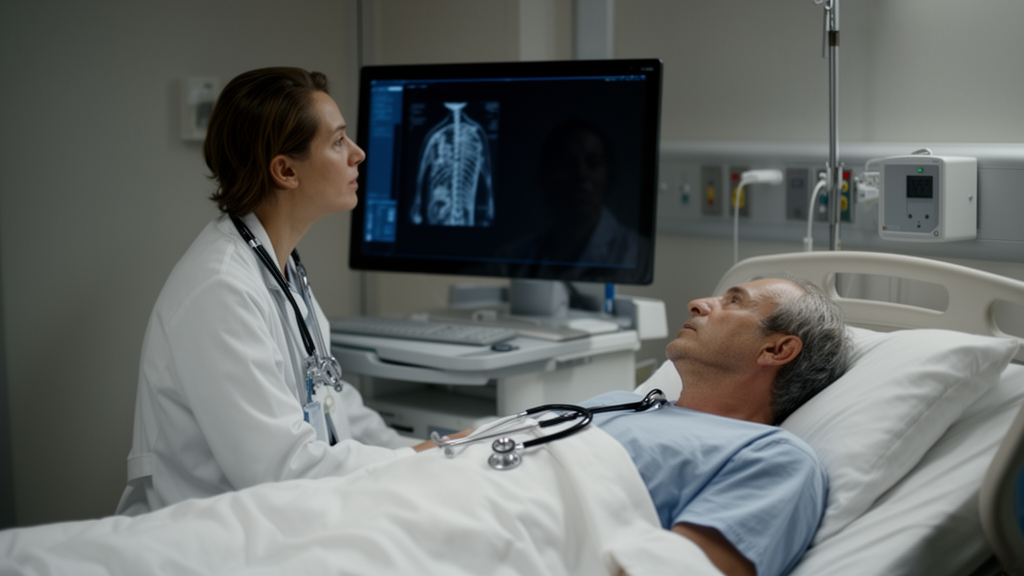
Medical artificial intelligence could become a powerful clinical partner, but only if it helps doctors listen to, examine and understand their patients rather than allowing software output to become the beginning and end of every decision. That is the central argument of an opinion article in Frontiers in Medicine, which invokes William Osler’s emphasis on direct observation, bedside learning and the physician-patient relationship as a counterweight to increasingly algorithm-driven care. The authors, Michel Goldman, Elie Cogan and Serge Goldman, do not oppose AI or seek to halt its development.
Instead, they argue that clinical training must be reorganized around a practical test: does each tool bring the physician closer to the patient, or does it interpose another screen between them? The case for AI is straightforward, the authors say. Systems built on algorithms can synthesize literature at scales no individual clinician can match, identify patterns in medical images and pathology that trained eyes may miss, draft clinical notes, triage risk, generate differential diagnoses and suggest therapeutic options within seconds.
These functions are already entering clinical workflows, including hematologic malignancies, where AI-based tools are being adopted to guide diagnosis, prognosis and treatment decisions. The authors contend that clinicians who dismiss such systems outright are being unrealistic. Their argument is not that every algorithmic output should guide every case, but that these tools can perform tasks that are difficult, slow or burdensome for people while leaving the deeper work of clinical judgment and human interaction intact.
Even a model with exceptional predictive performance cannot conduct a bedside examination, assess how an anxious patient behaves, notice something left unsaid or build the trust that may support adherence. Diagnosis by pattern matching on data is not equivalent to sitting with a patient and testing competing explanations against what can be seen, heard and elicited. The distinction matters because a model’s output depends on the information available to it, whereas a clinician can notice that information is absent, contradictory or clinically important.
Patients also enter consultations differently now than they did in Osler’s era. Internet access, social media and health-related AI tools have increased access to medical information, but they can also expose patients to misinformation and misinterpretation. Both sides of the encounter may consequently arrive shaped by algorithmic information, increasing rather than reducing the need for independent judgment and careful communication.
There is also a technical limitation to any system that reasons exclusively from digitized information. An algorithm works with the reality captured in a record, but an absent entry does not necessarily indicate the absence of a clinically meaningful fact. A hurried interview or incomplete examination can leave the dataset incomplete, allowing a model to return a precise-looking output built on missing observations.
Such outputs may create an illusion of certainty even when the underlying record is deficient. Direct observation is therefore not a sentimental addition to AI-assisted care; it is a technical prerequisite for judging whether the available data can support the system’s conclusion. Far from making listening, examination and clinical reasoning obsolete, AI increases the need to identify what matters, verify what is missing and recognize when a technically polished output is not reliable.
The erosion of bedside medicine did not begin with the current AI wave. Specialization and subspecialization have delivered major advances in diagnosis and treatment, yet they have also divided the patient into organ systems and technologies, making a holistic view harder to maintain. Administrative work has added another pressure: a time-and-motion study cited by the authors found that physicians spend nearly two hours on electronic health records and desk work for every hour of direct clinical face time with patients.
The article also cites an association between administrative burden, lower intrinsic motivation among physicians and poorer patient-reported care experiences. Studies among internal medicine trainees have documented declining direct patient time for more than a decade, and the authors say the trend continues in several disciplines. These developments create conditions in which algorithmic output can become the first input rather than the last consideration.
In practices organized around computer screens, physicians may review algorithmic results, multiomic profiles and risk calculators before examining the patient. The consultation can then become confirmation of a decision reached elsewhere rather than the encounter from which the decision should emerge. Market incentives can intensify that pattern.
Institutions may reward efficiency and early decisions, clinicians may gravitate toward workflows that are faster and less cognitively taxing, and AI tools are easiest to deploy on data that are already structured and available before a visit. Left to those pressures alone, the authors argue, AI is unlikely to restore the clinical encounter and could further hollow it out. Automation bias presents a related danger: clinicians may accept a computer-generated recommendation without the independent scrutiny they would apply to other evidence.
Blind rejection would likewise be a failure of judgment. Some systems already point in the opposite direction. In a recent randomized trial, ambient AI scribes that transcribed consultations and drafted clinical notes were associated with reduced physician burnout, while doctors reported that the technology allowed them to engage better with their patients.
The article presents this as an observed association within a trial rather than proof that every documentation system will have the same effect. Even so, the findings illustrate how AI may redirect attention from the screen to the patient if the time it creates is deliberately protected for the clinical encounter. The authors place this possibility within Osler’s three-part framework: listen to the patient, learn at the bedside and maintain calm, steady judgment under uncertainty, which Osler called “imperturbability.” Applied to AI, that discipline requires neither uncritical adoption nor reflexive dismissal but rigorous comparison with the physician’s own findings and other clinical evidence.
The proposed remedy is structural rather than rhetorical. Training programs could require trainees to form and record an independent clinical impression before viewing AI output, then compare that impression with the algorithmic information. Case studies could demonstrate how an omission in the history or examination changes an output, while communication exercises could address how to discuss AI-derived information with patients, including those who arrive informed or misinformed.
These activities would need to be embedded in formal assessment rather than treated as optional extras. The authors also propose that academic medical centers treat the clinical encounter as a parameter to be measured. Time at the bedside is necessary but insufficient because a longer consultation does not automatically produce better care.
Proposed mixed metrics include the time physicians actually spend with patients, the diagnostic accuracy of a physician working with AI compared with either working alone, and patients’ perceptions of empathy and trust assessed with validated instruments such as the Consultation and Relational Empathy measure. This is a call for deliberate implementation, not a rejection of technological progress. They also acknowledge that bedside time is only one component of a meaningful encounter.
Efficiency gains are valuable when they preserve or strengthen judgment, empathy and trust, but not when they merely move decisions away from the patient. Their approach asks educators to teach clinicians how to integrate electronic records, expanding diagnostic data, patient-supplied information and AI without allowing any of these inputs to displace direct observation and reasoning. Osler never encountered machine learning, but the authors argue that the challenge he left behind is immediate.
Algorithms can calculate from records, while medicine still depends on what trained humans notice, verify and understand at the patient’s side. AI may make certain cognitive tasks faster and may sometimes free clinicians to engage more attentively, as the randomized trial of ambient scribes suggests. Its broader effect on medicine will also depend on implementation, incentives, training and the willingness of physicians to preserve independent judgment.
On present evidence, the authors write, many deployments in disciplines already reorganized around screens and algorithms fail the test of bringing the physician closer to the patient. The proposed response is not to slow the technology down, but to accelerate the return of Oslerian observation, listening and equanimity to the training of every physician who will use it.
Subject of Research: How medical AI may affect bedside medicine and clinical training
Article Title: Medical AI: are Osler's principles lost in translation?
Article References: Goldman, M., Cogan, E., & Goldman, S. (2026). Medical AI: are Osler's principles lost in translation?. Frontiers in Medicine, 13, Article 1991244. https://doi.org/10.3389/fmed.2026.1991244
Image Credits: AI Generated
DOI: 10.3389/fmed.2026.1991244
Keywords: medical artificial intelligence, bedside medicine, clinical education, physician-patient relationship, William Osler, automation bias, ambient AI scribes, clinical reasoning, electronic health records, patient trust, Medical, Osler's
Cite Scienmag News
Ophelia Keating. (October 25, 2026). Medical AI: are Osler’s principles lost in translation? Scienmag. https://scienmag.com/medical-ai-are-oslers-principles-lost-in-translation/
Ophelia Keating. "Medical AI: are Osler’s principles lost in translation?" Scienmag, 25 October 2026, https://scienmag.com/medical-ai-are-oslers-principles-lost-in-translation/. Accessed 25 October 2026.
Ophelia Keating. "Medical AI: are Osler’s principles lost in translation?" Scienmag. October 25, 2026. https://scienmag.com/medical-ai-are-oslers-principles-lost-in-translation/


