


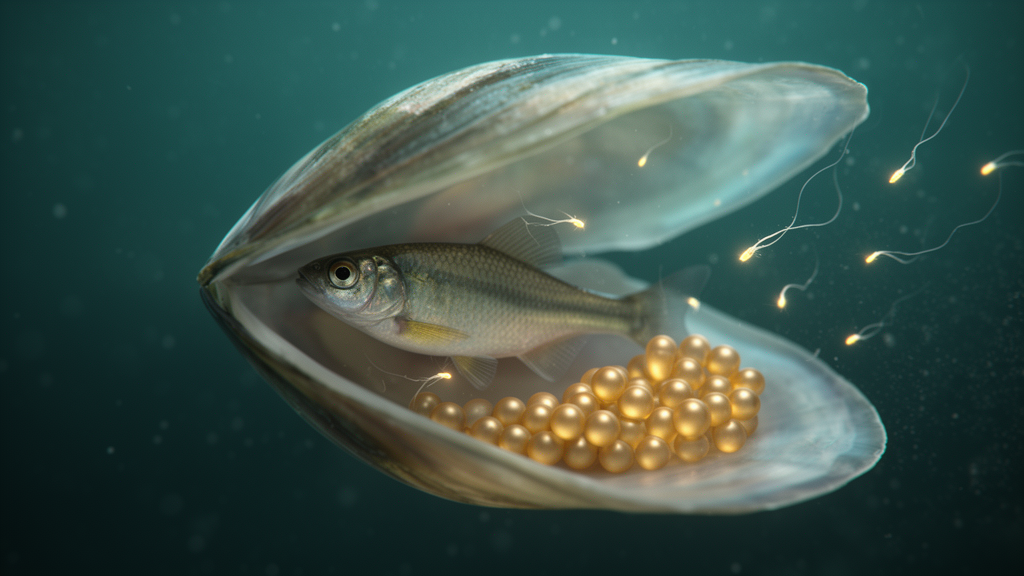
In a small freshwater fish with one of the strangest fertilisation strategies in the animal kingdom, female reproductive fluid still performs a job that, on paper, it should no longer need. The European bitterling, Rhodeus amarus, lays its eggs not in open water and not inside its own body, but in the gills of a living mussel. Males release sperm over the mussel’s inhalant siphon, and the mussel’s own breathing current carries the sperm to the eggs. Yet a new laboratory study shows that the fluid surrounding bitterling eggs actively attracts sperm, drawing significantly more cells towards it than towards plain water, and that the same fluid more than doubles how long sperm keep swimming.
The finding, published in Ecology and Evolution, comes from a team working with the European bitterling and a distantly related Chinese species, Sinorhodeus microlepis. Bitterling have been reproductive parasites of freshwater mussels for roughly 32 million years. During the spawning season, females grow a long tubular ovipositor, which they insert into the mussel’s exhalant siphon. Internal pressure then forces eggs, together with a small volume of fluid, down the length of the organ and into the water tubes of the mussel gill, where embryos develop for about a month. Males, meanwhile, ejaculate over the inhalant siphon, and the respiratory current of the mussel does the work of bringing gametes together.
That arrangement raises an evolutionary puzzle. In most external fertilisers, eggs and sperm are shed into open water, and chemical cues released with the eggs help sperm find their target in a vast, dilute environment. In internal fertilisers, female reproductive fluids guide sperm through the female tract. Female reproductive fluids, as the researchers describe them, are the media derived from the female reproductive tract, accessory glands or eggs with which sperm interacts before and during fertilisation. Across taxa, these fluids protect and nourish developing oocytes, guard against oxidative stress and pathogens, buffer eggs against hostile environments and lengthen the fertilisation window. A growing body of evidence shows they are far from passive: they influence a whole suite of sperm traits, with consequences for fertilisation success.
Because bitterling gamete encounters are mediated by the physical processes of mussel respiration, the authors reasoned that ancestral sperm-attractant properties of the fluid might be redundant and lost. If the same active compounds serve the fluid’s primary roles in supporting eggs, however, attraction could persist as a by-product. Alternatively, if females exert cryptic choice, the fluid might modulate preferential attraction towards particular sperm. To find out, the team used a recently developed multi-channel sperm selection chamber, a small rectangular device 3D printed in biologically inert resin, with three outer wells connected by channels to a central well.
The experimental logic was straightforward. The researchers loaded two outer wells with the media to be compared, allowed a chemical gradient to form in the central well for 90 seconds, and then added activated sperm solution to the third well. After 50 seconds, they collected liquid from the two media wells and counted sperm cells under a phase contrast microscope. Three types of trials were run: bitterling sperm against conspecific fluid versus water, against heterospecific fluid from S. microlepis versus water, and against the two fluids directly against each other. Because fluid from different females can affect sperm from different males differently, the team pooled ejaculates from pairs of males and treated each unique fluid–sperm pool combination as a replication unit, running 21, 17 and 12 combinations respectively across the three trial types.
The results were clear. In 19 of 21 conspecific trials, more sperm were recovered from the well containing bitterling reproductive fluid than from the water control, averaging 143.09 cells compared with 77.64, a statistically significant difference. Bitterling sperm were also attracted to the fluid of the Chinese species, with 137.11 cells recovered from the heterospecific fluid well against 105.94 from water, although the statistical effect was weaker than for conspecific fluid. When the two fluids competed head to head, however, there was no difference: sperm showed no clear preference for the fluid of their own species over that of an allopatric relative they never encounter in nature.
The team also measured sperm swimming longevity. In a solution of female reproductive fluid, bitterling sperm kept swimming progressively for an average of 243.38 seconds, more than double the 102.69 seconds recorded in a water control, a highly significant difference. The authors note that this longevity boost could in principle confound the attraction results, since longer-lived sperm might accumulate passively in the fluid well even without directional swimming. They argue the effect was negligible in the assays, however, because the longevity advantage only became apparent long after the 50-second collection point, and because sperm in the attraction trials were not activated directly in the fluid but swam towards a fluid–water gradient.
Why would attraction persist in a system where mussel breathing supposedly does the matchmaking? The authors offer several possibilities. The water flow inside a mussel may not deliver sperm along a straightforward path to the eggs. Female bitterling prefer mussels with high ventilation rates, which improves oxygen supply to embryos but could also shorten the time sperm remain in the gills. Under those circumstances, active chemical attraction might still be needed for gametes to meet within the fertilisation window. Male bitterling also commonly ejaculate over mussels before oviposition, often repeatedly, so eggs are frequently deposited into an environment already containing sperm that remains capable of fertilisation for minutes after activation, a feature unusual among cyprinids. In such a system, a chemical beacon released with the eggs could matter.
The lack of species specificity is equally telling. The bitterling radiation contains at least 60 species, many coexisting across China, Korea and Japan and sharing the same mussel hosts, while the European bitterling is the only western lineage and lives alongside no other bitterling species. In taxa where closely related species overlap, female reproductive fluids often act as post-mating barriers, favouring sperm of conspecific males and helping maintain species boundaries; in guppies, for example, the fluid favours sperm of males from the same population. The European bitterling’s indifference to heterospecific fluid fits a pattern in which discrimination scales with the risk of hybridisation. The authors point to a parallel finding in salmonids, where ovarian fluid of native North American species improved sperm performance of invasive European brown trout even more than that of conspecifics, despite hybrids being non-viable or sterile, possibly because native species have never faced a closely related heterospecific and their recognition mechanisms have not caught up.
The study leaves open what these properties are for. The authors caution that they cannot conclude from the current design whether sperm attraction and longevity enhancement are required for fertilisation, maintained as pleiotropic effects of genes governing the fluid’s primary roles in supporting maturing oocytes, or simply an evolutionary artefact. How the mussel microenvironment shapes interactions between ejaculates, eggs and fluid remains to be tested. What is clear is that even after tens of millions of years of outsourcing gamete delivery to a bivalve, the chemistry of attraction has not been switched off, and the fluid that bathes bitterling eggs may still give females a subtle way to bias fertilisation towards particular males in a system where sneaky ejaculations over rivals’ mussels are routine.
Subject of Research: Sperm attraction by female reproductive fluid in the mussel-parasitising European bitterling
Article Title: Sperm Attraction by Female Reproductive Fluid in a Fish With an Unconventional Fertilisation Strategy
Article References: Glavaschi, A., Polačik, M., & Reichard, M. (2026). Sperm Attraction by Female Reproductive Fluid in a Fish With an Unconventional Fertilisation Strategy. Ecology and Evolution, 16(10), Article e74552. https://doi.org/10.1002/ece3.74552
Image Credits: AI Generated
DOI: 10.1002/ece3.74552
Keywords: bitterling, sperm attraction, female reproductive fluid, mussel parasitism, external fertilisation, cryptic female choice, sperm competition, Rhodeus amarus, Sinorhodeus microlepis, sperm longevity, reproductive biology, fish
Cite Scienmag News
Gavin Prescott. (October 25, 2026). Sperm Still Chase Eggs in a Fish That Fertilises Inside a Living Mussel. Scienmag. https://scienmag.com/sperm-still-chase-eggs-in-a-fish-that-fertilises-inside-a-living-mussel/
Gavin Prescott. "Sperm Still Chase Eggs in a Fish That Fertilises Inside a Living Mussel." Scienmag, 25 October 2026, https://scienmag.com/sperm-still-chase-eggs-in-a-fish-that-fertilises-inside-a-living-mussel/. Accessed 25 October 2026.
Gavin Prescott. "Sperm Still Chase Eggs in a Fish That Fertilises Inside a Living Mussel." Scienmag. October 25, 2026. https://scienmag.com/sperm-still-chase-eggs-in-a-fish-that-fertilises-inside-a-living-mussel/


