


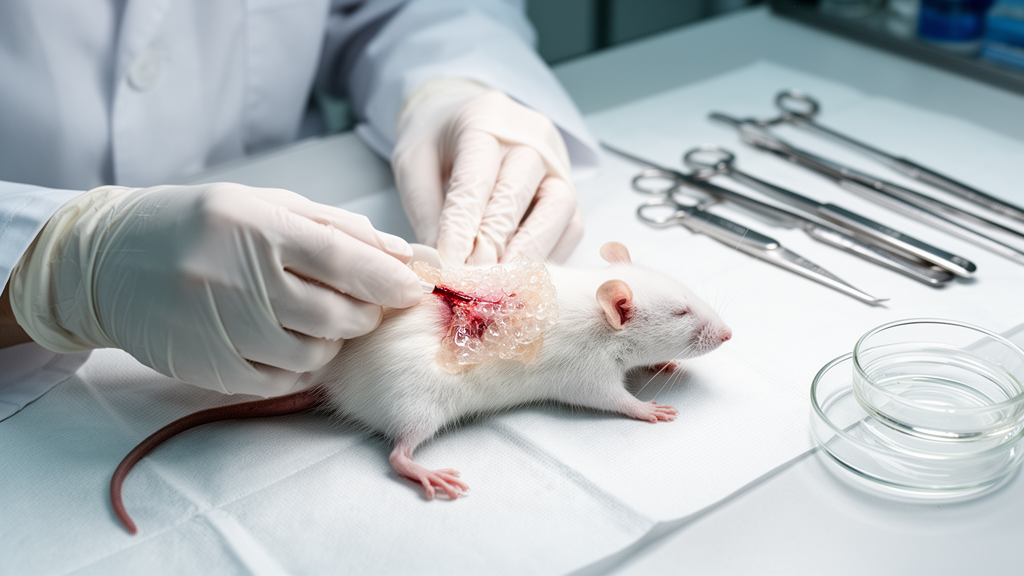
A Matrigel scaffold, delivered by intradermal injection, improved the histological repair of full-thickness excisional wounds in mice, and adding human placenta-derived mesenchymal stromal cells (hPMSCs) to the scaffold produced a modest further gain in collagen density, according to a preclinical study published in Scientific Reports. At 21 days after wounding, collagen density reached 86.1 ± 7.5% in the combined cell–scaffold group, compared with 77.8 ± 6.6% for Matrigel alone, 68.4 ± 5.1% for hPMSCs alone and 45.1 ± 4.1% for the vehicle control. The combination performed best of the conditions tested at that final time point, but the authors caution that the incremental benefit of the cells cannot be attributed specifically to their identity, because the study included no non-MSC cellular control.
The research team, led by Roya Saeedifar and colleagues, addressed a long-standing question in regenerative medicine: whether the reported benefit of mesenchymal stromal cells in cutaneous wounds comes from the cells themselves, from the delivery vehicle that carries them, or from both. Mesenchymal stromal cells — the term recommended by the International Society for Cell & Gene Therapy in preference to “mesenchymal stem cells” — have attracted attention as therapeutic agents because of their immunomodulatory and paracrine properties. Human placenta-derived MSCs are considered particularly attractive candidates because of their accessibility, proliferative capacity and low reported immunogenicity, yet the relative contribution of the cells versus the scaffold used to deliver them had not been resolved.
To disentangle these contributions, the researchers created two full-thickness excisional wounds on the dorsum of female BALB/c mice and treated them by intradermal injection with one of four preparations: hPMSCs alone, hPMSCs incorporated within a Matrigel scaffold, Matrigel alone, or a vehicle control of DMEM. Separate cohorts of animals were euthanized at 7, 14 and 21 days after wounding, with five mice — and therefore ten wounds — per group per time point. Repair was assessed by histological and histomorphometric analysis of sections stained with haematoxylin and eosin and with Masson’s trichrome. Collagen density was quantified morphometrically from the trichrome-stained sections, and re-epithelialization was graded on a five-point ordinal scale.
The morphometric results showed a clear hierarchy among the treatments at day 21, with the combination group ahead of Matrigel alone, which in turn exceeded hPMSCs alone, while the vehicle control lagged well behind. Notably, when the group means were compared descriptively across the three time points, the improvement in collagen density achieved with Matrigel alone was 80 to 93% as large as the difference between the combination group and the vehicle control. In other words, most of the measurable repair benefit in this model came from the scaffold itself rather than from the cells suspended in it. Adding hPMSCs to the scaffold did, however, deliver an incremental gain: the difference in collagen density between the combination group and Matrigel alone was 5.8 percentage points at day 7, 3.8 points at day 14 and 8.3 points at day 21. After Bonferroni adjustment for multiple comparisons, this incremental effect remained statistically significant only at day 7, underscoring that the cells’ added contribution was modest in magnitude and variable across the healing timeline. The combination group also showed the highest re-epithelialization grade and the most organized dermal architecture on qualitative histological assessment at day 21.
To probe the immunological side of the response, the team measured serum concentrations of interleukin-10, interleukin-17 and interferon-γ by ELISA at days 7, 14 and 21 as indices of the systemic inflammatory response. hPMSC administration was associated with elevated serum IL-10 and reduced interferon-γ relative to control, with little difference observed in IL-17. This pattern is consistent with the immunomodulatory profile that has made MSCs attractive for wound-healing applications, in which excessive inflammation is known to disrupt tissue regeneration and extracellular matrix remodeling. The authors are explicit about the limits of these findings. Because no local analysis of the wound bed — neither immunological nor angiogenic — was performed, the serum cytokine changes represent a systemic association rather than a demonstrated local immunomodulatory mechanism. Inflammatory cell infiltration and skin appendage regeneration were described qualitatively and were not quantified; inflammatory cells were not counted. Serial macroscopic wound-area measurements were also not performed, meaning the study speaks to the microscopic quality of the repaired tissue rather than to gross wound contraction over time. Without a non-MSC cellular control delivered in the same scaffold, the modest incremental benefit observed when hPMSCs were added to Matrigel cannot be attributed specifically to the identity or properties of placenta-derived MSCs. The authors position the work as an initial preclinical observation supporting combined cell–scaffold delivery, one that requires confirmation with an appropriate cellular control and direct assessment of the wound microenvironment before stronger claims can be made.
Subject of Research: Preclinical evaluation of Matrigel scaffold and human placenta-derived mesenchymal stromal cells in murine excisional wound healing
Article Title: Matrigel scaffold, alone or with human placenta-derived mesenchymal stromal cells, improves histological repair of murine excisional wounds
Article References: Saeedifar, R., Darehbagh, R. R., Jafarian, A., Moradveisi, B., & Parvizpour, F. (2026). Matrigel scaffold, alone or with human placenta-derived mesenchymal stromal cells, improves histological repair of murine excisional wounds. Scientific Reports. https://doi.org/10.1038/s41598-026-76889-9
Image Credits: AI Generated
DOI: 10.1038/s41598-026-76889-9
Keywords: wound healing, Matrigel scaffold, mesenchymal stromal cells, placenta-derived MSCs, collagen density, re-epithelialization, histomorphometry, cytokines, preclinical study, BALB/c mice, Matrigel, scaffold
Cite Scienmag News
Denise Maddox. (October 25, 2026). Matrigel Scaffold Improves Wound Repair in Mice, With Modest Cell Boost. Scienmag. https://scienmag.com/matrigel-scaffold-improves-wound-repair-in-mice-with-modest-cell-boost/
Denise Maddox. "Matrigel Scaffold Improves Wound Repair in Mice, With Modest Cell Boost." Scienmag, 25 October 2026, https://scienmag.com/matrigel-scaffold-improves-wound-repair-in-mice-with-modest-cell-boost/. Accessed 25 October 2026.
Denise Maddox. "Matrigel Scaffold Improves Wound Repair in Mice, With Modest Cell Boost." Scienmag. October 25, 2026. https://scienmag.com/matrigel-scaffold-improves-wound-repair-in-mice-with-modest-cell-boost/


