


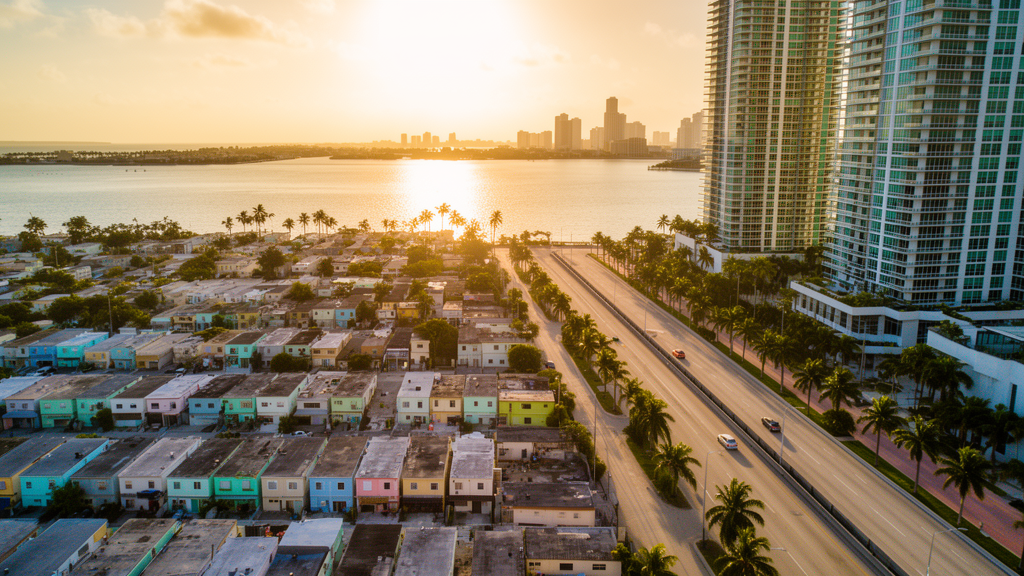
Reported COVID-19 cases in Miami-Dade County did not simply mirror where the virus spread. An ecological, cross-sectional analysis of 491,769 geocoded cases across 1,831 census block groups, covering March 2020 through May 2021, found that reported case rates traced a moving target: early hot spots clustered in lower-income neighborhoods, but by September 2020 the pattern had reversed, with elevated reported rates shifting toward more affluent areas. The researchers describe the result as a detection paradox, in which surveillance increasingly reflected who got tested rather than who got infected.
The study applied negative binomial regression with spatial eigenvector filtering, alongside Getis-Ord Gi* hot spot analysis, across five pandemic periods aligned with major policy shifts. In the earliest periods, hot spots concentrated in census block groups with median household incomes of roughly $52,022 to $55,676. By the period beginning around September 2020, hot spots had moved to areas with a median household income of $77,069. Meanwhile, historically Black neighborhoods along the I-95 corridor emerged as persistent cold spots, despite carrying multiple structural risk factors, including lower incomes, reduced insurance coverage, and limited healthcare access.
From the third period onward, predominantly Black census block groups showed significantly lower reported case rates, with incidence rate ratios of 0.991 to 0.995 (p < 0.001). Household overcrowding was tested as a predictor but was retained in none of the final models, indicating that it did not explain the observed spatial patterns once other characteristics were accounted for.
The authors argue that the apparent neighborhood protection was likely an artifact of testing access. As testing capacity expanded over the course of 2020, reported case rates came to track healthcare utilization rather than transmission itself. Barriers shaped by transportation constraints, inflexible work schedules, and historical relationships with medical institutions plausibly suppressed testing in the very neighborhoods where structural risk was highest. Cold spots in reported data therefore cannot be read as evidence of low burden.
The fine geographic scale of the analysis mattered. Patterns that were obscured at broader geographic scales became visible at the census block group level, suggesting that coarser surveillance summaries can mask systematic undercounting in low-resource minority neighborhoods. The findings challenge the assumption that reported case rates approximate true disease burden, a premise underlying much pandemic-era decision making. For emergency response planning, the study points to concrete adjustments: surveillance systems require complementary detection streams, risk-adjusted monitoring designed to flag potential underdetection, and targeted outreach concentrated where poverty and limited testing access coincide with low reported rates.
Subject of Research: Spatiotemporal patterns of reported COVID-19 cases and surveillance undercounting across Miami-Dade County neighborhoods
Article Title: The detection paradox: How COVID-19 surveillance patterns shifted from lower-income to more affluent neighborhoods in Miami-Dade County
Article References: Juhász, L., Garba, N. A., Moise, I. K., Bhoite, P. B., Clark, C., Clarke, R. D., Stuver, N. K., & Brown, D. R. (2026). The detection paradox: How COVID-19 surveillance patterns shifted from lower-income to more affluent neighborhoods in Miami-Dade County. PLOS One, 21(10), e0361211. https://doi.org/10.1371/journal.pone.0361211
Image Credits: AI Generated
DOI: 10.1371/journal.pone.0361211
Keywords: COVID-19, disease surveillance, Miami-Dade County, health disparities, hot spot analysis, testing access, census block groups, detection paradox, spatial epidemiology, healthcare utilization, detection, paradox
Cite Scienmag News
Kristina Jarvis. (October 25, 2026). COVID-19 Hot Spots Shifted From Poor to Affluent Miami Neighborhoods as Testing Expanded. Scienmag. https://scienmag.com/covid-19-hot-spots-shifted-from-poor-to-affluent-miami-neighborhoods-as-testing-expanded/
Kristina Jarvis. "COVID-19 Hot Spots Shifted From Poor to Affluent Miami Neighborhoods as Testing Expanded." Scienmag, 25 October 2026, https://scienmag.com/covid-19-hot-spots-shifted-from-poor-to-affluent-miami-neighborhoods-as-testing-expanded/. Accessed 25 October 2026.
Kristina Jarvis. "COVID-19 Hot Spots Shifted From Poor to Affluent Miami Neighborhoods as Testing Expanded." Scienmag. October 25, 2026. https://scienmag.com/covid-19-hot-spots-shifted-from-poor-to-affluent-miami-neighborhoods-as-testing-expanded/


