


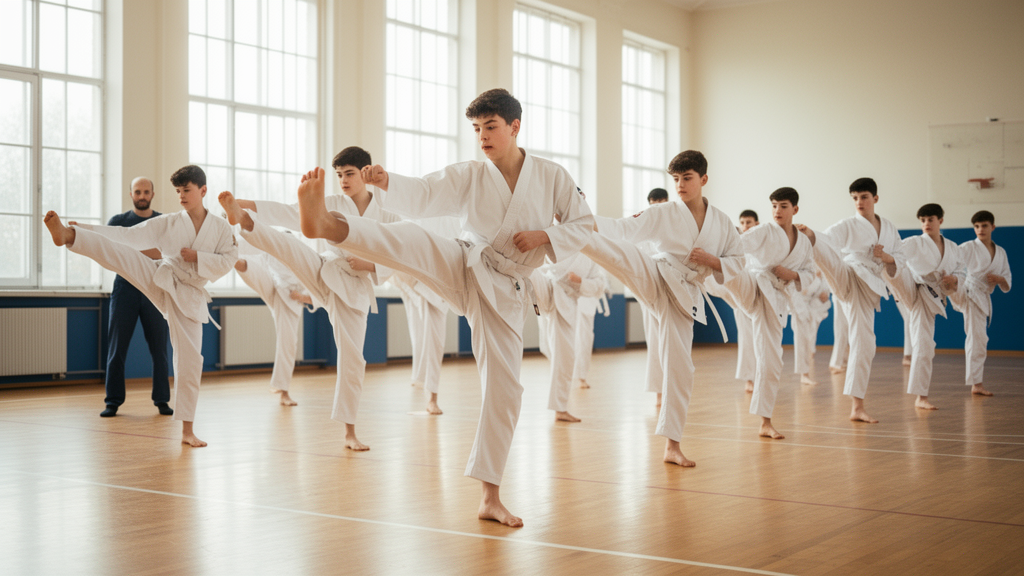
A 12-week school-based martial arts program improved physical fitness, executive function, and psychological resilience in adolescent boys more effectively than both traditional physical education and regular school activity, according to a quasi-experimental study published in Frontiers in Psychology. Researchers led by Yuanyuan Ma of Henan Finance University and Jun Liang of Nanchang Institute of Technology followed 120 male students aged 13 to 16 years recruited from three middle schools in Nanchang, China, and found that the martial arts group outperformed the comparison groups across all ten measured outcomes, with moderate-to-large effect sizes. The authors caution, however, that because each school implemented only one study condition, school-level factors may partly explain the differences, and the results should be read as associations rather than definitive evidence of a causal intervention effect.
The study addressed a pressing public health gap. A pooled analysis of 298 population-based surveys covering more than 1.6 million participants, cited by the authors, found that over 80 percent of school-going adolescents aged 11 to 17 years fail to meet the World Health Organization’s recommendation of at least 60 minutes of moderate-to-vigorous physical activity per day. Declining cardiorespiratory fitness, muscular strength, and motor competence among youth worldwide are linked not only to cardiometabolic risk but also to impaired cognitive development, reduced academic performance, and heightened psychological vulnerability. Because adolescence is a developmental window in which fitness, cognition, and resilience change rapidly and interdependently, the researchers argued that schools represent a practical setting for interventions that target all three domains simultaneously.
Martial arts were chosen because they combine features that conventional physical education often lacks. Training integrates progressive technical skill acquisition, rule-based behavioral codes, sustained attentional demands, rapid decision-making, and controlled movement sequencing, generating both physiological and neuromotor stimulation. Previous studies reviewed by the authors reported that school-based Taekwondo improved cognitive and affective self-regulation in elementary school children, that a one-year karate program across five European countries improved academic achievement, fitness, balance, and flexibility in children aged 7 to 8, and that six months of martial arts training enhanced inhibitory control, cognitive flexibility, and self-esteem in at-risk adolescents. Most earlier work, however, examined isolated outcomes or used single-group designs, motivating the present multidimensional comparison.
The quasi-experimental repeated-measures design allocated participants at the school level because individual randomization was not feasible within the participating educational settings. Forty students formed the School-Based Martial Arts Training Group, forty formed a Traditional Physical Education Group, and forty served as a usual-activity control group that continued standard school lessons. All groups were comparable at baseline in age, height, weight, and body mass index, with mean ages around 14.5 years. An a priori G*Power calculation indicated a minimum of 108 participants, though the authors note this individual-level estimate did not account for clustering associated with school-level allocation. Participants were excluded if they had a history of severe injury within six months, trained in martial arts outside school, or missed more than 15 percent of sessions. Written informed consent was obtained from participants and their parents or guardians.
The martial arts intervention ran three times per week for 60 minutes per session, structured into six phases of two weeks each. It began with a familiarization phase of basic stances, stepping patterns, and breathing control at 50 to 60 percent of maximum heart rate, progressed through neuromotor development, skill acquisition, and cognitive-motor integration phases featuring dual-task drills, response inhibition activities, and rapid decision-making tasks, and culminated in performance phases at 75 to 85 percent of maximum heart rate involving simulated routines, tactical sparring, and high-intensity coordination tasks. The traditional physical education program matched the frequency, duration, supervision, and progressive intensity of the martial arts condition but consisted of jogging, calisthenics, circuit training, agility ladders, and team sports without martial arts techniques. Certified instructors with at least five years of experience delivered both programs, and no intervention-related adverse events were reported.
Outcomes were assessed at baseline, six weeks, and twelve weeks using validated instruments. Physical fitness was measured with the Illinois Agility Test, the Y-Balance Test, the Standing Broad Jump Test, and the 20-Metre Multistage Shuttle Run Test, the last yielding an estimated peak oxygen uptake rather than a directly measured value. Executive function was evaluated with the Stroop Color and Word Test for inhibitory control, the WISC-V Digit Span subtest for working memory, and the Trail Making Test Part B for cognitive flexibility. Psychological measures included the 25-item Connor-Davidson Resilience Scale, the 36-item Adolescent Self-Regulatory Inventory, and the 10-item Perceived Stress Scale. Assessors were not blinded to group allocation, and testing sequences, environments, and equipment were standardized across assessment points.
The statistical analysis used a mixed multivariate analysis of variance with Bonferroni-adjusted post hoc comparisons. The multivariate Group by Time interaction was significant (Wilks’ Lambda = 0.214, F = 6.84, p < 0.001, partial eta squared = 0.41), and univariate interaction effects were significant for every outcome, with partial eta squared values ranging from 0.29 to 0.39. In the martial arts group, agility time fell from 19.82 to 17.58 seconds, dynamic balance rose from 84.35 to 94.71 percent of limb length, standing broad jump distance increased from 162.84 to 181.63 centimeters, and estimated VO2peak climbed from 39.62 to 45.34 milliliters per kilogram per minute, a 14.4 percent gain. Stroop interference scores dropped from 47.83 to 37.62, digit span scores rose from 8.42 to 10.84, and Trail Making Test Part B times shortened from 78.42 to 63.38 seconds, a 19.2 percent reduction.
Psychological changes were equally pronounced. Resilience scores in the martial arts group increased from 61.84 to 77.31, a 25.0 percent rise, while self-regulation scores climbed from 108.42 to 126.74, a 16.9 percent gain, and perceived stress fell from 24.82 to 16.74, a 32.6 percent reduction that far exceeded the 14.2 percent decline in the traditional physical education group and the negligible change in controls. Post hoc comparisons showed the martial arts group differed significantly from both comparison groups on all variables, while the traditional physical education group also outperformed controls on several measures, indicating that conventional physical education confers benefits of smaller magnitude. The authors suggest the martial arts advantage may stem from the structure, content, and specific cognitive and neuromuscular demands of the training rather than from total activity time, which was matched between the two intervention conditions.
The study’s limitations are substantial and were acknowledged explicitly by the authors. Because each study condition was implemented in a separate school, school and intervention condition were inherently confounded, and unmeasured contextual differences in teaching practices, facilities, or peer environments could have contributed to the observed differences. The sample included only male adolescents, so generalizability to girls is unknown, and biological maturation was not assessed. Outcome assessors were not blinded, cardiorespiratory fitness was estimated from a field test rather than measured by respiratory gas analysis, only the composite Y-Balance score was available, and there was no long-term follow-up to determine whether gains persisted beyond twelve weeks. Participants were drawn from a single region of China, further limiting generalizability.
Despite these constraints, the findings suggest that structured, cognitively engaging martial arts training may be a promising multidimensional addition to school physical education, simultaneously supporting agility, balance, power, endurance, inhibitory control, working memory, cognitive flexibility, resilience, self-regulation, and stress reduction. The authors recommend that future studies recruit multiple schools per condition, randomize at the school or class level where feasible, include both sexes, assess biological maturation, apply blinded assessment and direct fitness measurement, and incorporate longer follow-up periods to establish the reproducibility, durability, and intervention-specific nature of the observed effects.
Subject of Research: Effects of a 12-week school-based martial arts intervention on physical fitness, executive function, and psychological outcomes in adolescent boys
Article Title: Multidimensional effects of a school-based martial arts intervention on physical fitness, executive function, and psychological resilience in adolescents: a quasi-experimental study
Article References: Ma, Y., & Liang, J. (2026). Multidimensional effects of a school-based martial arts intervention on physical fitness, executive function, and psychological resilience in adolescents: a quasi-experimental study. Frontiers in Psychology, 17, Article 1891636. https://doi.org/10.3389/fpsyg.2026.1891636
Image Credits: AI Generated
DOI: 10.3389/fpsyg.2026.1891636
Keywords: martial arts, adolescents, physical fitness, executive function, psychological resilience, self-regulation, perceived stress, school-based intervention, quasi-experimental study, physical education, cardiorespiratory fitness, China
Cite Scienmag News
Cassandra Pierce. (October 25, 2026). School Martial Arts Program Boosts Fitness, Brain Skills and Resilience in Teen Boys. Scienmag. https://scienmag.com/school-martial-arts-program-boosts-fitness-brain-skills-and-resilience-in-teen-boys/
Cassandra Pierce. "School Martial Arts Program Boosts Fitness, Brain Skills and Resilience in Teen Boys." Scienmag, 25 October 2026, https://scienmag.com/school-martial-arts-program-boosts-fitness-brain-skills-and-resilience-in-teen-boys/. Accessed 25 October 2026.
Cassandra Pierce. "School Martial Arts Program Boosts Fitness, Brain Skills and Resilience in Teen Boys." Scienmag. October 25, 2026. https://scienmag.com/school-martial-arts-program-boosts-fitness-brain-skills-and-resilience-in-teen-boys/


