

Sunday, October 25, 2026
Science
No Result
View All Result
  • Login
  • HOME
  • SCIENCE NEWS
  • CONTACT US
  • HOME
  • SCIENCE NEWS
  • CONTACT US
No Result
View All Result
Scienmag
No Result
View All Result
Home Science News Technology and Engineering

Mixed antimony-aluminum orthophosphate inhibits carbon-steel corrosion in hydrochloric acid

October 25, 2026
in Technology and Engineering
Denise Maddox
By Denise Maddox Scienmag Editorial Profile - Mechanical Engineering
Reading Time: 2 mins read
0
Mixed antimony-aluminum orthophosphate inhibits carbon-steel corrosion in hydrochloric acid

Mixed antimony-aluminum orthophosphate inhibits carbon-steel corrosion in hydrochloric acid

65
SHARES
587
VIEWS
Share on FacebookShare on Twitter
ADVERTISEMENT

A laboratory study of a newly synthesized orthophosphate compound, Ba(SbV0.5AlIII0.5)(PO4)2, found a combination of dielectric, optical and corrosion-inhibiting properties. The material was prepared by solid-state reaction at 850 °C and identified as a monoclinic yavapaiite-type phase. In corrosion tests conducted in 1 M HCl, its corrosion-inhibition efficiency exceeded 70% at a concentration of 10−3 M. The results support the compound as a candidate for insulating, photonic and protective-coating applications, within the conditions investigated.

Powder X-ray diffraction followed by Rietveld refinement confirmed the proposed structure, including the C2/m space group and unit-cell parameters of a = 8.155(1) Å, b = 5.198(3) Å, c = 7.826(7) Å and β = 93.53°. The refined unit-cell volume was 331(1) Å3. Raman and infrared spectroscopy showed the predicted phosphate vibrational modes, while scanning electron microscopy coupled with energy-dispersive X-ray spectroscopy indicated consistent particle shape and elemental homogeneity. These measurements established the formation and basic characterization of the mixed antimony- and aluminum-containing orthophosphate.

Optical and electrical measurements indicated behavior compatible with a transparent dielectric material. The study estimated a direct band gap of approximately 3.8 eV and observed high resistivity with thermally activated hopping conduction. The dielectric response varied with both frequency and temperature, with Maxwell–Wagner interfacial charge polarization and defect-mediated jump conduction identified as the dominant contributions. Impedance analysis distinguished grain-boundary-controlled behavior at low frequencies from volume conduction at high frequencies. Electrical-modulus analysis identified one thermally activated relaxation mechanism with non-Debye characteristics; activation energies obtained from the peaks of the imaginary relaxation component were approximately 0.6–0.8 eV, comparable to values previously reported for defect-assisted conduction in phosphate ceramics.

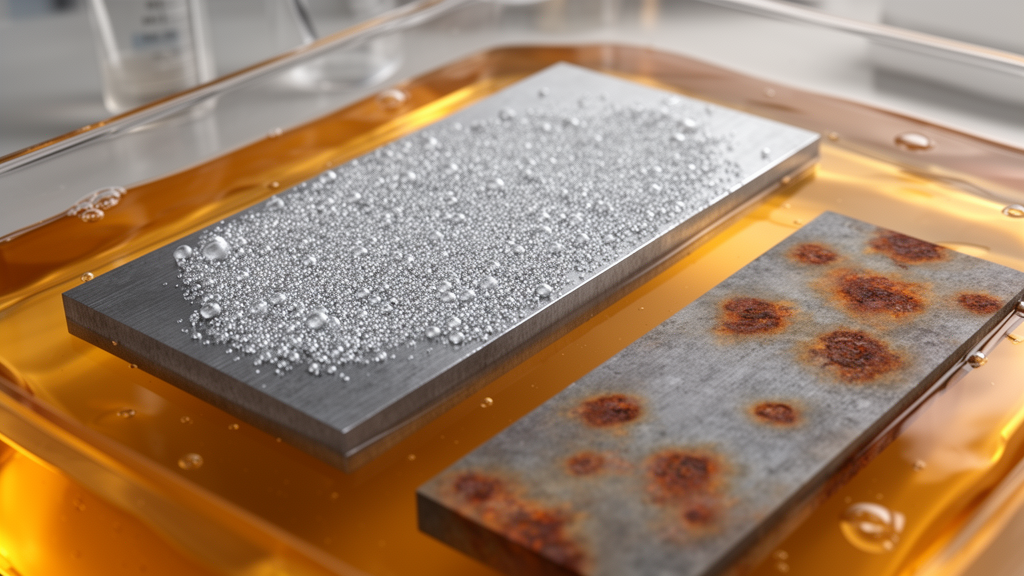
The corrosion-inhibition experiments formed the new application-focused part of the study, following earlier investigation of related compounds’ dielectric and optical properties. Electrochemical and gravimetric tests showed that Ba(SbV0.5AlIII0.5)(PO4)2 effectively inhibited carbon-steel corrosion in 1 M HCl, with efficiencies above 70% when the compound was used at 10−3 M. Adsorption investigations were interpreted as Langmuir-type behavior consistent with spontaneous physisorption. The combined structural, electrical, optical and electrochemical results led the authors to present the phase as promising for microelectronic and dielectric applications, photonic devices and protective-coating systems, although the reported corrosion evidence is specific to carbon steel and hydrochloric acid under the tested laboratory conditions.

Subject of Research: Dielectric, optical and corrosion-inhibiting properties of a yavapaiite-type mixed antimony-aluminum orthophosphate.

Article Title: Synthesis and investigation of a new orthophosphate compound BaII(SbV0.5AlIII0.5)(PO4)2: dielectric properties, optical features, and corrosion inhibition resistance

Article References: Skalli, S. K., chakir, A., Oubahou, M., Mehdaoui, B., Fakhreddine, R., Oumghar, M. O., Tigha, M. R., Naimi, Y., Aatiq, A., & Bouari, A. E. (2026). Synthesis and investigation of a new orthophosphate compound BaII(SbV0.5AlIII0.5)(PO4)2: dielectric properties, optical features, and corrosion inhibition resistance. Journal of Materials Science, 61(40), 30951-30975. https://doi.org/10.1007/s10853-026-13664-1

Image Credits: AI Generated

DOI: 10.1007/s10853-026-13664-1

Keywords: orthophosphate ceramic, yavapaiite structure, corrosion inhibition, carbon steel, hydrochloric acid, dielectric relaxation, optical band gap, impedance spectroscopy, Langmuir adsorption, solid-state synthesis, Synthesis, investigation

Cite Scienmag News

Denise Maddox. (October 25, 2026). Mixed antimony-aluminum orthophosphate inhibits carbon-steel corrosion in hydrochloric acid. Scienmag. https://scienmag.com/mixed-antimony-aluminum-orthophosphate-inhibits-carbon-steel-corrosion-in-hydrochloric-acid/


Denise Maddox. "Mixed antimony-aluminum orthophosphate inhibits carbon-steel corrosion in hydrochloric acid." Scienmag, 25 October 2026, https://scienmag.com/mixed-antimony-aluminum-orthophosphate-inhibits-carbon-steel-corrosion-in-hydrochloric-acid/. Accessed 25 October 2026.

Denise Maddox. "Mixed antimony-aluminum orthophosphate inhibits carbon-steel corrosion in hydrochloric acid." Scienmag. October 25, 2026. https://scienmag.com/mixed-antimony-aluminum-orthophosphate-inhibits-carbon-steel-corrosion-in-hydrochloric-acid/

Tags: Antimony-aluminum orthophosphatecarbon steelCarbon-steel corrosion protectioncorrosion inhibitionDielectric properties of orthophosphatesdielectric relaxationhydrochloric acidHydrochloric acid corrosion testingimpedance spectroscopyInvestigationLangmuir adsorptionoptical band gapOptical band gap and resistivity of ceramic materialsorthophosphate ceramicOrthophosphate corrosion inhibitorPhotonic and insulating coatingsRaman and infrared vibrational analysisRietveld refinement of monoclinic phaseSEM-EDX characterization of orthophosphatessolid-state synthesisSolid-state synthesis of antimony-aluminum orthophosphateSynthesisThermally activated hopping conduction in dielectric materialsyavapaiite structure
Share26Tweet16
Previous Post

Navigating a Long Road to Mental Health Care in Indonesia

Next Post

Rapid Blood Culture Growth Signals Higher Mortality Risk in ICU Bacteremia

Related Posts

AI Reads Nematode Body Shapes to Identify Devastating Crop Parasites
Technology and Engineering

AI Reads Nematode Body Shapes to Identify Devastating Crop Parasites

October 25, 2026
Two-Dimensional Flash Memory Redefines Speed, Power, and Reliability Trade-Offs
Technology and Engineering

Two-Dimensional Flash Memory Redefines Speed, Power, and Reliability Trade-Offs

October 25, 2026
Palladium on a 3D nanosheet array delivers 99.2% yield in model Heck coupling
Technology and Engineering

Palladium on a 3D nanosheet array delivers 99.2% yield in model Heck coupling

October 25, 2026
Adaptive Temperature Distillation Shrinks Multilingual AI Models for Classroom Use
Technology and Engineering

Adaptive Temperature Distillation Shrinks Multilingual AI Models for Classroom Use

October 25, 2026
One Oxide, Two Polarities: Electrochemical Gating Turns SnO Into SnO2 for Complementary Logic
Technology and Engineering

One Oxide, Two Polarities: Electrochemical Gating Turns SnO Into SnO2 for Complementary Logic

October 25, 2026
Reliability-coupled evidence fusion strengthens construction behavior recognition across shifting domains
Technology and Engineering

Reliability-coupled evidence fusion strengthens construction behavior recognition across shifting domains

October 25, 2026
Next Post
Rapid Blood Culture Growth Signals Higher Mortality Risk in ICU Bacteremia

Rapid Blood Culture Growth Signals Higher Mortality Risk in ICU Bacteremia

  • Mothers who receive childcare support from maternal grandparents show more optimized

    Mothers who receive childcare support from maternal grandparents show more parental warmth, finds NTU Singapore study

    27656 shares
    Share 11059 Tweet 6912
  • University of Seville Breaks 120-Year-Old Mystery, Revises a Key Einstein Concept

    1061 shares
    Share 424 Tweet 265
  • Bee body mass, pathogens and local climate influence heat tolerance

    682 shares
    Share 273 Tweet 171
  • Researchers record first-ever images and data of a shark experiencing a boat strike

    546 shares
    Share 218 Tweet 137
  • Groundbreaking Clinical Trial Reveals Lubiprostone Enhances Kidney Function

    531 shares
    Share 212 Tweet 133
Science

Embark on a thrilling journey of discovery with Scienmag.com—your ultimate source for cutting-edge breakthroughs. Immerse yourself in a world where curiosity knows no limits and tomorrow’s possibilities become today’s reality!

RECENT NEWS

  • Rapid Blood Culture Growth Signals Higher Mortality Risk in ICU Bacteremia
  • Mixed antimony-aluminum orthophosphate inhibits carbon-steel corrosion in hydrochloric acid
  • Navigating a Long Road to Mental Health Care in Indonesia
  • New Chalcone Compound B15 Eases Acute Lung Injury in Mice by Blocking p38 MAPK Signaling

Categories

  • Agriculture
  • Anthropology
  • Archaeology
  • Athmospheric
  • Biology
  • Biotechnology
  • Blog
  • Bussines
  • Cancer
  • Chemistry
  • Climate
  • Earth Science
  • Editorial Policy
  • Marine
  • Mathematics
  • Medicine
  • Pediatry
  • Policy
  • Psychology & Psychiatry
  • Science Education
  • Science News
  • Social Science
  • Space
  • Technology and Engineering

Subscribe to Blog via Email

Enter your email address to subscribe to this blog and receive notifications of new posts by email.

Join 5,151 other subscribers

© 2025 Scienmag - Science Magazine

Welcome Back!

Login to your account below

Forgotten Password?

Retrieve your password

Please enter your username or email address to reset your password.

Log In
No Result
View All Result
  • HOME
  • SCIENCE NEWS
  • CONTACT US

© 2025 Scienmag - Science Magazine

Discover more from Science

Subscribe now to keep reading and get access to the full archive.

Continue reading