


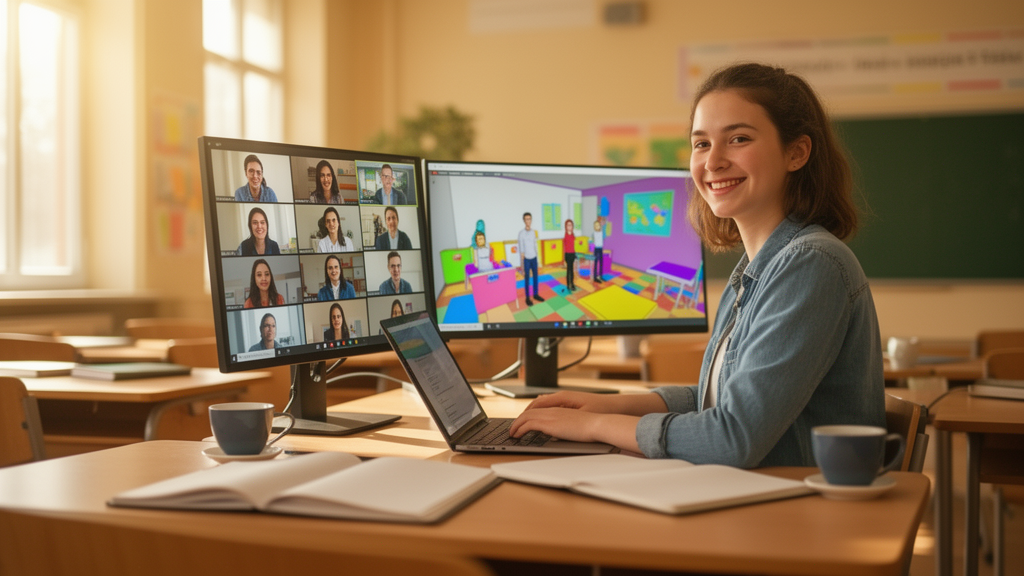
A combination of virtual exchange and simulation-based learning may offer trainee teachers a uniquely rich environment for professional growth, according to a new study of Romanian pre-service foreign-language teachers published in Frontiers in Education. Researchers at Babeș-Bolyai University in Cluj-Napoca examined how undergraduate and master’s students experienced a four-session online intervention that paired them with international peers to work through realistic educational dilemmas. The largest descriptive differences between the before and after measurements appeared in areas tied directly to internationalization and intercultural perception, rather than uniformly across every dimension of professional and personal development measured.
The intervention, run jointly with Universidad Católica de Valencia San Vicente Mártir in Spain as part of an international project operating since 2018, followed a three-stage structure familiar from simulation pedagogy: briefing, enactment, and debriefing. During the briefing stage, facilitators introduced participants to the simulation cycles, learning outcomes, assigned roles, and netiquette rules, deliberately establishing what the researchers describe as a psychologically safe space in which participants could take risks without fear of being judged. The enactment stage then immersed students in synchronous online discussions of real-life scenarios covering classroom management, intercultural communication, inclusive education, ethical decision-making, global citizenship, and the role of artificial intelligence in education. Finally, debriefing sessions encouraged reflection on performance, analysis of scenario sequences, and the sharing of personal experiences.
The study employed a repeated cross-sectional pre- and post-intervention design. Questionnaires were administered in February 2026, before the intervention, and again in May 2026, immediately after it concluded, yielding 25 pre-test and 22 post-test responses from a cohort of 30 students. Because the questionnaires were completed anonymously, individual responses could not be matched across the two measurement points, and because both samples came from the same closed cohort, they could not be treated as fully independent either. The researchers therefore restricted their quantitative analysis to descriptive comparisons of response distributions, explicitly avoiding any claim of statistically established individual-level change or causal intervention effects.
The survey instrument contained 31 five-point Likert-scale items organized into five composite dimensions: internationalization and professional orientation, intercultural competence, reflective and critical thinking, well-being and personal growth, and perceived usefulness of simulation-based learning. Internal consistency, assessed separately at each measurement point using Cronbach’s alpha, ranged from .738 to .932, though the authors caution that these coefficients represent preliminary indicators rather than evidence of full psychometric validation, given the small sample and the study-specific development of the questionnaire.
The descriptive comparisons revealed a clear pattern. The internationalization and professional orientation composite rose from a mean of 4.28 before the intervention to 4.75 afterward, the largest shift among the five dimensions, while intercultural competence increased from 4.42 to 4.72. By contrast, reflective learning moved only from 4.49 to 4.67, well-being from 4.45 to 4.62, and perceived usefulness of simulation from 4.49 to 4.67. The researchers suggest these comparatively modest differences may partly reflect a ceiling effect: participants entered the project with already strongly positive expectations about experiential learning, leaving limited room for upward movement on a five-point scale.
Item-level results reinforced the international focus of the change. Self-reported familiarity with virtual exchange climbed from a mean of 4.16 to 4.86, with a shrinking standard deviation suggesting a more confident, shared understanding of the concept. Ratings of collaborative skills in international contexts rose from 3.72 to 4.64, a difference of 0.92 points, and the proportion of respondents agreeing or strongly agreeing that they could adapt their communication style to culturally diverse audiences increased from 84 percent to 95.4 percent. Positive responses to the statement about awareness of how educational systems differ across countries reached 100 percent after the intervention, up from 84 percent before.
A comparison of anticipated and experienced challenges added further nuance. Before the project, 64 percent of participants expected pedagogical or theoretical knowledge to be difficult to handle; afterward, only 36.4 percent reported it as problematic. Understanding different educational systems dropped from 60 percent to 31.8 percent, and reaching agreement within groups fell from 44 percent to 22.7 percent. One challenge, however, persisted: synchronous online communication was flagged by 40 percent of participants before the intervention and 40.9 percent after. Rather than viewing this persistence as a weakness, the authors suggest that live intercultural exchange may itself generate the authentic professional complexity the learning environment is designed to approximate, requiring participants to process information, negotiate meaning, and coordinate decisions in real time.
Qualitative responses to four open-ended questions, totaling roughly 2,623 words, were analysed thematically and illuminated how participants experienced the intervention. Five themes emerged from the first corpus: perspective-taking through role enactment, exposure to diverse educational perspectives, reflective decision-making, professional growth and confidence, and learning beyond the comfort zone. Participants described being pushed to inhabit unfamiliar professional roles, with one noting they were ‘forced to put myself in the shoes of a character and think of ways that that character would react,’ and another reporting that the experience ‘brought me out of my comfort zone.’ The researchers interpret this emotional activation not as incompatible with well-being but as a controlled form of professional discomfort that, when processed through structured debriefing, can stimulate reflection and metacognitive development.
The qualitative data also captured the friction inherent in international collaboration. Participants cited differences in English proficiency, unfamiliar accents, unstable internet connections, absent cameras, and divergent cultural understandings of education. One participant observed that ‘the language barrier still exists, despite the fact that we all speak English,’ while another struggled to follow fast-moving arguments. Yet several respondents reported few or no difficulties, and many described the challenges as manageable. Alongside these frictions, participants repeatedly emphasized confidence gains, a sense of community, and the value of comparing teaching practices across borders, with one stating that the project offered ‘more perspectives on education, while also helping me develop both my teaching skills and my intercultural competence.’ All post-intervention respondents agreed the project had helped develop their sense of teacher identity, and 95.5 percent agreed that simulations provide a psychologically safe environment in which mistakes become learning opportunities.
The authors are careful to frame the findings as preliminary and descriptive rather than definitive. The sample was small, drawn from a single Romanian institution, exclusively female, and composed entirely of foreign-language teacher candidates, limiting transferability to mixed-gender cohorts or STEM-oriented programmes. There was no control or comparison group, so concurrent academic experiences or the novelty of a first virtual exchange could account for some of the positive post-intervention evaluations. Attrition between measurement points, an exploratory unvalidated questionnaire relying on self-report, and the absence of longitudinal follow-up further constrain interpretation. The study cannot establish whether perceived benefits persist into practicum or early-career teaching. Nevertheless, the researchers argue that virtual exchange combined with simulation-based learning may serve as a complementary pedagogical space within initial teacher education, one where trainee teachers can rehearse professional roles in low-risk settings, encounter intercultural complexity, and reflect on their emerging identities before entering full professional practice. Future research, they conclude, should examine larger and more diverse cohorts, include comparison groups where feasible, employ validated measures, and follow participants into their in-service careers to determine which components of the experience most strongly support professional learning and well-being over time.
Subject of Research: Pre-service teachers' perceptions of a virtual exchange and simulation-based learning intervention in Romanian initial teacher education
Article Title: Virtual exchange and simulation-based learning in initial teacher education: pre-service teachers’ perceptions of professional learning, reflection, and well-being
Article References: Pop, R., & Marc, A. (2026). Virtual exchange and simulation-based learning in initial teacher education: pre-service teachers’ perceptions of professional learning, reflection, and well-being. Frontiers in Education, 11, Article 1967197. https://doi.org/10.3389/feduc.2026.1967197
Image Credits: AI Generated
DOI: 10.3389/feduc.2026.1967197
Keywords: virtual exchange, simulation-based learning, initial teacher education, intercultural competence, teacher identity, well-being, reflective practice, pre-service teachers, Romania, experiential learning, Virtual, exchange
Cite Scienmag News
Blake Davidson. (October 25, 2026). Virtual Exchange Meets Simulation: Romanian Trainee Teachers Report Richer Intercultural Learning. Scienmag. https://scienmag.com/virtual-exchange-meets-simulation-romanian-trainee-teachers-report-richer-intercultural-learning/
Blake Davidson. "Virtual Exchange Meets Simulation: Romanian Trainee Teachers Report Richer Intercultural Learning." Scienmag, 25 October 2026, https://scienmag.com/virtual-exchange-meets-simulation-romanian-trainee-teachers-report-richer-intercultural-learning/. Accessed 25 October 2026.
Blake Davidson. "Virtual Exchange Meets Simulation: Romanian Trainee Teachers Report Richer Intercultural Learning." Scienmag. October 25, 2026. https://scienmag.com/virtual-exchange-meets-simulation-romanian-trainee-teachers-report-richer-intercultural-learning/


