


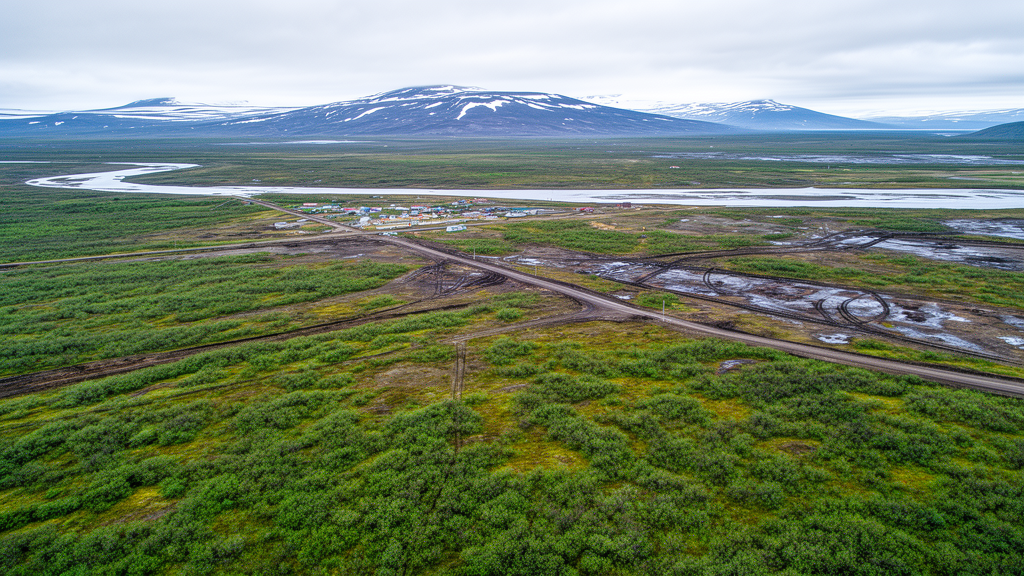
Climate warming has pushed Arctic vegetation toward widespread greening, but a new pan-Arctic analysis shows that human disturbance is quietly canceling out many of these gains. Using two decades of Landsat observations at 30-meter resolution, researchers separated climate-driven and disturbance-driven vegetation signals across 2,221 human footprint areas covering 21,402 square kilometers. Their results, published on 5 August 2026 in the Journal of Remote Sensing, reveal consistent browning around industrial zones, mines, roads, and settlements, even as the surrounding landscape greens under rising temperatures. The study was led by a team from Sun Yat-sen University with collaborators from Duke University, the University of North Carolina at Chapel Hill, and the Aerospace Information Research Institute of the Chinese Academy of Sciences.
Arctic vegetation plays an outsized role in high-latitude carbon storage, surface energy exchange, biodiversity, and ecosystem resilience. Satellite records have documented greening across much of the tundra as temperatures climb, yet some regions show stagnation or decline because of moisture stress, permafrost thaw, nutrient constraints, and other processes. Human activities add pressure through mining, hydrocarbon development, roads, settlements, and land-cover conversion. Earlier assessments, however, have often been geographically fragmented, temporally limited, or too coarse to distinguish localized disturbance from broader climatic effects, leaving the respective contributions of climate forcing and anthropogenic activity poorly quantified.
The research team addressed a persistent monitoring challenge: coarse-resolution satellite products can miss fine-scale vegetation damage within Arctic settlements, mines, and industrial corridors. The researchers analyzed Landsat 5, 7, and 8 imagery from 2000 to 2020, focusing on annual maximum growing-season NDVI, a widely used index of vegetation greenness. Human footprint areas were delineated using harmonized nighttime-light data combined with global mining inventories, an approach designed to capture low-light industrial sites that light-based mapping alone would overlook. Land-disturbance maps were then integrated with a proximity-pixel-reference framework in which each disturbed pixel was compared with stable reference pixels within 6 kilometers and with elevation differences of no more than 500 meters, helping ensure that comparisons reflected genuine disturbance rather than background environmental gradients.
To attribute the observed changes, the team applied z-score decomposition, splitting vegetation trends into climate-driven, disturbance-driven, and residual components. Sensitivity tests confirmed that the results were robust across different search radii. The attribution framework produced a more detailed assessment than broad-scale greening analyses, resolving opposing signals at a scale fine enough to capture damage within individual industrial zones.
The findings show that from 2000 to 2020, disturbed and stable landscapes within Arctic human footprint areas followed sharply different vegetation trajectories. Disturbed pixels browned at a rate of −109.7 × 10⁻⁴ NDVI units per year, while stable pixels greened at 37.8 × 10⁻⁴ units per year, with the divergence becoming clear after about 2011. At the cluster scale, each 1 percent increase in disturbance corresponded to an estimated 2.3-unit decline in the NDVI trend metric. Browning occurred in 58.7 percent of disturbed clusters, whereas 67.7 percent of stable clusters showed greening. Disturbance-related browning was strongest in industrial and mining regions and intensified toward lower latitudes.
The attribution analysis quantified how often each driver dominated. Climate contributions were positive in 76.3 percent of vegetated pixels, but disturbance contributions were negative in 68.9 percent. The most common combined pattern—climate-driven greening paired with disturbance-driven browning—covered 50.3 percent of the human footprint area, demonstrating that climate-driven gains and human-driven losses can coexist within the same region. Anthropogenic disturbance accounted for 16.1 percent of greenness variability within the footprint areas, a substantial share given the localized nature of the disturbances involved.
Case studies at Mirny, Yellowknife, and the Fort Knox gold mine confirmed the pattern, showing highly significant differences between disturbed and stable zones (P < 0.0001). Landsat trends closely matched results from the Moderate Resolution Imaging Spectroradiometer while revealing finer local patterns, illustrating how land transformation can offset regional warming-driven vegetation gains that coarse sensors would attribute entirely to climate.
The authors emphasize that Arctic vegetation change cannot be characterized by a uniform greening phenomenon. They argue that recognizing the duality of climate-driven gains and human-driven losses is essential for improving Earth system models, designing lower-impact infrastructure, and guiding restoration and land management as development expands northward. The framework could support disturbance-aware Arctic monitoring and provide an observation-based benchmark for climate and ecosystem models.
Future work could integrate high-resolution climate data, detailed disturbance inventories, synthetic-aperture radar, very-high-resolution imagery, leaf area index, and solar-induced chlorophyll fluorescence to resolve specific drivers. Beyond the Arctic, the approach may transfer to alpine environments and the Antarctic Peninsula. Better attribution, the researchers suggest, could help governments, local communities, Indigenous knowledge holders, and industry balance infrastructure development with ecosystem resilience, carbon-sink protection, and long-term land stewardship.
Subject of Research: Separating climate-driven and human-driven vegetation change in Arctic human footprint areas using satellite imagery
Article Title: Human activity erodes climate-driven Arctic greening
Article References: Human activity erodes climate-driven Arctic greening. Original publication (Bibliographic details unavailable.)
Image Credits: AI Generated
DOI: Not provided
Keywords: Arctic greening, vegetation dynamics, NDVI, Landsat, human footprint, industrial disturbance, climate attribution, permafrost, remote sensing, tundra ecosystems, mining impact, Earth system models
Cite Scienmag News
Denise Maddox. (October 24, 2026). Human Disturbance Is Eroding Climate-Driven Greening Across the Arctic. Scienmag. https://scienmag.com/human-disturbance-is-eroding-climate-driven-greening-across-the-arctic/
Denise Maddox. "Human Disturbance Is Eroding Climate-Driven Greening Across the Arctic." Scienmag, 24 October 2026, https://scienmag.com/human-disturbance-is-eroding-climate-driven-greening-across-the-arctic/. Accessed 24 October 2026.
Denise Maddox. "Human Disturbance Is Eroding Climate-Driven Greening Across the Arctic." Scienmag. October 24, 2026. https://scienmag.com/human-disturbance-is-eroding-climate-driven-greening-across-the-arctic/


