


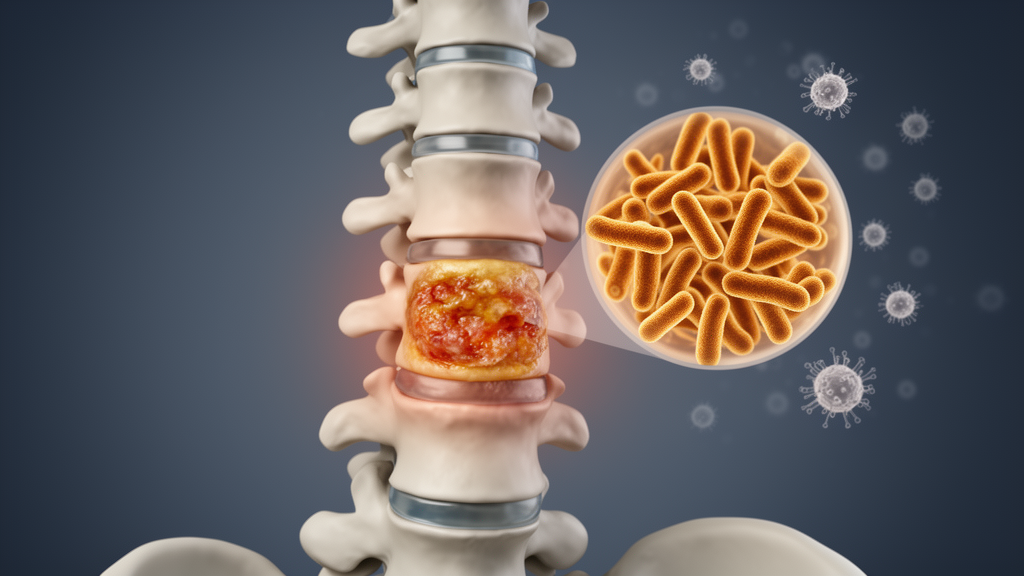
A 65-year-old man from Nepal with type 2 diabetes and recently diagnosed pulmonary tuberculosis spent five months fighting progressively worsening low back pain that radiated into his right leg. The obvious explanation, in a country where spinal tuberculosis is endemic, seemed to be tuberculous spondylodiscitis, the classic form of spinal infection known for more than a century as Pott’s disease. Yet when clinicians finally obtained a tissue sample from his infected spine, the organism that grew out was not Mycobacterium tuberculosis at all. It was Klebsiella pneumoniae, a gram-negative bacterium that accounts for only around one percent of spinal epidural abscess cases. The case, reported in accordance with the CARE guidelines, is a vivid illustration of how easily a bacterial spinal infection can hide behind the radiological signature of tuberculosis, and of why tissue-based diagnosis remains the cornerstone of managing spinal infections in tuberculosis-endemic regions.
Spinal epidural abscess and spondylodiscitis are uncommon but potentially life-threatening conditions that can inflict significant neurological damage if they are not diagnosed and treated promptly. Spondylodiscitis refers to infection involving the intervertebral disc and the adjacent vertebral bodies, and it may extend into the epidural space to form an abscess or into the paravertebral musculature to form a psoas collection. The typical presentation is subacute, with progressively worsening axial back pain, elevated inflammatory markers, and characteristic findings on magnetic resonance imaging. Diagnostic delays are frequent, and the time from symptom onset to diagnosis often spans weeks to months. The reported incidence of spinal epidural abscess has been rising over recent decades, a trend attributed largely to the increasing prevalence of predisposing conditions such as diabetes mellitus, immunosuppression, intravenous drug use and spinal instrumentation procedures, as well as to the improved sensitivity of MRI in detecting spinal infections. The condition is rare but serious, with an estimated incidence of approximately 5.1 cases per 10,000 hospital admissions.
Part of what makes early diagnosis so difficult is that the clinical picture is frequently non-specific. The classic triad of fever, back pain and neurological deficit is present in fewer than half of all cases, meaning that many patients lack the very features that would immediately raise suspicion of a spinal abscess. In the Nepali patient, the absence of fever and an entirely intact neurological examination at presentation represented an atypical picture, one that is consistent with prior literature documenting highly variable clinical manifestations across reported cases of Klebsiella spinal epidural abscess. On physical examination the man was haemodynamically stable and alert, with spinal tenderness elicited on palpation at the L3–L4 level. His straight leg raise test exceeded 70 degrees bilaterally, motor and sensory function in both lower limbs was preserved, there was no bowel or bladder dysfunction, and bilateral Babinski reflexes were downgoing, confirming intact upper motor neuron function. All other systemic examinations were unremarkable.
Staphylococcus aureus remains the most commonly identified causative organism in spinal epidural abscess, accounting for approximately 60 to 66 percent of cases. Gram-negative bacteria constitute roughly 16 percent of cases overall, and among these, Klebsiella pneumoniae accounts for only around one percent, making it an exceedingly rare but increasingly recognized pathogen, particularly in diabetic and elderly patients. Klebsiella pneumoniae is a member of the Enterobacterales family and is capable of causing a spectrum of community-acquired and healthcare-associated infections, including pneumonia, urinary tract infections, liver abscesses and bacteremia. One of the primary routes by which the bacterium reaches the epidural space is hematogenous seeding of the spinal column from a distant infectious focus. Diabetes mellitus is recognized as a significant independent risk factor for both spinal epidural abscess and Klebsiella infections, because impaired cellular immunity and microvascular disease create a permissive environment for invasive bacterial infection. A literature review cited in the report identified only 10 published cases of Klebsiella pneumoniae spinal epidural abscess, with diabetes mellitus present in half of them, confirming its role as a major predisposing factor.
The patient’s laboratory investigations revealed an elevated erythrocyte sedimentation rate and elevated C-reactive protein, the expected inflammatory signature of a spinal infection. His blood cultures, however, were repeatedly sterile. This detail matters more than it might first appear. Sterile blood cultures are not uncommon in spinal infections and do not exclude a pyogenic, that is bacterial, cause. Hematogenous spread from a distant infectious source accounts for nearly half of all spinal epidural abscess cases, yet blood cultures may fail to isolate the causative organism. This underscores the important role of CT-guided bone biopsy in establishing a microbiological diagnosis, particularly when blood cultures are negative or when the clinical and radiological picture is ambiguous. Without such a biopsy, the true pathogen in this case would almost certainly have remained unidentified.
Imaging told a story that seemed to confirm the clinical suspicion. MRI and CT imaging of the lumbosacral spine demonstrated L3–L4 spondylodiscitis with a significant epidural abscess and an associated psoas collection, findings radiologically suggestive of tuberculous spondylodiscitis. The lumbar spine is the most common location for spinal epidural abscess, accounting for approximately 48 percent of cases, followed by the thoracic spine at 31 percent and the cervical spine at 24 percent, so the L3–L4 involvement was consistent with the known distribution. The concurrent psoas collection, a recognized complication of lumbar spondylodiscitis, further complicated the radiological picture and reinforced the initial clinical suspicion of tuberculosis, given that psoas abscess is a classical feature of Pott’s disease. In tuberculosis-endemic regions such as Nepal, the radiological appearance of spondylodiscitis with epidural and psoas collections poses a particularly challenging diagnostic dilemma, because these findings are characteristic of both tuberculous and pyogenic spinal infections.
The diagnostic pitfall was compounded by the patient’s established diagnosis of pulmonary tuberculosis and the endemicity of the disease in Nepal. The co-existence of active pulmonary tuberculosis in a patient with spinal infection may lead to empirical anti-tubercular therapy without tissue-based microbiological confirmation, and pyogenic spondylodiscitis caused by gram-negative organisms is frequently misdiagnosed as tuberculous spondylodiscitis on the basis of imaging alone. In this case, the clinical team pursued a definitive answer: a CT-guided bone biopsy was performed, and microbiological culture of the biopsy specimen grew Klebsiella pneumoniae. Polymerase chain reaction testing for Mycobacterium tuberculosis was negative, and histopathology showed no granulomatous inflammation, together providing no microbiological or histopathological evidence of spinal tuberculosis. The report’s authors argue that tissue-based diagnosis through percutaneous biopsy with microbiological culture, PCR for Mycobacterium tuberculosis, and histopathological examination for granulomas should be pursued when clinically feasible, rather than relying solely on empirical anti-tubercular therapy.
Treatment in this case was conservative. The patient was managed without surgical intervention and, following multidisciplinary discussion, received culture-directed intravenous ceftriaxone for six weeks, alongside continued anti-tubercular therapy for his concurrent pulmonary tuberculosis. Ceftriaxone was selected based on the isolate’s susceptibility profile, consistent with its documented efficacy in Klebsiella spinal infections. Surgical decompression is generally recommended for patients with neurological deficits, spinal instability, or failure of medical therapy, but several published cases of Klebsiella spinal epidural abscess have demonstrated successful outcomes with antibiotic therapy alone in neurologically intact patients, supporting antibiotics without immediate surgery as a reasonable approach in carefully selected patients under close monitoring. There is an important pharmacological caveat: in cases involving extended-spectrum beta-lactamase producing strains of Klebsiella pneumoniae, ceftriaxone would be inadequate, and carbapenem therapy becomes the drug of choice, as demonstrated in a reported case of community-acquired ESBL-producing Klebsiella spinal epidural abscess in a diabetic patient.
The outcome was favorable. The patient showed marked clinical improvement, with progressive resolution of his low back pain, normalization of inflammatory markers, and radiological improvement of the epidural and psoas collections on follow-up imaging. He remained neurologically intact throughout the treatment course and recovered without complications. The multidisciplinary approach adopted in the case, involving spinal surgery, infectious disease expertise and close clinical monitoring, is consistent with best practice recommendations for the management of spinal infections. Prior work emphasized the importance of multidisciplinary expertise in achieving optimal outcomes in Klebsiella spondylodiscitis, noting that inadequate antimicrobial treatment and delayed surgical intervention can result in catastrophic neurological deterioration. Heightened clinical awareness of atypical gram-negative pathogens in spinal epidural abscess, prompt imaging, and culture-guided antibiotic therapy are described as critical determinants of favorable outcomes.
The case also speaks to a broader global pattern. Gram-negative spinal infections are gaining clinical significance worldwide, with a disproportionate representation of cases from the Asian Pacific region, potentially attributable to the higher prevalence of hypervirulent Klebsiella pneumoniae strains in this population. Taken together, the report reinforces that Klebsiella pneumoniae should be considered as a potential causative organism in spinal epidural abscess and spondylodiscitis even when tuberculosis is clinically suspected, and that tissue-based diagnosis should be pursued when clinically feasible to guide antimicrobial therapy, particularly when imaging findings are ambiguous or blood cultures are negative. For clinicians working in tuberculosis-endemic settings, the message is direct: gram-negative organisms belong in the differential diagnosis of spinal infections in diabetic and elderly patients, and a needle and a culture plate can prevent months of misdirected therapy.
Subject of Research: A case report of Klebsiella pneumoniae spinal epidural abscess and spondylodiscitis misdiagnosed as tuberculous spondylodiscitis in a diabetic patient from Nepal
Article Title: Klebsiella pneumoniae Epidural Abscess Presenting as Tubercular Spondylodiscitis: A Diagnostic Pitfall in a Diabetic Patient From Nepal
Article References: Rawat, R., Dhakal, S., & Poudel, S. (2026). Klebsiella pneumoniae Epidural Abscess Presenting as Tubercular Spondylodiscitis: A Diagnostic Pitfall in a Diabetic Patient From Nepal. Clinical Case Reports, 14(11), Article e73777. https://doi.org/10.1002/ccr3.73777
Image Credits: AI Generated
DOI: 10.1002/ccr3.73777
Keywords: Klebsiella pneumoniae, spinal epidural abscess, spondylodiscitis, tuberculosis, diabetes mellitus, CT-guided biopsy, Nepal, Pott's disease, ceftriaxone, gram-negative bacteria, Klebsiella, pneumoniae
Cite Scienmag News
Ophelia Keating. (October 24, 2026). Rare Klebsiella Spinal Abscess Masqueraded as Tuberculosis in a Diabetic Patient. Scienmag. https://scienmag.com/rare-klebsiella-spinal-abscess-masqueraded-as-tuberculosis-in-a-diabetic-patient/
Ophelia Keating. "Rare Klebsiella Spinal Abscess Masqueraded as Tuberculosis in a Diabetic Patient." Scienmag, 24 October 2026, https://scienmag.com/rare-klebsiella-spinal-abscess-masqueraded-as-tuberculosis-in-a-diabetic-patient/. Accessed 24 October 2026.
Ophelia Keating. "Rare Klebsiella Spinal Abscess Masqueraded as Tuberculosis in a Diabetic Patient." Scienmag. October 24, 2026. https://scienmag.com/rare-klebsiella-spinal-abscess-masqueraded-as-tuberculosis-in-a-diabetic-patient/


