

Saturday, October 24, 2026
Science
No Result
View All Result
  • Login
  • HOME
  • SCIENCE NEWS
  • CONTACT US
  • HOME
  • SCIENCE NEWS
  • CONTACT US
No Result
View All Result
Scienmag
No Result
View All Result
Home Science News Social Science

AI and Peer Feedback Improve Students’ Second-Language Writing Feedback Literacy

October 24, 2026
in Social Science
Courtney Benton
By Courtney Benton Scienmag Editorial Profile - Science and Technology Policy
Reading Time: 3 mins read
0
AI and Peer Feedback Improve Students’ Second-Language Writing Feedback Literacy

AI and Peer Feedback Improve Students' Second-Language Writing Feedback Literacy

65
SHARES
587
VIEWS
Share on FacebookShare on Twitter
ADVERTISEMENT

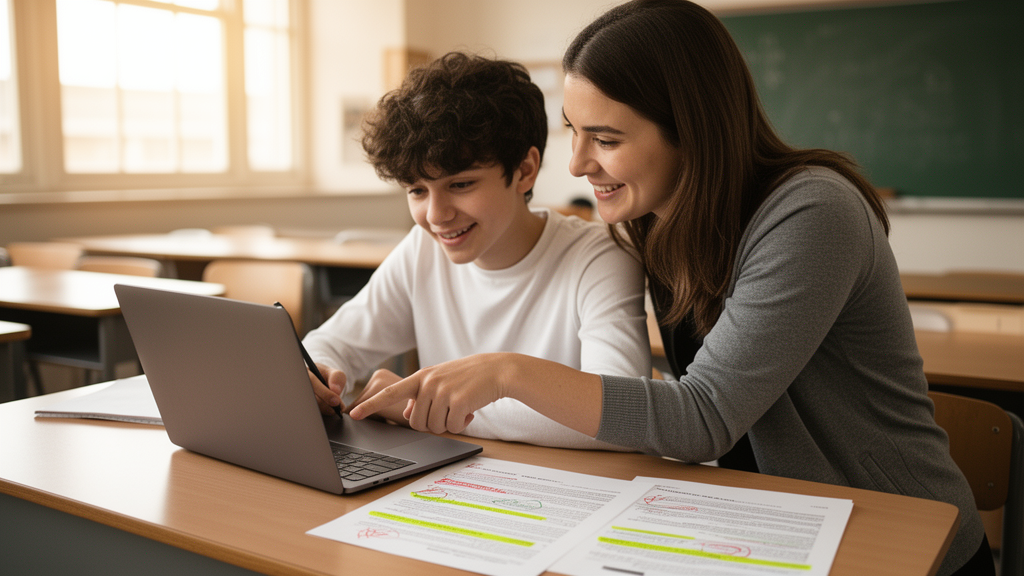
A 10-week quasi-experimental intervention with 126 Chinese university students has found that AI-generated feedback and peer feedback significantly improved learners' second-language (L2) writing feedback literacy, while teacher feedback produced no significant changes across the measured dimensions. The mixed-methods study, published open access in Humanities and Social Sciences Communications by Junying Yan and Yaru Meng, examined how feedback from these three different sources shaped students' capacity to engage with comments on their writing. The researchers measured this competence using the L2 Student Writing Feedback Literacy Scale (L2-SWFLS), administered as pre- and post-tests to three intact classes.

Because the study used intact classes rather than random assignment, the findings should be interpreted as quasi-experimental rather than fully causal. Qualitative interviews were also conducted with a subsample of participants to understand their perceptions and the processes involved in engaging with each feedback source. The quantitative results showed significant gains for both the AI and peer feedback groups, but with distinct patterns.

Students who received AI-generated feedback showed a particular advantage in acknowledging different feedback sources. The peer feedback group improved across a broader set of dimensions, including appreciating feedback, acknowledging different feedback sources, and making judgments about the comments they received. In contrast, the teacher feedback group showed limited improvement, with no significant changes in any of the measured dimensions of writing feedback literacy.

The authors note that most previous research on feedback literacy has focused mainly on teacher or peer feedback, leaving open the question of how feedback from different sources may differentially shape students' development in this area. The qualitative interviews helped explain these quantitative patterns. Students working with AI and peer feedback reported greater autonomy and more critical engagement when interpreting and using feedback, whereas teacher feedback did not foster these qualities to the same degree.

The authors suggest that these differentiated effects across feedback sources point to the value of integrating multiple feedback channels in L2 writing instruction, rather than relying on a single source, to optimize how students develop as receivers and users of feedback. Within the scope of this study, combining AI, peer, and teacher feedback appears promising for cultivating different components of feedback literacy. The study's scope carries limitations worth noting.

It involved a specific population of Chinese university students over a single 10-week intervention, and the use of intact classes means pre-existing differences between groups cannot be fully ruled out. The published version is an accepted manuscript shared early to provide faster access, and it remains subject to further edits before the final Version of Record replaces it. The findings therefore describe measurable changes in this particular context rather than universal outcomes, and the authors frame their results as highlighting how different feedback sources can be combined to support writing instruction.

Subject of Research: Effects of AI, peer, and teacher feedback on university students' L2 writing feedback literacy

Article Title: Exploring the impact of AI, peer, and teacher feedback on university students’ L2 writing feedback literacy

Article References: Yan, J., & Meng, Y. (2026). Exploring the impact of AI, peer, and teacher feedback on university students’ L2 writing feedback literacy. Humanities and Social Sciences Communications. https://doi.org/10.1057/s41599-026-09383-2

Image Credits: AI Generated

DOI: 10.1057/s41599-026-09383-2

Keywords: feedback literacy, second-language writing, AI feedback, peer feedback, teacher feedback, quasi-experimental study, Chinese university students, L2 education, writing instruction, mixed methods, Exploring, impact

Cite Scienmag News

Courtney Benton. (October 24, 2026). AI and Peer Feedback Improve Students’ Second-Language Writing Feedback Literacy. Scienmag. https://scienmag.com/ai-and-peer-feedback-improve-students-second-language-writing-feedback-literacy/


Courtney Benton. "AI and Peer Feedback Improve Students’ Second-Language Writing Feedback Literacy." Scienmag, 24 October 2026, https://scienmag.com/ai-and-peer-feedback-improve-students-second-language-writing-feedback-literacy/. Accessed 24 October 2026.

Courtney Benton. "AI and Peer Feedback Improve Students’ Second-Language Writing Feedback Literacy." Scienmag. October 24, 2026. https://scienmag.com/ai-and-peer-feedback-improve-students-second-language-writing-feedback-literacy/

Tags: AI feedbackAI feedback impact on language learnersAI-driven feedback in second-language writingChinese university studentseffects of teacher vs. peer feedback on L2 writingenhancing feedback literacy through technologyExploringfeedback literacyfeedback source recognition in language learningimpactimproving feedback engagement in L2 studentsL2 educationmixed methodsopen access research on L2 feedback strategiespeer feedbackpeer feedback literacy developmentqualitative insights into feedback engagementquasi-experimental studies in language educationquasi-experimental studysecond language writingsecond-language writing skills assessmentstudent perceptions of AI and peer feedbackteacher feedbackwriting instruction
Share26Tweet16
Previous Post

How Duterte’s arrest at the ICC tests the limits of international law

Next Post

Research report: A myriad of mysteries on many legs: Disentangling the systematics of Myriapoda with UCEs

Related Posts

How Duterte’s arrest at the ICC tests the limits of international law
Social Science

How Duterte’s arrest at the ICC tests the limits of international law

October 24, 2026
Sex, Birth and Breastfeeding May Share One Prolactin-Driven Brain Circuit
Social Science

Sex, Birth and Breastfeeding May Share One Prolactin-Driven Brain Circuit

October 24, 2026
Attachment anxiety and narcissism linked to problematic social media use
Social Science

Attachment anxiety and narcissism linked to problematic social media use

October 24, 2026
Forensic facial specialists identify faces from one or two features
Social Science

Forensic facial specialists identify faces from one or two features

October 24, 2026
Executives born along Long March route show reduced earnings management after commemorations
Social Science

Executives born along Long March route show reduced earnings management after commemorations

October 24, 2026
China’s prosecutors act as quasi-meta-governors in environmental public interest litigation
Social Science

China’s prosecutors act as quasi-meta-governors in environmental public interest litigation

October 24, 2026
Next Post
Research report: A myriad of mysteries on many legs: Disentangling the systematics of Myriapoda with UCEs

Research report: A myriad of mysteries on many legs: Disentangling the systematics of Myriapoda with UCEs

  • Mothers who receive childcare support from maternal grandparents show more optimized

    Mothers who receive childcare support from maternal grandparents show more parental warmth, finds NTU Singapore study

    27656 shares
    Share 11059 Tweet 6912
  • University of Seville Breaks 120-Year-Old Mystery, Revises a Key Einstein Concept

    1061 shares
    Share 424 Tweet 265
  • Bee body mass, pathogens and local climate influence heat tolerance

    682 shares
    Share 273 Tweet 171
  • Researchers record first-ever images and data of a shark experiencing a boat strike

    546 shares
    Share 218 Tweet 137
  • Groundbreaking Clinical Trial Reveals Lubiprostone Enhances Kidney Function

    531 shares
    Share 212 Tweet 133
Science

Embark on a thrilling journey of discovery with Scienmag.com—your ultimate source for cutting-edge breakthroughs. Immerse yourself in a world where curiosity knows no limits and tomorrow’s possibilities become today’s reality!

RECENT NEWS

  • Research report: A myriad of mysteries on many legs: Disentangling the systematics of Myriapoda with UCEs
  • AI and Peer Feedback Improve Students’ Second-Language Writing Feedback Literacy
  • How Duterte’s arrest at the ICC tests the limits of international law
  • Metabolomic Study Tracks How a Fermented Milk Beverage Holds Its Flavor Over 21 Days of Cold Storage

Categories

  • Agriculture
  • Anthropology
  • Archaeology
  • Athmospheric
  • Biology
  • Biotechnology
  • Blog
  • Bussines
  • Cancer
  • Chemistry
  • Climate
  • Earth Science
  • Editorial Policy
  • Marine
  • Mathematics
  • Medicine
  • Pediatry
  • Policy
  • Psychology & Psychiatry
  • Science Education
  • Science News
  • Social Science
  • Space
  • Technology and Engineering

Subscribe to Blog via Email

Enter your email address to subscribe to this blog and receive notifications of new posts by email.

Join 5,152 other subscribers

© 2025 Scienmag - Science Magazine

Welcome Back!

Login to your account below

Forgotten Password?

Retrieve your password

Please enter your username or email address to reset your password.

Log In
No Result
View All Result
  • HOME
  • SCIENCE NEWS
  • CONTACT US

© 2025 Scienmag - Science Magazine

Discover more from Science

Subscribe now to keep reading and get access to the full archive.

Continue reading