


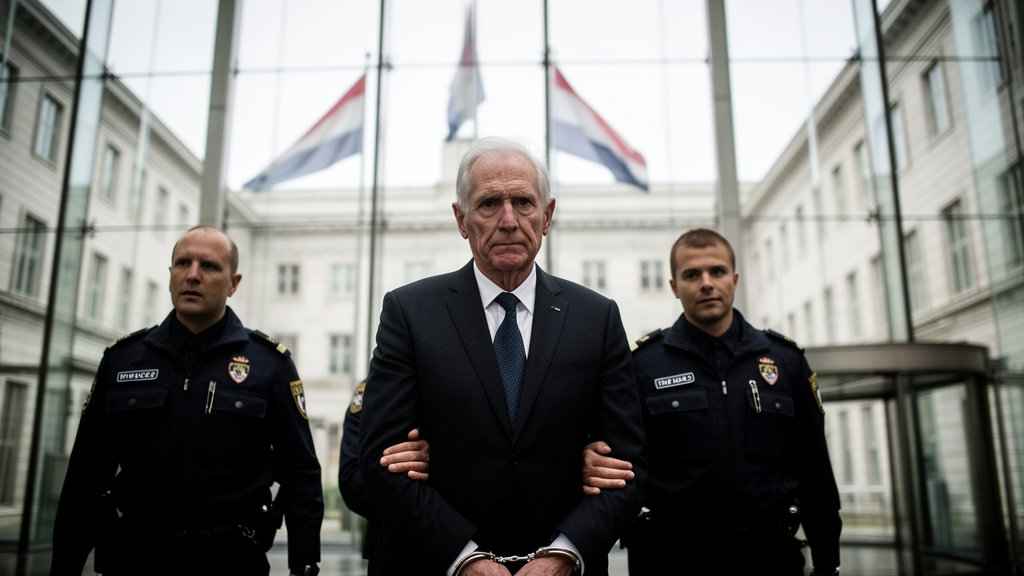
When former Philippine President Rodrigo Roa Duterte was arrested in Manila in March 2025 on a warrant issued by the International Criminal Court, it marked the first time a leader from Asia had been taken into custody to face the Hague-based tribunal. A new open-access study published in SN Social Sciences examines the arrest as a case study in how globalized ideas, laws, and enforcement practices travel across borders and collide with national sovereignty. Using qualitative discourse analysis, the researcher analyzed speeches, interviews, press releases, and a documentary to trace Duterte’s rise to power, his controversial war on drugs, and the communicative machinery behind his warranted arrest. The findings offer a detailed picture of how power was constructed during his tenure and how international and national actors cooperated to execute an arrest that the Philippines, no longer a member of the ICC since 2019, was not legally obliged to carry out.
The study draws on a distinctive set of publicly available sources. These include Duterte’s presidential inauguration speech in June 2016, his first State of the Nation Address in July 2016, and an exclusive interview with Al Jazeera recorded during his first 100 days in office and posted on YouTube. The researcher also analyzed a 27-minute documentary on the arrest posted by ABS-CBN, one of the Philippines’ largest broadcasting companies, on March 31, 2025, along with public news and press releases from the Presidential Communications Office and the ICC website, and press releases from the administration of current President Marcos Jr. following the arrest. The materials were transcribed, reviewed repeatedly, and grouped into themes using Foucauldian discourse analysis, an approach centered on how knowledge and power generate social realities and perceived truths in online data.
The analysis identified three manifestations of power during Duterte’s regime: charismatic, discursive, and institutional. Charismatic power operated through shared values, emotions, and vision. In his inaugural speech, Duterte invoked love of country and the common good, using the word “we” to create commonality with the masses and passionate language to appeal to the audience’s emotions. He mentioned “love of country” in all his speeches and interviews, and this allegiance to the nation was perceived as evidence of his deep commitment to the country and its people, potentially reducing scrutiny of his authority and actions. He also demonstrated self-sacrificing behavior, stating that he would put his honor, his life, and the presidency itself at stake, which created assurance among followers and established a leader-follower role that shaped new regimes of truth in Philippine society.
Discursive power, by contrast, worked through striking language and ideological framing. Duterte defined himself as the protector of the land and openly threatened criminals with death as punishment, famously declaring that those who destroyed his country would be killed in return. The study interprets this fear-inducing language as a strategic rhetoric and a form of government surveillance over constituents, functioning as a warning to citizens. The researcher notes that lexical choice plays a crucial role in persuading audiences of causes, motives, and intentions, and that the perception of a leader’s character may be judged from the words uttered. The killings and their effects, the analysis suggests, became knowledge perceived to be true if everyone believed it so, connecting to Foucault’s concept of the “general politics of truth,” in which society judges between true and false statements and requires validation through legal and scientific procedures.
Institutional power manifested through Duterte’s legitimate right as head of state to set rules and enforce them against criminals. He emphasized that his adherence to due process and the rule of law was uncompromising and that the fight against criminality, illegal drugs, and corruption would be relentless and sustained. This shaped a kind of knowledge about government during his tenure in which criminals should be punished by law, creating a discourse in which citizens were expected to follow orders. When questioned about human rights as part of the Constitution, Duterte dismissed the concern in coarse language, and when asked whether he feared ramifications, impeachment, or trial in an international court, he asserted that charges could only be filed if he was first proven to have committed crimes. The study suggests these statements reinforced an untouchable strongman persona while implying how power can manifest through political structure both within the law of the land and beyond borders.
The second major finding concerns the communicative practices behind the arrest itself, which the study organizes into four phases: “secret” communication, partnership formation, negotiation and stand-offs, and public communication. On the ICC website, the warrant of arrest against Duterte was labeled as “secret” on March 7, 2025, and made “public” on March 11, 2025. Although other sources did not directly quote the secrecy of the communication, Duterte’s statement during a political rally in Hong Kong on March 9, 2025, that he had been informed of an arrest warrant suggests that his camp had already received notification. By opening the topic and mentioning the arrest, Duterte employed a communicative strategy aimed at informing the public and gaining support, while the initial knowledge of the arrest circulated within the ICC and the organizations involved in executing the warrant.
The four-day window before the warrant was made public provided time for partnership formation. Reports and the documentary indicate that the arrest warrant was received by Interpol in Manila rather than being issued directly to the Office of the Philippine Ombudsman, which usually handles crimes committed by government officials. The study concludes that different governing bodies worked together to execute the arrest, a claim supported by the chief of the Philippine National Police, who said that the police were prepared and not caught off guard. President Marcos Jr.’s press conference statement, describing receiving the warrant from Interpol at 3 am and putting plans into place, reveals the involvement of the Office of the President, the Department of the Interior and Local Government, and the national police. The arrest thus shows collaboration among groups capable of exercising their power and functions in compliance with ICC procedures and law enforcement.
The execution of the arrest involved about 12 hours of negotiations and stand-offs. Duterte’s camp questioned the legality of the warrant, arguing that it was issued by the ICC and not by Interpol Manila or a Philippine court, and pointed to the Philippines’ non-membership in the ICC since 2019 as a defense. The chief of police insisted that arrests are sometimes made without the warrant in hand, a statement the study finds questionable under Philippine law. According to the Revised Rules of Criminal Procedure under Rule 113, Section 5, an arrest must generally be made with a warrant, with only three exceptions: when the offense is committed in the presence of a law enforcer, when the law enforcer has personal knowledge of the crime, and in cases of unlawful escape. The researcher argues that the use of police authority and any exemption requires clearer public explanation to understand the nature of a warrantless arrest.
After the negotiations, Duterte was transferred to The Hague, and the “secret” communication was made “public” through Marcos Jr.’s press conference. The President stated that the Philippines acted because Interpol asked it to and that the country lived up to its commitments, adding that this was what the international community expected of a democratic country that is part of a community of nations. The study observes that the ICC has no police power and relied on Interpol, which itself has no direct power to arrest individuals but serves as a facilitator of police cooperation among member states. The arrest was therefore made possible through cooperation and mutual agreements between Interpol, the national government, and other public authorities with the legal power to execute police functions. The analysis also notes that Marcos Jr.’s framing of the arrest as a debt owed to Interpol reflects a Filipino cultural value of reciprocity, and that his correction of “ICC” to “Interpol” during the press conference indicates confusion in the flow of knowledge that could affect public perception of the truth about the arrest.
The implications cut in two directions. For the international community, Duterte’s arrest testifies to the ICC’s power across continents after seven years of investigation, from 2018 to 2025, and could defend the court against criticisms that it focuses trials on African political leaders, although it does not stop criticisms of its selectivity toward developing nations. By record, Duterte is not the first president issued an arrest warrant for crimes against humanity, as warrants for Putin and Netanyahu failed due to non-cooperation, meaning the ICC’s arrest process remains dependent on international cooperation. The study traces the shift in the Philippine government’s stance, announced in November 2024 and January 2025, from years of refusal to cooperation, coinciding with a worsening feud between Marcos Jr. and Duterte’s daughter, a claimed presidential rival for the 2028 election. For Philippine society, the findings highlight a divided public, with Duterte’s supporters in dismay and another group condemning the war on drugs, and encourage critical evaluation of how truths about leadership and law are socially and politically constructed. The study acknowledges its data are limited to online sources and calls for future research on the legitimacy of arrests concerning the sovereign power of ICC non-member countries.
Subject of Research: Law and Politics
Article Title: The interplay between international and national jurisprudence: the case of ex-Philippine President Duterte’s arrest at the International Criminal Court (ICC)
Article References: Sotto, R. (2026). The interplay between international and national jurisprudence: the case of ex-Philippine President Duterte’s arrest at the International Criminal Court (ICC). SN Social Sciences, 6(8), Article 343. https://doi.org/10.1007/s43545-026-01624-0
Image Credits: AI Generated
DOI: 10.1007/s43545-026-01624-0
Keywords: interplay, between, international, national, jurisprudence, case, ex-Philippine, President, Duterte, arrest, Criminal, Court
Cite Scienmag News
Courtney Benton. (October 24, 2026). How Duterte’s arrest at the ICC tests the limits of international law. Scienmag. https://scienmag.com/how-dutertes-arrest-at-the-icc-tests-the-limits-of-international-law/
Courtney Benton. "How Duterte’s arrest at the ICC tests the limits of international law." Scienmag, 24 October 2026, https://scienmag.com/how-dutertes-arrest-at-the-icc-tests-the-limits-of-international-law/. Accessed 24 October 2026.
Courtney Benton. "How Duterte’s arrest at the ICC tests the limits of international law." Scienmag. October 24, 2026. https://scienmag.com/how-dutertes-arrest-at-the-icc-tests-the-limits-of-international-law/


