

Saturday, October 24, 2026
Science
No Result
View All Result
  • Login
  • HOME
  • SCIENCE NEWS
  • CONTACT US
  • HOME
  • SCIENCE NEWS
  • CONTACT US
No Result
View All Result
Scienmag
No Result
View All Result
Home Science News Psychology & Psychiatry

Higher Daily Liquid Intake Linked to Lower Post-Stroke Depression and Anxiety Risk in Estazolam Users

October 24, 2026
in Psychology & Psychiatry
Glenn Wilkins
By Glenn Wilkins Scienmag Editorial Profile - Clinical Psychology
Reading Time: 3 mins read
0
Higher Daily Liquid Intake Linked to Lower Post-Stroke Depression and Anxiety Risk in Estazolam Users

Higher Daily Liquid Intake Linked to Lower Post-Stroke Depression and Anxiety Risk in Estazolam Users

65
SHARES
587
VIEWS
Share on FacebookShare on Twitter
ADVERTISEMENT

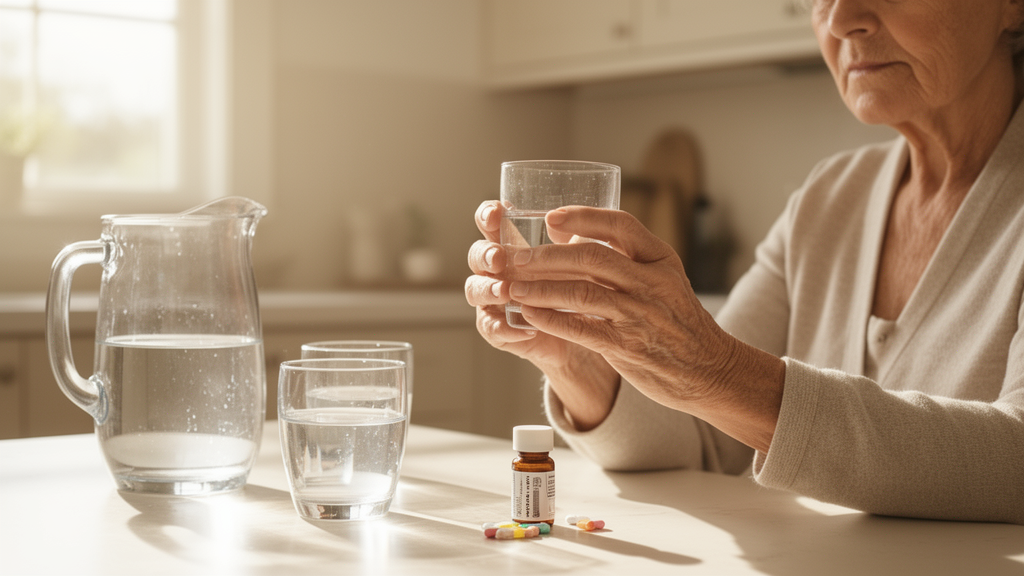
Stroke survivors who take the sedative-hypnotic drug estazolam for post-stroke insomnia may face a lower likelihood of depressive and anxiety symptoms when they drink more fluids each day, according to a prospective cohort study published in BMC Psychiatry. The study followed 453 people with ischemic stroke who were on long-term estazolam treatment and found that higher average daily liquid intake during the first six months after stroke was significantly associated with a reduced risk of screening-positive depressive and anxiety symptoms at both seven and twelve months after stroke. Insomnia is common among ischemic stroke survivors, and estazolam, a long-acting benzodiazepine, is frequently prescribed to manage it.

However, both stroke itself and long-term benzodiazepine use are recognized risk factors for post-stroke depressive and anxiety symptoms, making this population particularly vulnerable to neuropsychiatric complications. The researchers designed the study to examine whether a modifiable daily behavior, fluid consumption, might be associated with these manifestations in patients receiving estazolam, with the aim of informing their clinical management. To capture drinking habits over time rather than at a single moment, the investigators measured each participant's 24-hour liquid intake repeatedly between one and six months after stroke and averaged the results.

Depressive and anxiety symptoms were then assessed at two follow-up points, seven and twelve months after stroke, using four validated clinical instruments: the 17-item Hamilton Depression Rating Scale (HAM-D-17), the nine-item Patient Health Questionnaire (PHQ-9), the Hamilton Anxiety Rating Scale (HAM-A), and the seven-item Generalized Anxiety Disorder scale (GAD-7). Depressive symptoms were defined as screening-positive at a HAM-D-17 score of 7 or higher or a PHQ-9 score of 5 or higher, while anxiety symptoms were defined as screening-positive at a HAM-A score of 7 or higher or a GAD-7 score of 5 or higher. In multivariate logistic regression analyses, higher long-term 24-hour liquid intake from one to six months after stroke was significantly associated with a reduced risk of screening-positive depressive symptoms and anxiety symptoms at both the seven-month and twelve-month assessments, with all reported associations reaching statistical significance.

Dose-response analyses demonstrated a graded relationship, meaning the association strengthened across increasing levels of intake rather than emerging only above a single threshold. Sensitivity analyses, which test whether results hold under alternative analytical assumptions, confirmed the robustness of the findings. Because liquid intake was not assigned by the researchers, the results demonstrate an association rather than a causal effect.

Residual confounding therefore cannot be excluded as an explanation for the observed relationship. The study's conclusion states that, among ischemic stroke survivors receiving long-term estazolam for insomnia, higher liquid intake was associated with a lower risk of screening-positive post-stroke depressive and anxiety symptoms. The authors note that whether deliberately increasing liquid intake would improve mental health outcomes in this population remains to be determined, and that interventional studies are needed before any such recommendation can be made.

Subject of Research: The association between daily liquid intake and post-stroke depressive and anxiety symptoms in ischemic stroke survivors treated with estazolam

Article Title: Association of liquid intake with post-stroke depressive and anxiety symptoms in subjects using estazolam: a prospective cohort study

Article References: Jing, J., Du, R., Wen, L., & Fang, Y. (2026). Association of liquid intake with post-stroke depressive and anxiety symptoms in subjects using estazolam: a prospective cohort study. BMC Psychiatry. https://doi.org/10.1186/s12888-026-08771-x

Image Credits: AI Generated

DOI: 10.1186/s12888-026-08771-x

Keywords: stroke, estazolam, liquid intake, depression, anxiety, insomnia, prospective cohort, neuropsychiatry, HAM-D-17, PHQ-9, GAD-7, observational study

Cite Scienmag News

Glenn Wilkins. (October 24, 2026). Higher Daily Liquid Intake Linked to Lower Post-Stroke Depression and Anxiety Risk in Estazolam Users. Scienmag. https://scienmag.com/higher-daily-liquid-intake-linked-to-lower-post-stroke-depression-and-anxiety-risk-in-estazolam-users/


Glenn Wilkins. "Higher Daily Liquid Intake Linked to Lower Post-Stroke Depression and Anxiety Risk in Estazolam Users." Scienmag, 24 October 2026, https://scienmag.com/higher-daily-liquid-intake-linked-to-lower-post-stroke-depression-and-anxiety-risk-in-estazolam-users/. Accessed 24 October 2026.

Glenn Wilkins. "Higher Daily Liquid Intake Linked to Lower Post-Stroke Depression and Anxiety Risk in Estazolam Users." Scienmag. October 24, 2026. https://scienmag.com/higher-daily-liquid-intake-linked-to-lower-post-stroke-depression-and-anxiety-risk-in-estazolam-users/

Tags: anxietyDepressionestazolamEstazolam use in stroke recoveryGAD-7HAM-D-17Hydration and mental health outcomes in stroke patientsImpact of fluid intake on mental health after strokeinsomnialiquid intakeLong-term benzodiazepine effects on neuropsychiatric healthManaging insomnia in ischemic stroke survivorsModifiable lifestyle factors for post-stroke depressionneuropsychiatryobservational studyPHQ-9Post-stroke depression risk factorsprospective cohortProspective cohort study on stroke and mental healthRole of fluid consumption in neuropsychiatric symptom preventionStrategies to reduce post-stroke anxiety and depressionstroke
Share26Tweet16
Previous Post

Multimodal program lifts sterile processing compliance in Tunisian hospital

Next Post

Cocoa Husk Pectin Films Show UV Shielding, Antioxidant Activity, and Rapid Soil Disintegration

Related Posts

Avoidant coping linked to psychological difficulties among Palestinian adolescents, survey finds
Psychology & Psychiatry

Avoidant coping linked to psychological difficulties among Palestinian adolescents, survey finds

October 24, 2026
White Matter Tracts Show Subtle Changes in the Months After Anorexia Hospitalization
Psychology & Psychiatry

White Matter Tracts Show Subtle Changes in the Months After Anorexia Hospitalization

October 24, 2026
VR Meditation Linked to Lower Anxiety and Depressive Symptoms in Middle-Aged and Older Adults
Psychology & Psychiatry

VR Meditation Linked to Lower Anxiety and Depressive Symptoms in Middle-Aged and Older Adults

October 24, 2026
Acute Response to ECT Linked to Lower Readmission Risk in South Korean Cohort
Psychology & Psychiatry

Acute Response to ECT Linked to Lower Readmission Risk in South Korean Cohort

October 24, 2026
Course Grades, Not Confidence, Track Burnout in Saudi English Learners
Psychology & Psychiatry

Course Grades, Not Confidence, Track Burnout in Saudi English Learners

October 24, 2026
Coloured rating scales match numeric gauges for emotion and pain intensity
Psychology & Psychiatry

Coloured rating scales match numeric gauges for emotion and pain intensity

October 24, 2026
Next Post
Cocoa Husk Pectin Films Show UV Shielding, Antioxidant Activity, and Rapid Soil Disintegration

Cocoa Husk Pectin Films Show UV Shielding, Antioxidant Activity, and Rapid Soil Disintegration

  • Mothers who receive childcare support from maternal grandparents show more optimized

    Mothers who receive childcare support from maternal grandparents show more parental warmth, finds NTU Singapore study

    27656 shares
    Share 11059 Tweet 6912
  • University of Seville Breaks 120-Year-Old Mystery, Revises a Key Einstein Concept

    1061 shares
    Share 424 Tweet 265
  • Bee body mass, pathogens and local climate influence heat tolerance

    682 shares
    Share 273 Tweet 171
  • Researchers record first-ever images and data of a shark experiencing a boat strike

    546 shares
    Share 218 Tweet 137
  • Groundbreaking Clinical Trial Reveals Lubiprostone Enhances Kidney Function

    531 shares
    Share 212 Tweet 133
Science

Embark on a thrilling journey of discovery with Scienmag.com—your ultimate source for cutting-edge breakthroughs. Immerse yourself in a world where curiosity knows no limits and tomorrow’s possibilities become today’s reality!

RECENT NEWS

  • Cocoa Husk Pectin Films Show UV Shielding, Antioxidant Activity, and Rapid Soil Disintegration
  • Higher Daily Liquid Intake Linked to Lower Post-Stroke Depression and Anxiety Risk in Estazolam Users
  • Multimodal program lifts sterile processing compliance in Tunisian hospital
  • Antiviral Drug Behavior Varies Widely Across Rare Bird Species

Categories

  • Agriculture
  • Anthropology
  • Archaeology
  • Athmospheric
  • Biology
  • Biotechnology
  • Blog
  • Bussines
  • Cancer
  • Chemistry
  • Climate
  • Earth Science
  • Editorial Policy
  • Marine
  • Mathematics
  • Medicine
  • Pediatry
  • Policy
  • Psychology & Psychiatry
  • Science Education
  • Science News
  • Social Science
  • Space
  • Technology and Engineering

Subscribe to Blog via Email

Enter your email address to subscribe to this blog and receive notifications of new posts by email.

Join 5,152 other subscribers

© 2025 Scienmag - Science Magazine

Welcome Back!

Login to your account below

Forgotten Password?

Retrieve your password

Please enter your username or email address to reset your password.

Log In
No Result
View All Result
  • HOME
  • SCIENCE NEWS
  • CONTACT US

© 2025 Scienmag - Science Magazine

Discover more from Science

Subscribe now to keep reading and get access to the full archive.

Continue reading