


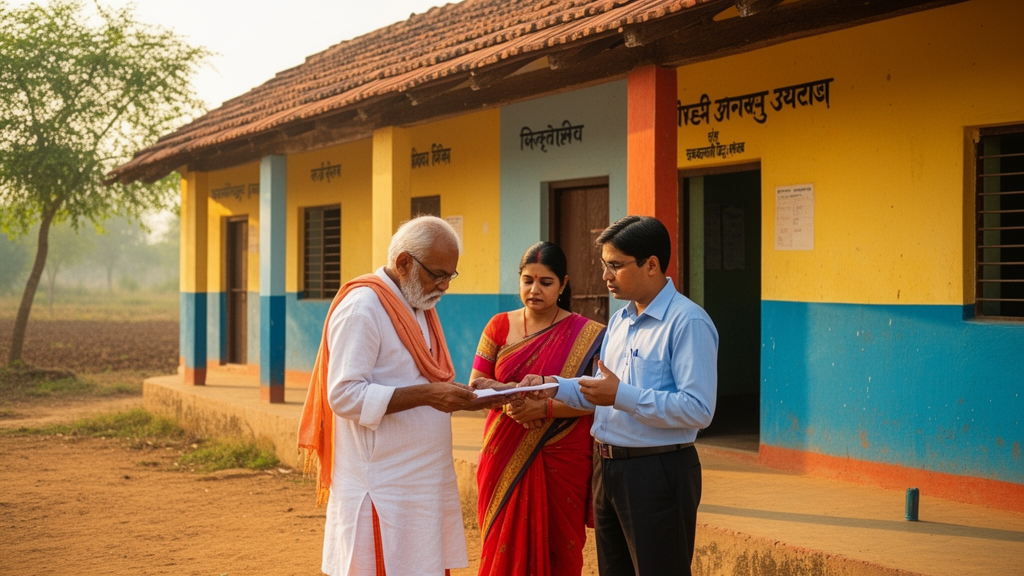
A new comparative study of rural North India has found that village councils have largely solved the problem of getting children physically into school, yet the governance functions most central to the right to education, such as monitoring enrolment, retention and dropout, are the least performed. The research, published in the International Journal of Child Care and Education Policy, evaluated how far local self-governance in Punjab, Haryana and Himachal Pradesh respects, protects, fulfils and promotes the right to free and compulsory elementary education, and examined the Sarva Shiksha Abhiyan (SSA) as the principal instrument through which that right is delivered. The verdict is a study in contrasts: near-universal legal awareness and universal school access coexist with collapsed oversight, weak child-labour enforcement and participatory committees that operate on paper only.
The study rests on a legal architecture built over three decades. India’s Supreme Court read the right to education into the right to life in the Mohini Jain (1992) and Unni Krishnan (1993) judgments, momentum that produced the Eighty-Sixth Constitutional Amendment of 2002, inserting Article 21 A and making free and compulsory education for children aged six to fourteen a fundamental right. The Right of Children to Free and Compulsory Education (RTE) Act of 2009 translated that guarantee into enforceable obligations, prescribing minimum norms for infrastructure, class size and teacher qualifications, reserving a quarter of private-school places for disadvantaged children, and prohibiting capitation fees, screening and corporal punishment. The Seventy-Third Constitutional Amendment of 1992 had already empowered Panchayats, through Article 243G and the Eleventh Schedule, to prepare and implement plans for economic development and social justice, including elementary education, while Section 9 of the RTE Act assigns Gram Panchayats specific duties to ensure admission, attendance and completion of elementary education for every child in their jurisdiction.
To measure compliance, the researchers adopted the Respect–Protect–Fulfil–Promote (RPFP) framework, a four-fold articulation of State obligations first developed by Shue and Eide and given formal standing in the Maastricht Guidelines and General Comment No. 13 of the Committee on Economic, Social and Cultural Rights. A State respects a right by refraining from interference, protects it by preventing violations by third parties, fulfils it through legislative and administrative measures, and promotes it through awareness and mobilisation. The framework maps directly onto the statutory duties of local bodies: the duty to respect corresponds to awareness of the right and monitoring of school conditions and enrolment; the duty to protect to securing admission of out-of-school children and preventing child labour; the duty to fulfil to providing and maintaining school infrastructure; and the duty to promote to awareness campaigns, enrolment drives and the educational use of the Gram Sabha. Each survey and checklist indicator was assigned to one of the four obligations, with compliance expressed as the percentage of affirmative responses.
The evidence came from a mixed-methods design spanning three purposively selected districts, five Gram Panchayats per state, and twenty-nine government schools. In total, 1,050 respondents were surveyed: 150 Panchayat functionaries, comprising Sarpanches and elected members, and 900 adult residents and parents selected by simple random sampling. A structured schedule recorded functionaries’ discharge of their education obligations, a questionnaire captured beneficiaries’ awareness of and access to RTE and SSA entitlements, and an institutional checklist assessed each school’s performance against SSA norms covering infrastructure, teaching staff and support services. The stakes are considerable: UNESCO estimates roughly 251 million children, adolescents and youth are out of school globally, and India recorded over 1.17 million out-of-school children on the PRABANDH portal in 2024, with courts recently flagging acute teacher shortages in Punjab.
The results expose a sharp asymmetry within the obligation to respect. Awareness of the right of children to free and compulsory education was near-universal among Panchayat members, averaging 98 per cent, confirming that the constitutional guarantee has been internalised at the governance–community interface. Yet awareness did not translate into oversight. Monitoring of school conditions such as water, sanitation, books and mid-day meals held up reasonably well at 89.3 per cent on average but fell to 70 per cent in Punjab, while the monitoring of enrolment, retention and dropout, the function most central to the right, collapsed to an average of 54.7 per cent, dropping to just 20 per cent in Punjab against 76 per cent in Himachal Pradesh and 68 per cent in Haryana. The single most consequential educational-governance function is thus the least performed, most starkly in the state with the strongest physical infrastructure.
The protective and fulfilment obligations produced an uneven institutional response. Panchayats were active in securing the admission of out-of-school children to neighbourhood schools, averaging 87.3 per cent, and extending access to children from disadvantaged, disabled and minority backgrounds proved the strongest indicator in the protective obligation at 92.7 per cent. Prevention of child labour, by contrast, averaged only 74.0 per cent and was highly variable, falling to 50 per cent in Haryana against 94 per cent in Himachal Pradesh, a reminder that local bodies may be willing to act yet lack the authority, resources or political backing to confront entrenched socio-economic practices. On fulfilment, every state reported that government schools lie within walking distance of children’s homes, a genuine achievement in dissolving physical exclusion, but quality and maintenance lagged: equipping schools with modern facilities averaged 80.0 per cent but fell to 60 per cent in Punjab, and maintenance of basic facilities through Panchayat funds, complete in Haryana and Himachal Pradesh, again stood at 60 per cent in Punjab.
The obligation to promote was the weakest across all four, and beneficiary responses deepened the asymmetry. Awareness campaigns on the right to education averaged 80.0 per cent, but campaigns for universal enrolment and retention and Total Literacy Campaign activities each averaged only 60.0 per cent, with Punjab and Haryana at 40 per cent against Himachal Pradesh’s 100 per cent, and the use of the Gram Sabha for educational purposes reached only 66.7 per cent. Awareness of the SSA, the School Management Committee and the entitlement to compulsory education up to age fourteen was highest in Himachal Pradesh, where roughly four-fifths of respondents were aware across these indicators, moderate in Haryana and lowest in Punjab. Meanwhile, all three states reported high fulfilment on access to schools, basic infrastructure, drinking water, mid-day meals and toilets, producing a pronounced gap between the services delivered and public awareness of them. Where awareness is low, the accountability that participation is meant to generate does not follow.
School-level evidence located the patterns institutionally. Punjab operated the largest schools, averaging 224.6 students against 133.4 in Haryana and 56.9 in Himachal Pradesh, and correspondingly the highest pupil–teacher ratio, while Himachal Pradesh’s small, scattered mountain schools produced the most favourable classroom conditions. Women teachers outnumbered men in Punjab at 3.3 per school, whereas Haryana and Himachal Pradesh averaged only 1.5 and 1.6 respectively, a policy signal given evidence that a stronger presence of women teachers raises demand for girls’ schooling where social barriers are high. Girls’ enrolment remained high everywhere, attaining universal scores in Punjab and Himachal Pradesh and 88.9 per cent in Haryana. Textbook distribution and in-service teacher training were complete across all states, but the distribution of free uniforms reached all eligible children in Himachal Pradesh, only about 70 per cent in Punjab and a mere 29 per cent in Haryana. Sanitation, library and playground facilities were frequently rated poor, and digital infrastructure diverged sharply, rated excellent in many Himachal Pradesh schools, polarised in Haryana and no more than moderate in Punjab.
The sharpest paradox concerned the School Management Committees, which the RTE Act requires every school to constitute, composed largely of parents, to oversee administration, monitor expenditure and prepare School Development Plans. In every sampled Gram Panchayat the committee was duly constituted, conducted meetings as prescribed and recorded full attendance, indicating complete procedural compliance. Yet this formal regularity coexisted with low beneficiary awareness and weak promotional activity, implying that the committees function as a procedural requirement rather than a living instrument of participation. The fieldwork also recorded striking good practices: classroom walls painted with murals doubling as permanent learning aids, model schools with digital screens and smart laboratories, a Haryana school displaying a mission statement committing to measurable improvements in enrolment and retention, and a Himachal Pradesh school displaying a safety pledge with evacuation drills, anti-bullying measures and a POCSO complaint box.
The study’s central proposition is that decentralisation bridges rights-based legislation and educational outcomes only where local capacity, financial autonomy and outcome-based monitoring are present. Himachal Pradesh integrated awareness-building, digital provision and institutional functioning most fully, translating the decentralised structure into substantive outcomes, whereas Punjab and Haryana, despite stronger physical infrastructure in certain respects, showed weaker community mobilisation and grassroots monitoring, making decentralisation ornamental where local capability is low. The authors recommend treating capacity-building as a structural investment rather than a peripheral activity, strengthening fiscal and decision-making autonomy at the local level so that decentralisation amounts to governance rather than delegated administration, and shifting monitoring towards outcome-oriented review that foregrounds retention, learning continuity and community accountability. The findings carry limitations: the data are self-reported and the purposive sampling of a single district and five Gram Panchayats per state limits statistical generalisation. But the comparative account is rigorous, and its message is clear: the constitutional vision behind the right to education extends beyond access to schooling, and realising it requires sustained attention to the quality of participation, the depth of local empowerment, and the alignment between rights on paper and educational experience on the ground.
Subject of Research: Role of rural local self-governance in realising the right to education in North India
Article Title: Role of LSG in realizing the right to education in North India
Article References: Pathak, P., Benny, N. C., & Kaur, R. (2026). Role of LSG in realizing the right to education in North India. International Journal of Child Care and Education Policy, 20(1), Article 23. https://doi.org/10.1186/s40723-026-00189-y
Image Credits: AI Generated
DOI: 10.1186/s40723-026-00189-y
Keywords: right to education, Panchayati Raj, Sarva Shiksha Abhiyan, RTE Act, Punjab, Haryana, Himachal Pradesh, School Management Committees, decentralisation, education policy, Role, realizing
Cite Scienmag News
Courtney Benton. (October 24, 2026). Village councils deliver school access but miss monitoring in North India. Scienmag. https://scienmag.com/village-councils-deliver-school-access-but-miss-monitoring-in-north-india/
Courtney Benton. "Village councils deliver school access but miss monitoring in North India." Scienmag, 24 October 2026, https://scienmag.com/village-councils-deliver-school-access-but-miss-monitoring-in-north-india/. Accessed 24 October 2026.
Courtney Benton. "Village councils deliver school access but miss monitoring in North India." Scienmag. October 24, 2026. https://scienmag.com/village-councils-deliver-school-access-but-miss-monitoring-in-north-india/


