


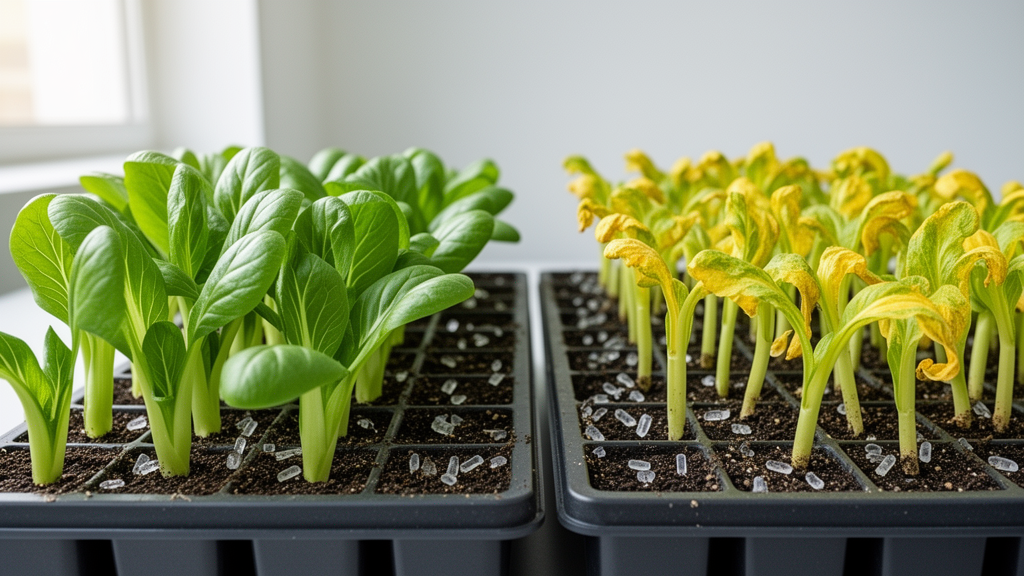
Polyvinyl chloride microplastics can have opposite effects on pak choi seedlings depending on how much of the particles ends up in the soil, according to a controlled experiment published in BMC Plant Biology. At a low soil concentration of 0.5 percent by weight, the microplastics promoted growth: the seedlings accumulated more biomass, elongated their shoots more strongly, and showed elevated chlorophyll content in their leaves. At a fourfold higher concentration of 2 percent by weight, the same particles turned from stimulant to stressor, producing clear signs of phytotoxicity.
The study focused on Brassica chinensis L., a leafy vegetable widely grown in Asia, and exposed its seedlings to three soil treatments: no microplastics, 0.5 percent PVC microplastics, and 2 percent PVC microplastics by weight. The dose-dependent pattern that emerged was consistent across the measured traits. The low dose acted as a mild stimulus, while the high dose suppressed development after an early phase in which plant height was initially stimulated but subsequently inhibited.
The authors traced the low-dose benefit to changes below ground. Exposure to 0.5 percent PVC microplastics was associated with root morphological adjustment, in particular proliferation of lateral roots. More lateral roots can improve the efficiency of water and nutrient uptake, and the seedlings paired this root modification with enhanced assimilation, which translated into greater shoot elongation and biomass accumulation. Elevated foliar chlorophyll at this dose is consistent with that photosynthetic boost.
The high-dose response followed a different physiological route. At 2 percent PVC microplastics, the seedlings accumulated proline in their leaves, a classic osmoregulatory response that plants use to protect cells under stress. At the same time, stem starch reserves dropped markedly. The authors interpret this as starch being converted to soluble sugars, which serve as osmolytes, meaning the plants drew on their stored carbohydrate reserves to cope with the microplastic-induced stress rather than investing those reserves in growth. Photosynthetic machinery also took a hit at the high dose: the study reports that chloroplast damage compromised photosynthetic performance under 2 percent exposure, undermining the carbon fixation that fuels biomass production. Together, the proline accumulation, starch depletion and impaired photosynthesis describe a coordinated stress response that ended in growth inhibition, in sharp contrast to the growth promotion seen at the lower concentration.
The findings carry caveats tied to the experimental design. The work was a controlled experiment on seedlings, so the responses describe an early life stage rather than mature plants, and only one polymer type, polyvinyl chloride, was tested at two concentrations in soil. Within that scope, the study demonstrates that dose, not merely the presence of microplastics, determines the outcome for young pak choi plants: a low dose of PVC particles stimulated lateral root formation, chlorophyll content and biomass accumulation, while a high dose damaged chloroplasts, depleted starch reserves and triggered osmoregulatory stress responses that constrained growth. The distinct concentration-dependent mechanisms the authors describe, root-driven promotion at 0.5 percent and stress-driven inhibition at 2 percent, offer a physiological framework for interpreting how PVC microplastics shift from stimulant to stressor as their soil concentration rises.
Subject of Research: Growth and physiological responses to microplastics exposure in Brassica chinensis L. seedlings
Article Title: Growth and physiological responses to microplastics exposure in Brassica chinensis L. seedlings
Article References: Lin, X., Huang, Y., Wen, S., & Li, Q. (2026). Growth and physiological responses to microplastics exposure in Brassica chinensis L. seedlings. BMC Plant Biology. https://doi.org/10.1186/s12870-026-10236-y
Image Credits: AI Generated
DOI: 10.1186/s12870-026-10236-y
Keywords: Growth, physiological, responses, microplastics, exposure, Brassica, chinensis, seedlings, scientific research
Cite Scienmag News
Alan Morgan. (October 24, 2026). Low-Dose PVC Microplastics Boost Pak Choi Seedlings, High Doses Trigger Stress. Scienmag. https://scienmag.com/low-dose-pvc-microplastics-boost-pak-choi-seedlings-high-doses-trigger-stress/
Alan Morgan. "Low-Dose PVC Microplastics Boost Pak Choi Seedlings, High Doses Trigger Stress." Scienmag, 24 October 2026, https://scienmag.com/low-dose-pvc-microplastics-boost-pak-choi-seedlings-high-doses-trigger-stress/. Accessed 24 October 2026.
Alan Morgan. "Low-Dose PVC Microplastics Boost Pak Choi Seedlings, High Doses Trigger Stress." Scienmag. October 24, 2026. https://scienmag.com/low-dose-pvc-microplastics-boost-pak-choi-seedlings-high-doses-trigger-stress/


