


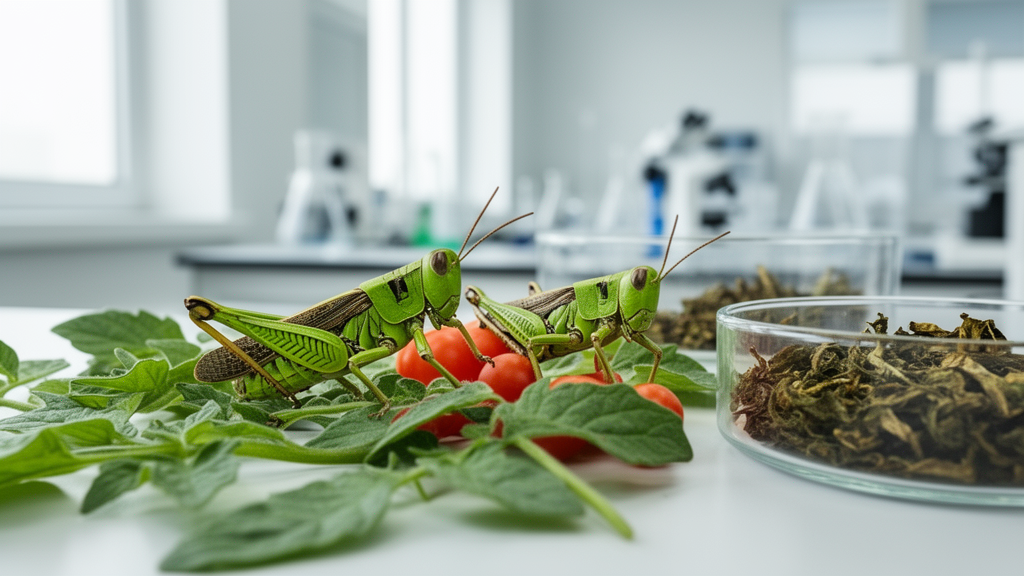
Freshly pruned tomato leaves, an abundant byproduct of greenhouse production, can be fed to desert locusts without harming their growth or survival, regardless of whether the leaves are fed fresh, refrigerated for days, or kept turgid with their stems in water, according to a controlled feeding study published in Scientific Reports. Researchers found that all four leaf handling methods produced comparable body weights, survival rates, and protein content in the insects, while significantly altering the locusts' mineral composition. The work suggests a practical route for converting a low-value agricultural residue into insect biomass rich in protein and omega-3 fatty acids.
The research team, based at the Albrecht Daniel Thaer Institute of Agricultural and Horticultural Sciences at Humboldt-Universität zu Berlin, addressed a logistical problem. In commercial greenhouse tomato production, two or three leaves per plant are typically removed every seven to ten days, although high-tech facilities may harvest fresh leaves daily. Feeding locusts leaves at peak freshness would require strict synchronization between plant maintenance and insect feeding schedules, increasing labor and logistical demands.
The researchers therefore tested whether storage or simple preservation techniques could decouple the two operations without compromising insect performance. Desert locusts, Schistocerca gregaria, are among the most nutritionally rich and historically consumed insects, and they are already produced in China, Thailand, and parts of sub-Saharan Africa. An earlier small-scale study had shown that locusts could survive on tomato leaves, producing 14.38 grams of biomass from 375.8 grams of fresh leaves over a seventeen-day feeding period, with a crude protein content of 61 percent and a fat content of 8 percent.
Tomato leaves themselves are generally unsuitable for other farmed insects: black soldier fly larvae fed tomato leaves showed no growth and 100 percent mortality, an effect attributed to insecticidal glycoalkaloids such as tomatine. The leaves used in the new trial came from tomato plants of the cultivar Avalantino grown in the CUBES Circle facility in Berlin, a soilless aquaponic greenhouse in which Nile tilapia supply nutrients through a recirculating water system. The plants had been treated with Micula, a rapeseed oil-based pest management formulation, so the trial reflected leaves generated under practical production conditions.
Four treatments were compared: freshly harvested leaves fed daily; leaves sealed in plastic bags and stored at 8 degrees Celsius for three days; leaves stored at 8 degrees Celsius for six days and portioned out daily; and a leaf-cutting method in which stem ends were trimmed at an angle and the leaves kept in water-filled containers inside the rearing cages, replaced on the fourth day. Before the feeding trial, a parallel one-week simulation experiment without locusts quantified moisture loss and chemical changes in the leaves under each regime. The average initial moisture content of tomato leaves was 89.19 percent.
Fresh leaves placed in cages for twenty-four hours showed the lowest evaporative moisture loss, about 47.13 percent, whereas leaves stored for six days lost the most, about 70.86 percent. The leaf-cutting method was the most effective at preserving turgor: average daily evaporative loss was lowest at 14.04 percent, cumulative loss over seven days reached only 31.57 percent, and the leaves remained structurally intact for up to four days, while uncut fresh leaves visibly wilted within twenty-four hours. Handling also altered leaf chemistry.
The leaf-cutting treatment produced the highest α-tomatine content, averaging 1683.45 nanomoles per gram of fresh weight, while dehydrotomatine levels showed no significant differences across treatments. Keeping cut stems in water appeared to leach some elements from the leaf tissue, with significantly reduced concentrations of chromium, potassium, sodium, and zinc after both three and seven days, and reductions in copper and iron after seven days, consistent with the ionic forms in which these elements occur in plant tissues. Crude protein in the leaves declined slightly, from 24.37 percent in fresh material to 23.35 percent and 23.14 percent after three and seven days under the leaf-cutting method.
Throughout, α-linolenic acid dominated the leaf fatty acid profile at 64.23 to 65.10 percent of total fatty acids. The locusts themselves were largely indifferent to these differences. Over the twenty-one-day trial, insects in all four treatments grew from an initial average body weight of roughly 0.08 to 0.09 grams to between 1.04 and 1.14 grams.
Mean survival rates ranged from 82 to 89 percent, with no statistically significant differences among treatments in fresh weight, dry weight, estimated feed conversion ratio, or crude protein content, which ranged from 59.37 to 60.51 percent. The authors note that the feed conversion ratios are estimates, because leaf dry matter intake had to be corrected for evaporative moisture loss, and feeding fragmentation mixed leftover leaf material with frass, potentially overestimating feed intake. One of the most striking results concerned the toxic glycoalkaloids.
Locusts fed water-maintained leaves, which carried the highest α-tomatine loads, did not accumulate more of the compound in their tissues; dehydrotomatine levels in the insects were significantly lowest under this treatment. The researchers suggest that higher dietary α-tomatine may induce stronger detoxification in the locusts, thereby limiting accumulation in insect tissue, although the study does not provide direct evidence for the mechanism. Comparable detoxification systems have been described in other species: the armyworm Spodoptera litura relies on GSTS1-mediated detoxification in the midgut and fat body to cope with tomatine, and the mealworm Tenebrio molitor exhibits metabolic reprogramming that increases energy production to support detoxification.
The handling method did reshape the insects' mineral profile. Among eighteen elements analyzed, zinc concentrations were significantly lower in locusts fed fresh leaves than in those given stored or water-maintained leaves, and both copper and lead were significantly lower in the fresh-leaf group than under the leaf-cutting method. Notably, the leaves under the leaf-cutting treatment themselves contained less copper and zinc, which the authors attribute to elemental accumulation depending on digestibility and bioavailability rather than dietary concentration alone.
Copper and zinc are essential trace elements commonly used as feed additives in pig and poultry production, though excessive supplementation raises concerns about environmental accumulation and antimicrobial resistance. Perhaps the most nutritionally notable finding lies in the fatty acid profile. The locusts' lipids were dominated by α-linolenic acid, an omega-3 polyunsaturated fatty acid accounting for 40.63 to 43.12 percent of total fatty acids, followed by palmitic acid at 20.2 to 21.5 percent and oleic acid at 15.0 to 17.6 percent, with a very low omega-6 to omega-3 ratio of 0.25.
These C18:3 values are substantially higher than those previously reported for locusts. The researchers frame the work as a step toward entomoponic systems, in which greenhouse plant waste feeds insects and insect frass is recycled back as fertilizer for plants, closing the nutrient loop. For now, the study demonstrates the feasibility of the first half of that cycle: with appropriate handling, a problematic waste stream can sustain healthy locusts while reducing the frequency of daily harvesting and feeding operations.
Subject of Research: Rearing desert locusts on handled tomato leaf waste as insect protein feed
Article Title: Effects of tomato leaf handling methods on growth performance and chemical composition of Schistocerca gregaria
Article References: Luo, Y., Förster, N., Mewis, I., Schulz, S., Bogdanova, M., Grebenteuch, S., Rohn, S., Ulrichs, C., & Yakti, W. (2026). Effects of tomato leaf handling methods on growth performance and chemical composition of Schistocerca gregaria. Scientific Reports, 16(1), Article 33915. https://doi.org/10.1038/s41598-026-75607-9
Image Credits: AI Generated
DOI: 10.1038/s41598-026-75607-9
Keywords: desert locust, tomato leaves, insect protein, entomoponics, alpha-tomatine, glycoalkaloids, omega-3 fatty acids, greenhouse waste, feed conversion ratio, trace elements, sustainable feed, Schistocerca gregaria
Cite Scienmag News
Denise Maddox. (October 24, 2026). Desert Locusts Grow Just as Well on Stored or Water-Fresh Tomato Leaf Waste. Scienmag. https://scienmag.com/desert-locusts-grow-just-as-well-on-stored-or-water-fresh-tomato-leaf-waste/
Denise Maddox. "Desert Locusts Grow Just as Well on Stored or Water-Fresh Tomato Leaf Waste." Scienmag, 24 October 2026, https://scienmag.com/desert-locusts-grow-just-as-well-on-stored-or-water-fresh-tomato-leaf-waste/. Accessed 24 October 2026.
Denise Maddox. "Desert Locusts Grow Just as Well on Stored or Water-Fresh Tomato Leaf Waste." Scienmag. October 24, 2026. https://scienmag.com/desert-locusts-grow-just-as-well-on-stored-or-water-fresh-tomato-leaf-waste/


