


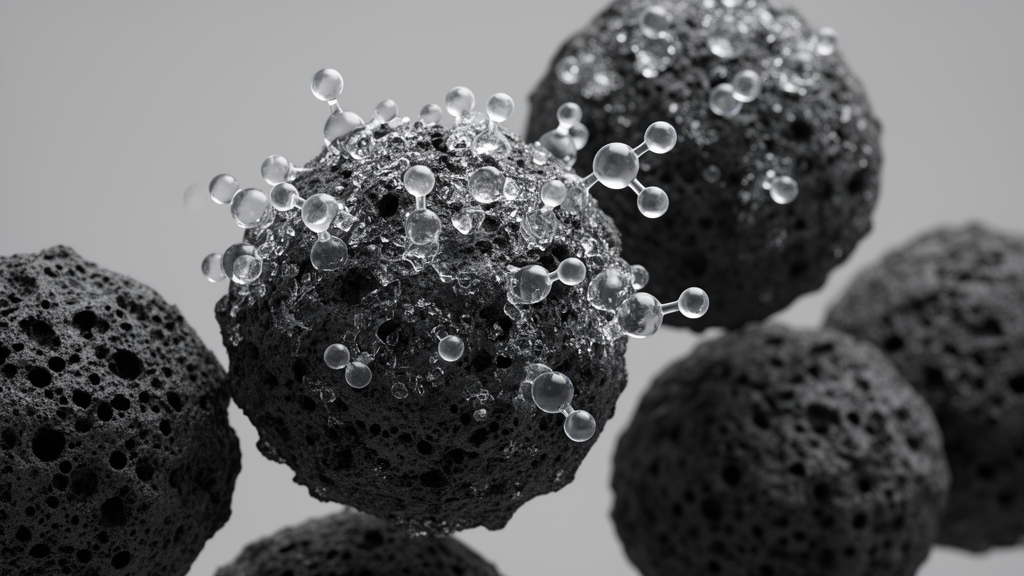
Formaldehyde is one of the most stubborn indoor air pollutants, emitted steadily from building materials, furnishings, and industrial processes, and linked to acute irritation of the eyes, skin, and respiratory tract as well as chronic conditions including asthma and elevated cancer risk. Adsorption onto activated carbon remains one of the most practical countermeasures because it works at ambient temperature with low energy demand, unlike catalytic or photocatalytic methods that require heat or light activation. Yet pristine activated carbon has an intrinsically nonpolar surface, and the polar carbonyl group of formaldehyde interacts only weakly with it, capping the material’s capacity for this particular gas. A new study now reports that a simple alkaline treatment can overcome this limitation, and that the improvement comes almost entirely from surface chemistry rather than from any expansion of the pore network.
Researchers systematically compared four widely used alkaline modifiers, ammonium hydroxide, sodium hydroxide, potassium carbonate, and potassium hydroxide, applied to the same commercial microporous activated carbon under rigorously controlled conditions. The pristine carbon was ground and sieved to particles of 212 to 260 micrometers, then stirred in aqueous base solutions at 80 degrees Celsius for five hours, washed to neutral pH, and dried. Samples were prepared at modifier concentrations of 0.1 and 2 molar for all four bases, with additional concentrations of 1, 3, and 4 molar tested for the best-performing modifier. The team then evaluated gaseous formaldehyde uptake in a fixed-bed reactor using breakthrough analysis, thermodynamic partition coefficients, humidity-dependent experiments, cyclic operation tests, and in situ diffuse reflectance infrared Fourier transform spectroscopy, known as DRIFTS.
The standout material was the carbon treated with 3 molar potassium hydroxide, designated AK-3. Under dynamic flow conditions with 10 pascals of formaldehyde, AK-3 achieved a total adsorption capacity of 25.52 milligrams per gram and a partition coefficient of 0.085 moles per kilogram per pascal, the highest values among all materials tested. That capacity is approximately 3.3 times higher than that of the pristine carbon, which managed only 7.71 milligrams per gram. The improvement was reproducible across triplicate experiments with a relative standard deviation below five percent. In comparative rankings, AK-3 outperformed the sodium hydroxide-treated sample at 17.93 milligrams per gram, the ammonium hydroxide sample at 14.86, and the potassium carbonate sample at 11.92.
The critical insight came when the researchers separated the contribution of porosity from that of surface chemistry. Nitrogen adsorption analysis showed that AK-3 retained a micropore surface area of 1021 square meters per gram, essentially unchanged from the pristine carbon’s 1019 square meters per gram, an increase of only 0.2 percent. Linear regression of adsorption capacity against micropore surface area across all twelve samples yielded a weak correlation coefficient below 0.3, whereas capacity tracked strongly with surface oxygen content measured by energy-dispersive X-ray analysis, which reached 6.65 weight percent oxygen on AK-3. In other words, a 0.2 percent change in porosity cannot plausibly explain a 3.3-fold capacity gain; the oxygen-bearing functional groups introduced by the base treatment are the dominant driver.
Multiple spectroscopic techniques converged on the same conclusion. Infrared spectroscopy revealed intensified bands for hydroxyl stretching between 3000 and 3500 wavenumbers, carbonyl stretching near 1670 and 1750 wavenumbers, and carbon-oxygen stretching between 1040 and 1120 wavenumbers on the treated surface. X-ray photoelectron spectroscopy identified phenolic, ether, carbonyl, and hydroxyl species on AK-3, and zeta potential measurements showed the surface charge shifting from about minus 27 millivolts on pristine carbon to minus 35.4 millivolts after treatment, consistent with a higher density of deprotonated hydroxyl and carboxylate groups. X-ray diffraction confirmed that the amorphous carbon framework itself was untouched, with no significant change in long-range crystalline order across all treated samples.
The authors propose that potassium hydroxide outperforms the other bases for three reasons. Potassium ions have a smaller hydrated radius and higher mobility than sodium or ammonium ions, allowing deeper penetration into the micropore network during impregnation. Potassium hydroxide is also a stronger base than ammonium hydroxide or potassium carbonate, and its reaction with surface carbon at 80 degrees Celsius generates additional oxygen-containing functionalities through controlled oxidation and etching of edge sites, without the severe structural damage caused by high-temperature activation. Finally, potassium ions can intercalate between graphitic layers, exposing additional edge sites for functionalization. By contrast, sodium hydroxide penetrates micropores less effectively, ammonium hydroxide decomposes during drying, and potassium carbonate is too weak a base to generate many reactive species under the mild conditions used.
In situ DRIFTS measurements under an air atmosphere provided the most direct mechanistic evidence. On pristine carbon, formaldehyde produced only weak, broad bands, indicating reversible physisorption dominated by van der Waals interactions with negligible chemical transformation. On AK-3, however, well-defined peaks grew over time: a band at 3650 wavenumbers for surface hydroxyl groups, bands at 1180 and 1017 wavenumbers characteristic of dioxymethylene species, and bands at 1580 and 1356 wavenumbers assigned to surface formate ions. This sequence suggests that adsorbed formaldehyde is converted first to dioxymethylene intermediates and then oxidized to formate, with molecular oxygen from the air stream driving the oxidation and the KOH-induced basic sites activating oxygen or stabilizing intermediates. The authors note that this evidence for conversion is indirect, based on peak assignments, and that definitive proof would require isotopic labeling or product desorption analysis.
Modeling results painted a nuanced picture of the dual-mode mechanism. The Freundlich isotherm fit the pressure-dependent data best, with a correlation coefficient of 0.999 and an exponent of 1.43 indicating favorable uptake on a heterogeneous, multilayer surface. The Dubinin-Radushkevich model yielded a mean adsorption energy of only 0.225 kilojoules per mole, far below the 8 to 40 kilojoules per mole typical of chemisorption, confirming that the bulk of formaldehyde uptake is physical pore filling. Kinetic analysis told a similar story: the pseudo-first-order model predicted capacities closely matching experimental values, while the pseudo-second-order model overestimated capacity, implying that chemisorption is not the rate-limiting step. Physical condensation within micropores therefore supplies the volumetric storage capacity, while localized chemisorption and surface oxidation at basic oxygen sites govern the retention affinity reflected in the elevated partition coefficient.
Practical operating conditions mattered considerably. Increasing the inlet formaldehyde partial pressure from 5 to 20 pascals raised total capacity from 15.48 to 40.11 milligrams per gram but accelerated early breakthrough, with the ten percent breakthrough volume falling from 74.8 to 29.8 liters per gram at higher concentrations. Humidity had a strong inhibitory effect on initial capture: at 80 percent relative humidity, the ten percent breakthrough volume dropped to 33.3 liters per gram as water molecules competed for the polar adsorption sites, although total capacity declined only moderately, from 25.52 to 22.66 milligrams per gram, because micropore filling remained partially accessible. Higher gas flow rates shortened contact time and reduced capacity utilization, and three consecutive adsorption cycles showed progressive decay, with capacity falling from 25.52 to 16.63 milligrams per gram, pointing to incomplete regeneration and irreversible occupation of some active sites.
Placed against previously reported sorbents, the KOH-modified carbon holds its own remarkably well. It exceeded the capacities of thiourea-modified steam-activated and phosphoric acid activated carbons, which reached only 16 to 17 milligrams per gram despite surface areas up to 1659 square meters per gram, roughly 1.6 times larger than AK-3’s 1037 square meters per gram. It also outperformed aminosilylated carbon, silver nitrate-modified carbon, nitric acid oxidized coconut carbon, and various polymer-based sorbents under the conditions compared. The authors argue that this demonstrates targeted surface-chemistry engineering can surpass porosity-centric strategies, offering a design principle for next-generation formaldehyde sorbents. With potassium hydroxide being a widely available industrial reagent and the modification requiring nothing more than aqueous stirring at 80 degrees Celsius followed by drying, the approach appears compatible with existing manufacturing. The cyclic capacity decay and humidity sensitivity remain open challenges, and the findings rest on laboratory fixed-bed experiments with a single commercial carbon, but the central result stands: on microporous activated carbon, base-generated oxygen functional groups, not pore development, are what turn a passive physisorbent into a chemically reactive trap for gaseous formaldehyde.
Subject of Research: Base modification of activated carbon for enhanced gaseous formaldehyde adsorption
Article Title: Base-generated functional groups as active drivers for the enhanced retention of gaseous formaldehyde on microporous carbon
Article References: Ahmadi, K., Maitlo, H. A., & Kim, K.-H. (2026). Base-generated functional groups as active drivers for the enhanced retention of gaseous formaldehyde on microporous carbon. Results in Engineering, 32, Article 113608. https://doi.org/10.1016/j.rineng.2026.113608
Image Credits: AI Generated
DOI: 10.1016/j.rineng.2026.113608
Keywords: formaldehyde, activated carbon, adsorption, potassium hydroxide, surface chemistry, indoor air quality, microporous carbon, DRIFTS, chemisorption, volatile organic compounds, breakthrough analysis, air purification
Cite Scienmag News
Bethany Barker. (October 24, 2026). KOH-Treated Activated Carbon Triples Formaldehyde Capture Through Surface Chemistry, Not Pores. Scienmag. https://scienmag.com/koh-treated-activated-carbon-triples-formaldehyde-capture-through-surface-chemistry-not-pores/
Bethany Barker. "KOH-Treated Activated Carbon Triples Formaldehyde Capture Through Surface Chemistry, Not Pores." Scienmag, 24 October 2026, https://scienmag.com/koh-treated-activated-carbon-triples-formaldehyde-capture-through-surface-chemistry-not-pores/. Accessed 24 October 2026.
Bethany Barker. "KOH-Treated Activated Carbon Triples Formaldehyde Capture Through Surface Chemistry, Not Pores." Scienmag. October 24, 2026. https://scienmag.com/koh-treated-activated-carbon-triples-formaldehyde-capture-through-surface-chemistry-not-pores/


