


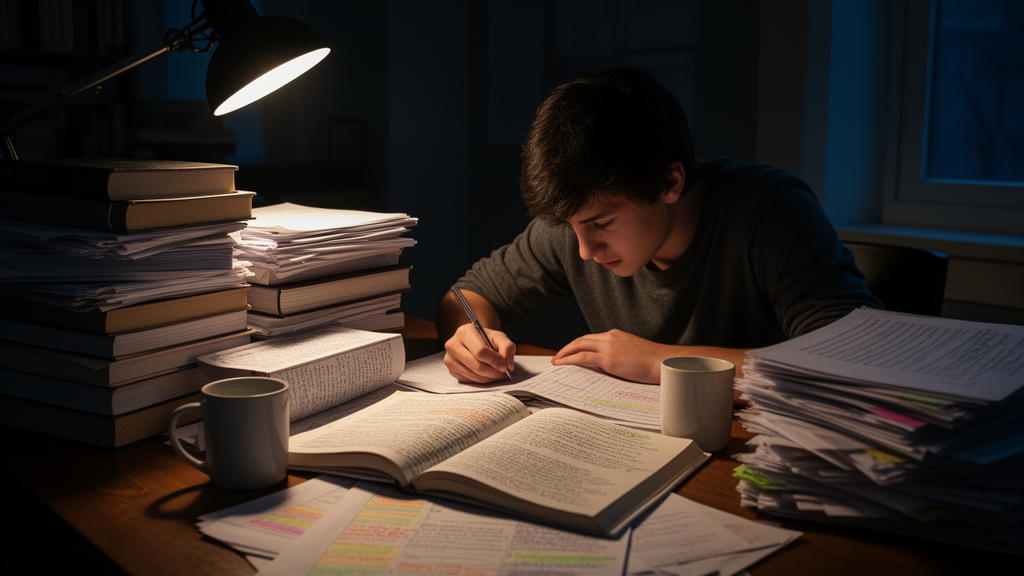
Students who fall behind at university are not necessarily failing to regulate their learning at all. Many of them plan, work, and reflect constantly — but in reactive, examination-driven, and emotionally fragile ways that quietly undermine the very goals they are trying to reach. That is the central conclusion of a mixed-methods study conducted at a public non-elite university in Guangdong Province, China, published in Discover Education. The research suggests that persistent academic difficulty may be better understood not as a simple deficit in self-regulated learning, but as a process the author calls regulatory distortion, in which regulatory activities continue yet become fragmented and misaligned with effective learning.
The study, led by Haiyan Xu, used an explanatory sequential mixed-methods design. In the first phase, 200 undergraduate questionnaires were distributed online; after screening out invalid responses, including reports of grade point averages exceeding the institution’s maximum, 120 valid questionnaires remained. The respondents were 86 men and 34 women aged 19 to 24, drawn from second-, third-, and fourth-year cohorts across multiple majors. Academic achievement was measured using cumulative GPA on the university’s five-point scale, which ranged from 1.89 to 4.05 with a mean of 3.13. Self-regulated learning was assessed with a Chinese adaptation of the Self-Regulation of Learning Self-Report Scale, covering six dimensions: planning, self-monitoring, effort, self-efficacy, evaluation, and reflection.
The quantitative results showed a consistent positive relationship between self-regulated learning and achievement. Overall SRL correlated with GPA at r = .52, and every individual dimension correlated significantly, with coefficients ranging from .29 for self-efficacy to .40 for effort. In a multiple linear regression, the six dimensions together explained 29.3 percent of the variance in GPA. But when the shared variance among the dimensions was accounted for, only two predictors remained statistically significant: effort (β = 0.282) and planning (β = 0.227). Monitoring, evaluation, reflection, and self-efficacy showed negligible unique effects once the other dimensions were controlled. Students classified as experiencing academic difficulty — those in the lowest 27 percent of the GPA distribution — reported significantly lower SRL than their peers across all six dimensions.
The second phase of the study dug into what those numbers actually mean in students’ daily lives. From the 32 students in the lowest GPA band, 21 of whom had documented course failures, the researcher purposively selected ten students who had failed courses in three consecutive semesters. All ten were male, comprising six second-year and four third-year students; none of the six female students in the lower-GPA group met the three-semester criterion. Each participated in a 30-to-40-minute semi-structured interview conducted in Chinese, organized around the six SRL dimensions and Zimmerman’s cyclical model of forethought, performance, and self-reflection. Interviews continued until thematic saturation was reached.
Four interrelated themes emerged. The first was reactive and examination-oriented regulation. Rather than planning deliberately across a semester, most participants described studying as something triggered by imminent exams. One student explained that he usually did not start reviewing until shortly before finals, and because so many subjects competed for attention, he often could not cover everything and failed courses as a result. Effort followed the same compressed rhythm: concentrated study occurred only in the days before exams, while problems encountered earlier were postponed. As unresolved questions accumulated, frustration and anxiety intensified, sometimes culminating in outright avoidance. One participant described reaching for his phone when he could not follow a lecture, watching undone questions pile up, feeling increasingly anxious, and eventually stopping studying altogether.
The second theme was superficial monitoring, evaluation, and reflection. Students showed some awareness of their emotional states and attention problems, but this awareness rarely translated into corrective action. Instead, they relied on external indicators such as teacher feedback and exam results, and several equated completing exercises with genuinely understanding the material — an illusion of understanding that collapsed at examination time. Evaluation focused on surface indicators like memorized problem-solving steps rather than conceptual grasp. Reflection, when it occurred, often took a maladaptive form: students attributed poor performance to stable, internal causes such as lack of ability rather than to controllable factors like ineffective strategies. One student said that even when he worked hard he still did worse than classmates, so it felt as though ability, not effort, made the difference — an interpretation that closed off the possibility of adjusting his approach.
The third theme was fragile, support-contingent self-efficacy. Only a few participants expressed confidence in their ability to complete academic tasks, and even that confidence depended on external conditions such as available teacher or peer support or sufficient preparation time. Most reported persistent self-doubt and fear of failure that led to disengagement rather than increased effort. Some described difficulties with self-control and concentration that further eroded their belief in independent learning. In the starkest example, one student admitted he skipped an exam because he was convinced he would fail it anyway. Success temporarily lifted confidence, but repeated failure quickly drained it, making self-efficacy fluctuate with short-term performance rather than function as a stable motivational resource.
The fourth theme concerned context. Teacher-related experiences shaped students’ willingness to engage in both directions: competent, engaging instructors fostered effort and sometimes produced acceptable grades despite ongoing difficulties, while negative experiences, some rooted in secondary school, triggered fear and avoidance that disrupted attention in class. One student said he had been afraid of mathematics since high school and could not really listen during university lectures. Family support was similarly inconsistent with students’ needs. Some participants found that family members did not understand their struggles, making them reluctant to communicate about them, while others described family expectations as unrealistic or mismatched with their actual academic situation.
Integrating both strands of evidence, the study argues that planning and effort play an ambivalent role. Statistically, they were the strongest predictors of GPA, consistent with prior meta-analytic findings. Qualitatively, however, struggling students did not lack planning or effort altogether — they enacted them in reactive, exam-driven ways characterized by last-minute cramming and a focus on short-term performance rather than deep understanding. Planning and effort appear to contribute to learning only when accompanied by continuous monitoring, adaptive reflection, and strategic adjustment; when those complementary processes are weak, they may sustain short-term examination performance while contributing little to long-term learning. The author links this pattern to resource-based accounts, in which immediate exam demands consume limited cognitive resources and crowd out proactive regulation, and to value-oriented perspectives, in which performance-focused goals direct regulatory effort toward passing tests rather than building competence.
The study’s limitations are substantial and worth keeping in view. The quantitative data were self-reported at a single institution with a modest sample, the cross-sectional design precludes causal inference, and demographic covariates were not controlled. The 27 percent cutoff for the academic-difficulty group was statistically derived and validated against course-failure records rather than a formal institutional criterion. The translated questionnaire lacked formal back-translation and factor-structure validation, and the self-monitoring subscale showed internal consistency below the conventional 0.70 threshold, so estimates involving it should be interpreted cautiously. The qualitative subsample was small, entirely male, and all coding was performed by a single researcher without independent co-coding or member checking. Within those constraints, the practical implication is clear: support for struggling students should move beyond urging greater effort or teaching isolated strategies, and instead help them build coherent regulatory processes — continuous monitoring, adaptive reflection, emotional regulation, and resilient self-efficacy — within learning environments that gradually cultivate genuine autonomy.
Subject of Research: Self-regulated learning and academic difficulty among undergraduates at a non-elite Chinese university
Article Title: Understanding academic difficulty through self-regulated learning at a non-elite Chinese university
Article References: Xu, H. (2026). Understanding academic difficulty through self-regulated learning at a non-elite Chinese university. Discover Education, 5(1), Article 1208. https://doi.org/10.1007/s44217-026-02346-4
Image Credits: AI Generated
DOI: 10.1007/s44217-026-02346-4
Keywords: self-regulated learning, academic difficulty, higher education, Chinese universities, GPA, mixed methods, metacognition, self-efficacy, planning, effort regulation, regulatory distortion, examination-oriented learning
Cite Scienmag News
Courtney Benton. (October 24, 2026). Struggling students still plan and work hard — but in distorted, exam-driven ways, study finds. Scienmag. https://scienmag.com/struggling-students-still-plan-and-work-hard-but-in-distorted-exam-driven-ways-study-finds/
Courtney Benton. "Struggling students still plan and work hard — but in distorted, exam-driven ways, study finds." Scienmag, 24 October 2026, https://scienmag.com/struggling-students-still-plan-and-work-hard-but-in-distorted-exam-driven-ways-study-finds/. Accessed 24 October 2026.
Courtney Benton. "Struggling students still plan and work hard — but in distorted, exam-driven ways, study finds." Scienmag. October 24, 2026. https://scienmag.com/struggling-students-still-plan-and-work-hard-but-in-distorted-exam-driven-ways-study-finds/


