


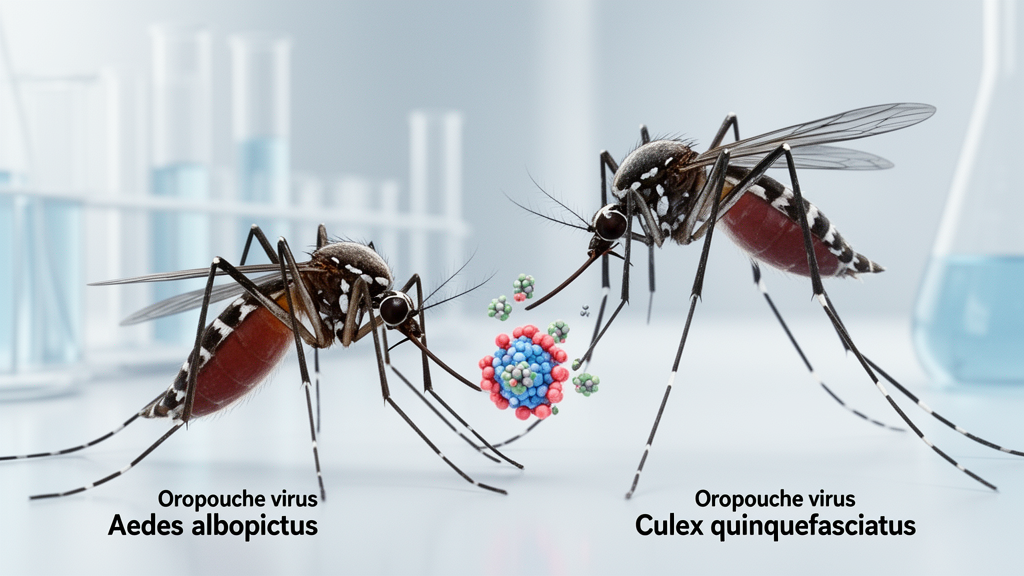
Oropouche virus, the cause of Oropouche fever across much of Latin America and the Caribbean, is transmitted mainly by the biting midge Culicoides paraensis, with occasional evidence pointing to mosquito involvement. In 2024, case numbers rose sharply and spread beyond the Amazon Basin, a surge associated with the emergence of a new reassortant Oropouche virus strain. A new laboratory study asked whether this expansion could be explained by more efficient replication or transmission of the reassortant strain in two peri-urban mosquito species, Culex quinquefasciatus and Aedes albopictus, and the answer, on current evidence, is largely no.
The researchers orally exposed laboratory colonies established from Salvador, Brazil to either the ancestral Oropouche strain BeAn 19991 or the contemporary outbreak strain 240023, using viral doses ranging from 10⁴ to 10⁶ PFU/mL. They then quantified viral replication in mosquito bodies, legs, and saliva, the standard steps for assessing vector competence: whether the virus infects the midgut, escapes into the hemocoel, and ultimately reaches the saliva in infectious form.
In Culex quinquefasciatus, the outbreak strain replicated less efficiently than the historical strain at low viral doses, although this difference disappeared at high infection doses. More decisively, regardless of strain or dose, vector competence was extremely low: only 0 to 1 percent of mosquitoes shed infectious Oropouche virus particles in their saliva after the extrinsic incubation period. These results indicate that Cx. quinquefasciatus is unlikely to sustain transmission of either viral strain under the conditions tested.
Aedes albopictus told a more nuanced story. The mosquitoes showed consistently higher body infection rates with the 240023 strain than with BeAn 19991, at both low and high doses, suggesting the reassortant virus infects this species more readily. Yet overall transmission potential remained limited: only 0 to 6.4 percent of leg or saliva samples were positive across strains and doses, meaning most infected mosquitoes never progressed to a transmissible state.
To evaluate the influence of mosquito genotype on infection outcomes, the team compared Ae. albopictus lines from Salvador City in Brazil and Houston in the United States. The higher infection rates of the 240023 strain held across both genotypes, but infectious saliva was detected only in the Salvador line, reaching up to 20 percent, and never in the Houston line, which stayed at 0 percent. This contrast suggests that local mosquito genetics shape whether higher infectivity translates into actual transmission potential.
Taken together, the findings indicate that the recent geographic expansion of Oropouche virus is unlikely to be driven by a vector shift from midges to these two mosquito species. The extremely low salivary shedding in Cx. quinquefasciatus and the limited transmission in Ae. albopictus, even with the contemporary strain, do not support the idea that mosquitoes are fueling the 2024 surge.
The authors do flag one forward-looking observation: the higher infectivity of the 240023 strain in Ae. albopictus across different mosquito lines may have implications if the virus further adapts to this species over time. That possibility remains speculative on the present evidence, and the study’s scope is confined to laboratory colonies and two mosquito species, so it cannot rule out roles for other vectors, other mosquito populations, or field conditions not reproduced in the lab.
As a laboratory vector-competence study with fixed viral doses and colony mosquitoes, the work measures potential rather than real-world transmission, and the observed differences in infection and salivary shedding carry the uncertainty inherent to small percentages and limited sample outcomes. Within those limits, the results argue against enhanced mosquito transmission as the explanation for Oropouche’s expansion, while leaving open the question of what actually drove the 2024 rise in cases beyond the Amazon region.
Subject of Research: Virology
Article Title: Vector competence of Aedes albopictus and Culex quinquefasciatus for Oropouche virus
Article References: Abu, A. E. I., Hua, X., Sattler, R., Becker, M. V., Forato, J., de Lima, S. T. S., Claro, I. M., Scachetti, G. C., Simões Mello, L. M., Sallum, M. A. M., Plante, K. S., Weaver, S. C., Proenca-Modena, J. L., de Souza, W. M., & Dickson, L. B. (2026). Vector competence of Aedes albopictus and Culex quinquefasciatus for Oropouche virus. PLOS Neglected Tropical Diseases, 20(10), e0014656. https://doi.org/10.1371/journal.pntd.0014656
Image Credits: AI Generated
DOI: 10.1371/journal.pntd.0014656
Keywords: Oropouche virus, Aedes albopictus, Culex quinquefasciatus, vector competence, arbovirus, reassortant strain, Brazil, mosquitoes, Culicoides paraensis, Oropouche fever, Vector, competence
Cite Scienmag News
Kristina Jarvis. (October 24, 2026). Lab study finds extremely low salivary transmission of Oropouche virus in Aedes albopictus and Culex quinquefasciatus. Scienmag. https://scienmag.com/lab-study-finds-extremely-low-salivary-transmission-of-oropouche-virus-in-aedes-albopictus-and-culex-quinquefasciatus/
Kristina Jarvis. "Lab study finds extremely low salivary transmission of Oropouche virus in Aedes albopictus and Culex quinquefasciatus." Scienmag, 24 October 2026, https://scienmag.com/lab-study-finds-extremely-low-salivary-transmission-of-oropouche-virus-in-aedes-albopictus-and-culex-quinquefasciatus/. Accessed 24 October 2026.
Kristina Jarvis. "Lab study finds extremely low salivary transmission of Oropouche virus in Aedes albopictus and Culex quinquefasciatus." Scienmag. October 24, 2026. https://scienmag.com/lab-study-finds-extremely-low-salivary-transmission-of-oropouche-virus-in-aedes-albopictus-and-culex-quinquefasciatus/


