


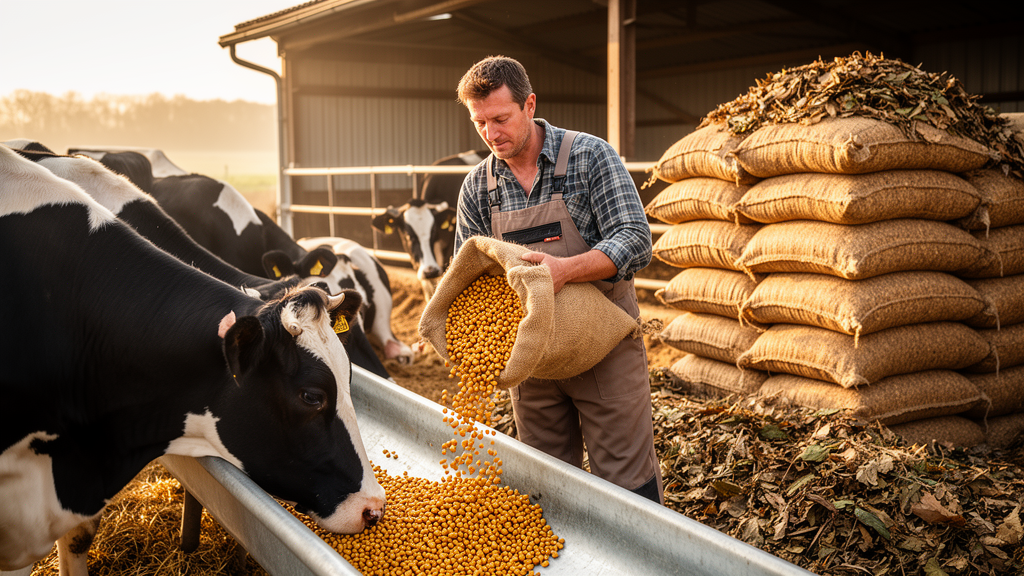
Livestock farming leaks nitrogen on an enormous scale. Roughly one-third of anthropogenic nitrogen emissions are attributed to livestock supply chains, and ruminants are among the least efficient converters of feed protein into milk and meat, excreting much of what they consume in urine and feces. A comprehensive review now examines whether phytogenic bioactives—the tannins, saponins, essential oils, alkaloids and other secondary metabolites found in plants and agri-food byproducts—can shrink that footprint, tracing nitrogen from the rumen all the way to manure-amended soil. Its verdict is cautiously encouraging but blunt: the most promising compounds can redirect nitrogen excretion, yet demonstrated improvements in nitrogen use efficiency and verified reductions in gaseous emissions remain elusive in many systems.
The problem begins in the rumen. Microbial proteases and peptidases break dietary protein into peptides and amino acids, which can be deaminated to ammonia. When microbes fail to capture that ammonia—something that depends heavily on a synchronous supply of fermentable carbohydrate—it is absorbed into the blood, converted to urea in the liver, and ultimately excreted in urine. Urinary nitrogen is the most environmentally damaging fraction, feeding ammonia volatilization, nitrate leaching and nitrous oxide emissions, a greenhouse gas with a 100-year global warming potential of 273 relative to carbon dioxide according to the IPCC Sixth Assessment Report. Hepatic urea can also be recycled to the gut, where microbial urease releases it again for microbial use; the widely cited 40 to 80 percent recycling range refers to the share of urea production entering the gut, not the fraction of dietary nitrogen captured into microbial protein.
The scale of the waste is quantifiable. In lactating Holstein cows, raising dietary crude protein from 13.5 to 19.4 percent of dry matter increased urinary nitrogen from 23.8 to 36.2 percent of nitrogen intake while cutting milk nitrogen efficiency from 36.5 to 25.4 percent. Once excreted, urea in urine is rapidly hydrolyzed by fecal urease, and emission factors vary enormously by management stage: a synthesis of land-application studies reported ammonia losses of 3 percent of applied nitrogen for broadcast cattle solid manure versus 24 percent for slurry in temperate wet climates. Nitrous oxide emission factors for cattle urine deposited on soil in wet climates were roughly five times those for dung, reflecting the readily available urea in urine compared with the organic nitrogen in feces that must first be mineralized.
Among the phytogenic options, tannins show the clearest and most reproducible effect on nitrogen partitioning. These polyphenols form reversible complexes with dietary proteins in the rumen, slowing microbial proteolysis and shifting excretion from urine toward feces. A meta-analysis of 97 small-ruminant studies confirmed lower urinary nitrogen and higher fecal nitrogen, but also reduced nutrient digestibility and no significant overall gain in retained nitrogen. Field and laboratory measurements add nuance: tannic acid supplementation at 16.9 grams per kilogram of dry matter in beef cattle reduced urine-derived nitrous oxide by roughly 41 to 46 percent in soil assays, while complete replacement of bermudagrass hay with sericea lespedeza hay in Florida cut cumulative urine-derived nitrous oxide by about 98 percent over two 32-day observation periods on a single soil type. Yet sorghum grain, despite lowering the urinary nitrogen share, actually increased urine-derived nitrous oxide—demonstrating that a favorable shift in excretion routes does not guarantee lower emissions.
Costs accompany these benefits. In dairy goats, increasing quebracho extract from zero to 6 percent of dietary dry matter depressed crude protein digestibility by up to 21 percent, with milk yield peaking at 4 percent and falling to its lowest at 6 percent, while nitrogen use efficiency did not improve. Three percent Acacia mearnsii extract in a low-CP dairy diet cut energy-corrected milk by 8 percent and nitrogen use efficiency by 4 percent, and added rumen-protected protein failed to restore performance. Practical constraints also bite: when grazing dairy cows were offered chestnut tannin extract targeting 5 to 10 grams per kilogram of dry matter, actual intake fell far short because the animals rejected the pellets, and no nitrogen use efficiency benefit materialized. The review stresses that commercial extracts, purified compounds and whole tannin-containing byproducts such as grape pomace or tea waste are not interchangeable, since byproduct composition varies with origin, season, processing and storage.
A particularly intriguing post-excretion mechanism involves hippuric acid, a urinary metabolite of dietary polyphenols. Laboratory experiments reported roughly 50 to 65 percent lower nitrous oxide after increasing the hippuric-acid fraction of urinary nitrogen, implicating its breakdown product benzoic acid in inhibiting soil nitrogen transformations. Feeding willow leaves, which contain both tannins and salicylates, to weaned Holstein bull calves altered urinary phenolic profiles; subsequent 48-hour soil incubations of that urine showed average ammonia and nitrous oxide emission rates reduced by 14 and 81 percent respectively. However, field studies adding hippuric or benzoic acid directly found no significant mitigation under the conditions tested, and an artificial-urine incubation showed hippuric acid can increase ammonia release while suppressing nitrous oxide—reminding researchers that effects on the two gases can diverge.
Essential oils present a far more mixed picture. Arnica montana oil produced linear decreases in urinary nitrogen and ruminal ammonia in lambs on high-concentrate diets, and cinnamaldehyde improved conversion of dietary nitrogen into milk protein in dairy cows. But commercial blends at practical doses, oregano oil or pure carvacrol at 50 milligrams per kilogram of dry matter, and graded eugenol supplementation repeatedly failed to improve nitrogen excretion or efficiency. In one comparison, simply lowering dietary crude protein from 165 to 155 grams per kilogram reduced nitrogen excretion, while adding an essential oil blend to the lower-protein diet provided no additional benefit. Alkaloids show compound-specific promise: enriched mesquite piperidine alkaloid extract allowed dietary crude protein to drop from 16 to 13 percent without compromising nitrogen retention in lambs, and the protoberberine alkaloid epiberberine disrupted urease maturation in vitro, lowering ammonia by 13 to 16 percent at laboratory concentrations that cannot yet be translated into feeding recommendations.
Plantain-derived aucubin and saponins illustrate how mechanistic leads can fade under field scrutiny. A field experiment applying aucubin with bovine urine reported 70 percent lower nitrous oxide, but two subsequent field trials found no significant cumulative reduction. A meta-analysis of plantain pastures showed approximately 22 percent lower daily urinary nitrogen and 17 percent greater urine volume relative to ryegrass–white clover controls, but these whole-forage effects cannot be assigned to aucubin alone. Saponins reliably suppress rumen protozoa through membrane cholesterol complexation, yet a meta-analysis found no consistent overall gain in nitrogen retention, and Quillaja extract in lambs reduced protozoa while paradoxically lowering fiber digestibility without improving nitrogen use. Defaunation, it turns out, is not synonymous with better nitrogen capture.
The review also surveys monitoring methodology, warning that the endpoints most easily measured are frequently misinterpreted. Ruminal ammonia concentrations, milk urea nitrogen and blood urea are contextual indicators rather than proof of improved efficiency—increased dietary salt lowered milk urea nitrogen without reducing daily urinary urea excretion in a controlled study. Mid-infrared spectroscopy offers high-throughput milk urea estimation but requires population-specific calibration, and chamber-based gas flux measurements, photoacoustic and cavity ring-down spectroscopy, and open-path Fourier transform infrared with inverse dispersion modeling each carry instrument- and design-specific limitations that must be documented for emission factors to be comparable across studies.
Looking forward, the authors outline gene editing as a prospective route to deliver these bioactives directly in forage, noting that CRISPR/Cas9 has already modified specialized-metabolite pathways in plants and edited lignin traits in alfalfa. But no end-to-end demonstration currently links a targeted increase in forage bioactives to sustained animal nitrogen use efficiency gains and lower measured ammonia or nitrous oxide emissions. The bottom line is disciplined: tannins can reliably shift nitrogen from urine to feces, urinary metabolites may modify soil processes, and laboratory mechanisms abound—but whether any of this translates into farm-scale mitigation requires longer-term trials connecting animal nitrogen balance with manure storage, soil emissions, crop nitrogen recovery and honest economic accounting, including the null and adverse results that determined which interventions survive scrutiny.
Subject of Research: Phytogenic bioactive compounds for reducing nitrogen losses in ruminant production from rumen to soil
Article Title: Valorizing Phytogenic Byproducts to Reduce Ruminant Nitrogen Footprint: From Rumen to Soil
Article References: Chen, Y., Liu, R., Zhao, X., Fang, L., Jiang, L., & Zhao, Y. (2026). Valorizing Phytogenic Byproducts to Reduce Ruminant Nitrogen Footprint: From Rumen to Soil. Journal of Agriculture and Food Research, Article 103388. https://doi.org/10.1016/j.jafr.2026.103388
Image Credits: AI Generated
DOI: 10.1016/j.jafr.2026.103388
Keywords: ruminants, nitrogen use efficiency, tannins, essential oils, saponins, alkaloids, aucubin, ammonia emissions, nitrous oxide, phytogenic feed additives, agri-food byproducts, manure management
Cite Scienmag News
William Thompson. (October 23, 2026). Plant Byproducts Could Trim Livestock’s Nitrogen Footprint, Review Finds, but Evidence Gaps Remain. Scienmag. https://scienmag.com/plant-byproducts-could-trim-livestocks-nitrogen-footprint-review-finds-but-evidence-gaps-remain/
William Thompson. "Plant Byproducts Could Trim Livestock’s Nitrogen Footprint, Review Finds, but Evidence Gaps Remain." Scienmag, 23 October 2026, https://scienmag.com/plant-byproducts-could-trim-livestocks-nitrogen-footprint-review-finds-but-evidence-gaps-remain/. Accessed 23 October 2026.
William Thompson. "Plant Byproducts Could Trim Livestock’s Nitrogen Footprint, Review Finds, but Evidence Gaps Remain." Scienmag. October 23, 2026. https://scienmag.com/plant-byproducts-could-trim-livestocks-nitrogen-footprint-review-finds-but-evidence-gaps-remain/


