In the shaded understory of an Araucaria forest in southern Brazil, female yerba mate trees are quietly outperforming their male neighbors — but not in the way raw growth numbers would suggest. A two-year field study, now analyzed with gradient boosting machine learning, has revealed that the two sexes of this subtropical, dioecious tree track light in fundamentally different ways. Females follow the sheer quantity of light — daily photon totals and morning intensity — while males respond more strongly to the spectral quality of low-angle morning light and to the length of the night. The finding, published in Frontiers in Photobiology, reframes how secondary sexual dimorphism is expressed in trees and suggests that sex differences in plant performance are written not in raw growth numbers, but in how each sex decodes its light environment.
The research team, led by Miroslava Rakocevic of the State University of North Fluminense and colleagues at UNICAMP and the Pontifical Catholic University of Paraná, followed 30 yerba mate trees (Ilex paraguariensis St. Hil.) growing in two contrasting cultivation systems near Barão de Cotegipe in Rio Grande do Sul: a full-sun monoculture plantation and an agroforestry system beneath a mature forest canopy dominated by Araucaria angustifolia. Ninety tagged main axes were observed monthly for 25 months, from June 2003 to June 2005, spanning two complete annual growth cycles. The dataset — extending earlier published work with never-before-analyzed light measurements — included five branch-scale growth traits, eight leaf-scale gas exchange parameters, and a full suite of climate and light variables.
The light contrast between the two systems was dramatic. At midday, the average photosynthetic photon flux density reaching the upper leaf layer of monoculture plants was 938.5 µmol photons per square meter per second, compared with just 80.7 µmol photons per square meter per second in agroforestry — a roughly twelvefold difference. The red-to-far-red ratio (R:FR), the spectral cue that plants use to detect shade, averaged 1.023 in monoculture but only 0.683 in agroforestry at midday. Crucially, the team also measured light during low-sun-angle morning and afternoon periods, which most studies ignore. In the deep agroforestry understory, morning R:FR plummeted to an average of 0.503 — decisively below the roughly 0.6 threshold that triggers the shade-avoidance syndrome in many species — delivering a persistent, unambiguous shade signal to the plants each dawn.
The morning–afternoon asymmetry proved to be one of the study’s most striking discoveries. Across all environments, morning R:FR was consistently the lowest of the three diurnal periods, and the gap between morning and afternoon values widened systematically with canopy shade depth, from a modest difference in the open field to a pronounced one beneath the forest canopy. The two low-angle periods, the authors conclude, are not interchangeable: afternoon sunlight penetrating from the west passed through different canopy structures than morning light from the east, undergoing less selective red-wavelength filtering. This matters biologically because the morning period, carrying the day’s deepest shade signal, turned out to be the strongest driver of monthly leaf area and leaf number production.
At the leaf level, the gradient boosting machine — an ensemble method that builds roughly 150 sequential decision trees, each correcting the errors of the last — cleanly partitioned the ecophysiological traits by their environmental drivers. Net CO2 assimilation, transpiration, intrinsic water-use efficiency, and light-use efficiency were primarily governed by midday photon flux, which alone explained 81 percent of the importance weighting for assimilation. Stomatal conductance, instantaneous water-use efficiency, and the leaf-to-air temperature difference, by contrast, were driven primarily by the midday R:FR ratio, implicating the phytochrome system — the photoreceptors that sense red and far-red light — in stomatal and thermal regulation. Classical statistics confirmed a consistent pattern of female dominance: in monoculture, females showed significantly higher assimilation, transpiration, and intrinsic water-use efficiency than males, while in agroforestry, female superiority extended to light-use efficiency and leaf cooling capacity.
For growth architecture, the environment overwhelmed sex differences in absolute terms. Monoculture trees produced approximately five times as many primary branches as their agroforestry counterparts (40.6 versus 8.3 on average), and their crowns were dominated by medium-length, plagiotropic — horizontally oriented — branches. The shaded agroforestry trees, meanwhile, stretched upward with fewer but longer, almost entirely erect branches, a textbook shade-avoidance response aimed at escaping the canopy. When the team normalized branching by the light each system actually received, a remarkable inversion appeared: agroforestry plants were roughly twice as efficient at producing branches per unit of daily light integral as monoculture plants. Notably, male-biased branching emerged only in the high-light monoculture, where males branched more than females; in the shade, the sexes branched alike.
When the researchers trained the machine learning model to classify plant sex from growth data alone, it succeeded with 72.2 percent accuracy and a ROC-AUC of 0.709 — and, tellingly, every ounce of that predictive power came from the growth traits themselves. Environmental features contributed nothing, because both sexes within each plot experienced identical light and climate. Sex, in other words, was encoded in how each shoot grew, not in where it grew. Training separate models for each sex then exposed the crossover at the heart of the study: morning R:FR was far more important to females for shoot elongation (37.0 percent versus 16.1 percent for males), yet far more important to males for leaf number increase (30.5 percent versus 2.0 percent). Female metamer emission was overwhelmingly driven by night length (72.3 percent), while males split that process between night length and morning R:FR.
The sensitivity analysis sharpened the picture further. Females consistently tracked daily light integral and peak-hour photon flux more closely than males, whereas males responded more to low-angle spectral signals and to photoperiod. Pearson correlations reinforced the pattern: female shoot elongation correlated positively and significantly with all six light signals measured, while male elongation showed no significant correlation with midday or afternoon light and even slightly negative correlations with morning R:FR. Yet in mean monthly values across the 25 months, no trait showed a statistically significant sex effect — the dimorphism lived entirely in the light-tracking behavior, not in the raw growth totals. The authors argue this is precisely why classical pairwise analyses missed it, and why a multivariable machine learning framework, which handles collinearity and interactions among all thirteen environmental variables simultaneously, could detect it.
The sex-specific signal routing may be tied to the resource demands of each sexual function. As a dioecious species, yerba mate females bear the carbon cost of producing fruits and seeds, and their tighter tracking of light quantity — and modestly higher leaf-level carbon and water performance — was consistent with supporting that additional reproductive burden in this study. Males, which appeared more attuned to the photoperiodic calendar and low-angle spectral cues, branched more prolifically when light was abundant. The study also carries practical weight for yerba mate cultivation, whose leaves supply the region’s iconic mate infusions. Agroforestry systems, though yielding far less biomass, mimic the species’ natural forest habitat and produced leaves roughly twice as efficient at converting each photon into both fixed carbon and new branches.
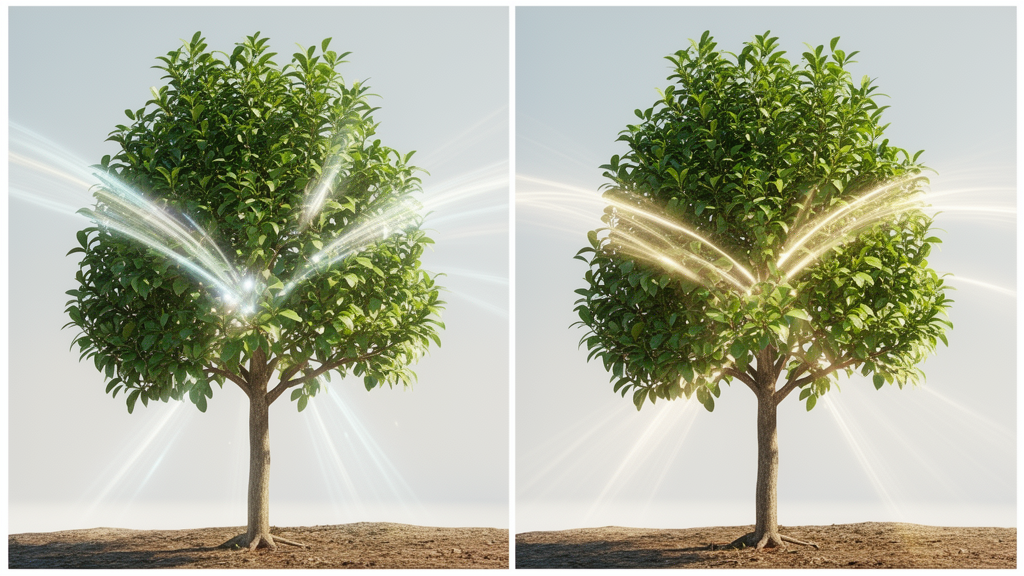
The deeper lesson may extend well beyond one species. If the same environmental cue — the cool, far-red-rich light of a forest morning — is interpreted one way by female trees and another by males, then plantation designs and growth projections for dioecious species may need to account for sex-specific light perception. The work also highlights how machine learning can extract patterns that classical statistics leave buried: not bigger differences between the sexes, but different ways of reading the world. For yerba mate, the forest’s morning light speaks two languages, and each sex has learned to listen to a different one.
Subject of Research: Light, photoperiod, and temperature drive growth, functional, and secondary sexual dimorphism modulations in yerba mate: new insights provided by machine learning
Article Title: Light, photoperiod, and temperature drive growth, functional, and secondary sexual dimorphism modulations in yerba mate: new insights provided by machine learning
Article References: Rakocevic, M., & Alomenu, D. (2026). Light, photoperiod, and temperature drive growth, functional, and secondary sexual dimorphism modulations in yerba mate: new insights provided by machine learning. Frontiers in Photobiology, 4, Article 1971844. https://doi.org/10.3389/fphbi.2026.1971844
Image Credits: AI Generated
DOI: 10.3389/fphbi.2026.1971844
Keywords: Light, photoperiod, temperature, drive, growth, functional, secondary, sexual, dimorphism, modulations, yerba, mate
Cite Scienmag News
Teresa Odom. (October 23, 2026). Machine Learning Reveals Male and Female Yerba Mate Trees Read Light in Radically Different Ways. Scienmag. https://scienmag.com/machine-learning-reveals-male-and-female-yerba-mate-trees-read-light-in-radically-different-ways/
Teresa Odom. "Machine Learning Reveals Male and Female Yerba Mate Trees Read Light in Radically Different Ways." Scienmag, 23 October 2026, https://scienmag.com/machine-learning-reveals-male-and-female-yerba-mate-trees-read-light-in-radically-different-ways/. Accessed 23 October 2026.
Teresa Odom. "Machine Learning Reveals Male and Female Yerba Mate Trees Read Light in Radically Different Ways." Scienmag. October 23, 2026. https://scienmag.com/machine-learning-reveals-male-and-female-yerba-mate-trees-read-light-in-radically-different-ways/