


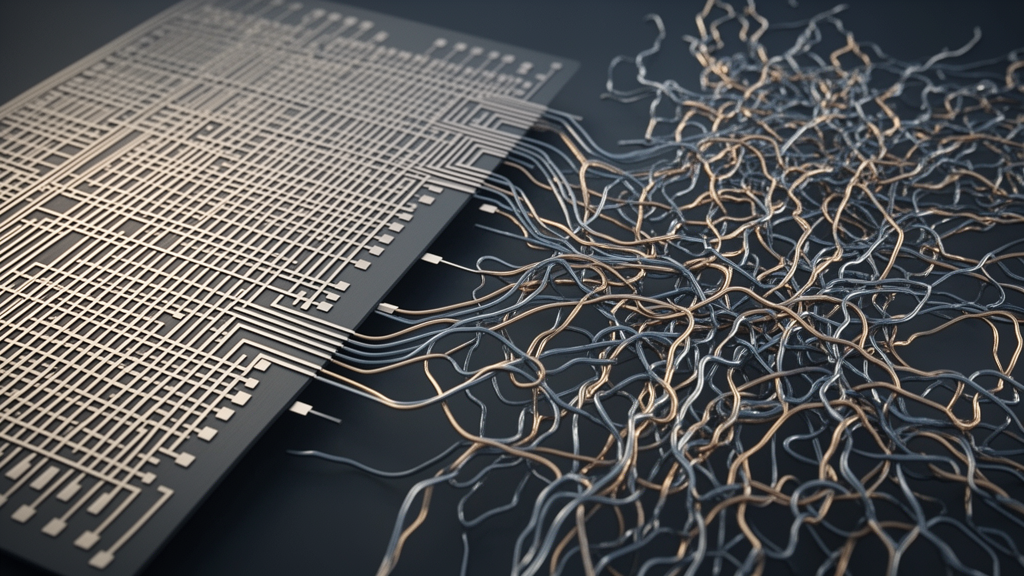
Robots that can feel the world have long borrowed their designs from biology, but a new study shows that one of biology’s apparent quirks — messy, scattered wiring in the skin — may actually outperform the tidy layouts engineers tend to prefer. In research published in Frontiers in Computational Neuroscience, Alejandro Pequeño-Zurro of the University of Groningen, working with Chiara Bartolozzi of the Italian Institute of Technology and Elisabetta Chicca, built spiking neural networks that learn to detect the orientation of edges pressed against a simulated patch of robot skin. The networks run without any supervision, use only local learning rules compatible with existing neuromorphic chips, and, unexpectedly, performed best when their first layer of neurons sampled the skin almost at random rather than through the orderly local windows typical of artificial vision and touch systems.
The motivation comes from the human hand. Neurophysiological work by Pruszynski and Johansson showed that orientation selectivity — the ability of a neuron to respond preferentially to edges aligned in a particular direction — already appears in first-order afferent nerves in the peripheral nervous system, not only in the cortex. Their recordings revealed that these nerve fibers pool signals from mechanoreceptors spread in patchy, irregular clusters across the skin rather than in neat contiguous zones. The clusters overlap, their sizes vary from small fields at the fingertips to wider ones on the palm, and their sparse activation contributes to an efficient tactile code. The new model borrowed two of these properties directly: the patchy, overlapping shape of the receptive fields and the way their outputs converge on later processing stages.
The artificial system is deliberately compact. Its simulated skin patch contains a 15 by 15 grid of tactile elements, or taxels, inspired by the capacitive skin of the iCub humanoid robot. A bar, two taxels wide and fifteen long, was pressed against this surface at orientations distributed evenly around 360 degrees, with random shifts in position and partially occluded activation to mimic the varying pressure a tilted bar produces. An encoding layer converts pressure values into Poisson spike trains whose firing rates follow the instantaneous pressure, echoing the behavior of slowly adapting mechanoreceptors. Those spikes then feed a fixed layer of 144 neurons whose receptive fields are set in advance, followed by an output layer of 80 spiking neurons that learn through experience.
Only the connections between the receptive field layer and the output layer are learned, and they learn by a biologically plausible, calcium-based rule of the kind developed by Brader and colleagues. Rather than tracking precise spike timings as spike-timing-dependent plasticity does, the rule monitors a calcium trace that rises with postsynaptic firing and decays exponentially. When a presynaptic spike arrives, the synapse is potentiated or depressed depending on the postsynaptic membrane voltage and where the calcium trace sits between defined thresholds. Every synapse is binary and bistable, holding one of two stable states, which supports long-term memory retention in spiking hardware. The membrane voltage condition also injects stochasticity, so which neurons win the race to strengthen their connections depends partly on chance — a feature the authors turned into an advantage.
What makes the scheme work without a teacher signal is self-regulation inside the output layer. Each output neuron excites itself and inhibits its neighbors. Self-excitation acts like an internally generated teaching signal: a neuron that fires early boosts its own calcium trace into the potentiation range, locking in whichever input patterns drove it. Lateral inhibition then silences competitors, preventing them from crossing their own potentiation thresholds and pushing the population to divide the input space among themselves. The authors demonstrate this dynamics step by step: in a single stimulus presentation, the neurons that reach the potentiation window first reinforce their synapses, while inhibited ones do not, so different neurons end up tuned to different orientations without anyone labeling the data. Hyperparameters were tuned for every condition using Optuna, a Bayesian optimization framework, to keep comparisons fair.
When the team benchmarked three ways of wiring the receptive field layer — fully random taxel selection with no spatial constraint, the biologically inspired
— unstructured clusters, and the conventional kernel layout — the team found that every neuron in the fixed first layer received exactly the same budget of connectivity: sixteen active binary weights, regardless of how those weights were arranged on the skin. This control matters, because it isolates spatial structure as the only variable. The kernel condition tiled the surface with square local windows and no randomization at all. The unstructured condition, modeled on the biological afferents, scattered five small clusters of three adjacent taxels across the patch, so each neuron sampled both local contiguity and distant, weakly correlated regions. The random condition removed the spatial constraint entirely, letting each neuron draw its sixteen taxels from anywhere on the surface. Because the total number of active weights was held constant across conditions, any difference in performance could be attributed to how the sampling was distributed rather than to how much of the skin each neuron watched.
The benchmark results were unambiguous. Across every number of orientation classes tested, accuracy declined as the angular spacing between stimuli shrank, as expected for a harder discrimination problem, but the ordering of the three receptive field types held throughout: random fields performed best on average, the biologically inspired unstructured fields came second, and the kernel fields trailed in every comparison, with statistically significant differences between the conditions. Taking the fourteen-class task — orientations separated by 25.7 degrees — as a reference point, the random-field networks misclassified stimuli by a mean of only 1.05 degrees, roughly four percent of the spacing between neighboring classes. The unstructured fields produced a mean error of 9.21 degrees, about 36 percent of a discrimination step, while the kernel fields erred by 20.67 degrees, or 80 percent of a step. At eighteen classes, the random-field networks reached a mean error of 5.15 degrees, a figure that sits comfortably alongside published results from real event-based tactile fingertips, despite the new system learning and deciding entirely through its own network activity rather than an external classifier.
The advantage of the distributed wirings was largest exactly where discrimination is hardest: at fine angular resolution and small positional offsets of the bar. When the bar’s location on the skin was jittered by a few taxels, the random and unstructured conditions retained higher accuracy than the kernel condition, although they were also more sensitive to the hyperparameters tuned for each offset. Beyond an offset of about five taxels, performance fell sharply for all three conditions, marking a practical limit on how much positional variability the compact network can absorb. The authors note that the slope of this decline differs between conditions because each network was tuned individually, so the sensitivity reflects the interplay of receptive field structure and optimization rather than structure alone.
Sparsity measurements reinforced the efficiency story. In the trained networks, activity in the receptive field layer compressed dramatically on its way to the output layer: the ratio of spikes emitted by the first layer to those emitted by the output layer ranged from 6.2-fold for the random condition to 148-fold for the kernel condition. Both the Gini coefficient and the Treves–Rolls sparseness measure confirmed that output activity was highly sparse per stimulus, even though the network was never explicitly optimized for sparsity. Interestingly, the random fields, which achieved the highest accuracy, produced the least sparse output code of the three conditions. The authors interpret this as evidence that the self-regulating dynamics retain whichever units are needed for discrimination rather than maximizing sparsity for its own sake — a trade-off between representational capacity and metabolic economy that mirrors debates about coding strategies in biological sensory systems.
The system also proved adaptable after deployment. In an incremental learning experiment, networks first trained to discriminate orientations separated by 30 degrees were retrained, with learning reactivated, to resolve finer differences down to 20 degrees. The earlier classes were retained with little or no forgetting, and the incrementally trained networks outperformed networks trained independently on the finer task from scratch. The authors attribute this to the structure of the task itself: new, finer orientation classes overlap substantially with those already learned, so the new representations build on existing ones. For a deployed robotic system, this means angular resolution can be improved over the lifetime of the hardware without erasing what the system already knows — a property directly relevant to lifelong learning applications.
A first-order energy estimate, derived from spike statistics rather than hardware measurement, put the cost of classifying a single stimulus between 0.16 and 17.18 microjoules depending on the neuromorphic platform and task difficulty. The architecture was deliberately kept small enough to fit on current mixed analog-digital neuromorphic chips such as BrainScaleS-2, Dynap-se2, and Texel, and the learning rule touches only local signals — presynaptic spikes, postsynaptic voltage, and the calcium trace — so no weight transport or global error signal is required. The fixed receptive field layer can be hardwired near the sensors, leaving only the plastic output synapses to be implemented in reconfigurable memory.
The study is candid about its limits. The stimuli are synthetic and instantaneous, with no temporal dynamics of contact onset; real recorded tactile data with realistic time structure is the natural next test. Performance depends on careful per-condition hyperparameter tuning, and the authors suggest that homeostatic mechanisms could let the network self-adjust its activity levels and relax this dependence. The energy figures await validation on physical hardware. Even so, the central finding stands on its own: the structure of the receptive field layer is a first-order determinant of what a neuromorphic tactile system can learn, and the apparently haphazard wiring that biology arrived at may be less a constraint of anatomy than a design principle worth copying.
Subject of Research: Orientation detection for self-calibrating neuromorphic systems
Article Title: Orientation detection for self-calibrating neuromorphic systems
Article References: Pequeño-Zurro, A., Bartolozzi, C., & Chicca, E. (2026). Orientation detection for self-calibrating neuromorphic systems. Frontiers in Computational Neuroscience, 20, Article 1878557. https://doi.org/10.3389/fncom.2026.1878557
Image Credits: AI Generated
DOI: 10.3389/fncom.2026.1878557
Keywords: Orientation, detection, self-calibrating, neuromorphic, systems, scientific research
Cite Scienmag News
Denise Maddox. (October 23, 2026). Random Skin Wiring Beats Neat Layouts in Self-Calibrating Touch Circuits. Scienmag. https://scienmag.com/random-skin-wiring-beats-neat-layouts-in-self-calibrating-touch-circuits/
Denise Maddox. "Random Skin Wiring Beats Neat Layouts in Self-Calibrating Touch Circuits." Scienmag, 23 October 2026, https://scienmag.com/random-skin-wiring-beats-neat-layouts-in-self-calibrating-touch-circuits/. Accessed 23 October 2026.
Denise Maddox. "Random Skin Wiring Beats Neat Layouts in Self-Calibrating Touch Circuits." Scienmag. October 23, 2026. https://scienmag.com/random-skin-wiring-beats-neat-layouts-in-self-calibrating-touch-circuits/


