


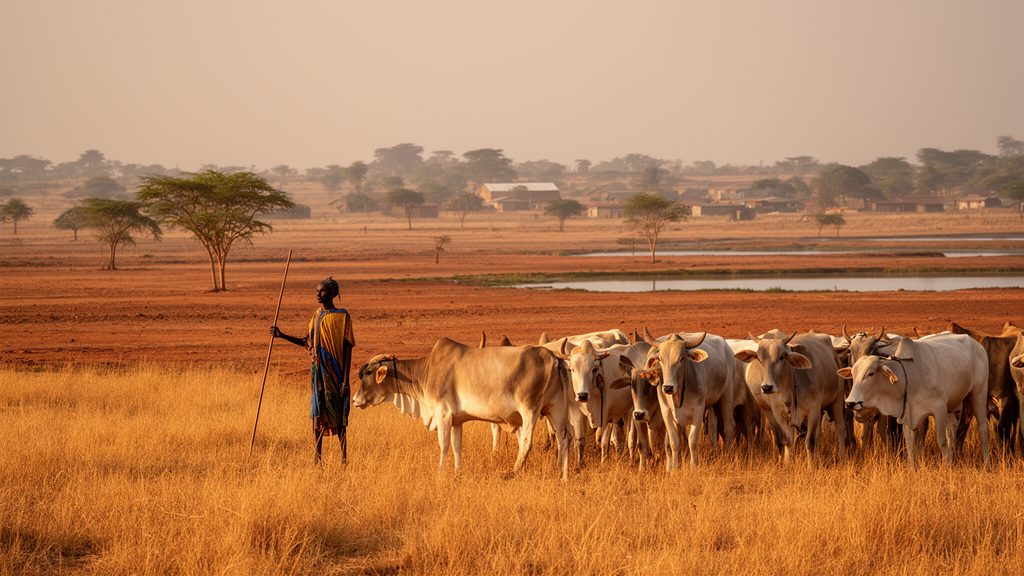
In the heart of Côte d’Ivoire, the fate of sedentary cattle farming may hinge less on climate data alone and more on where a herder’s family came from. A new cross-sectional survey of 126 cattle farmers in the central Ivorian towns of Bouaké and Toumodi reveals that historical settlement patterns, pastoral tradition in one town and a non-pastoral, peri-urban origin in the other, strongly influence how farmers perceive climate hazards and which strategies they deploy against livestock feed gaps. The study, conducted by researchers from the University of Göttingen and Ivorian and Senegalese partner institutions, found that nearly all herders reported changing rainfall patterns and rising temperatures, and that the overwhelming majority, 88 percent, perceive feed gaps, periods when available forage fails to meet the nutritional needs of their animals, as a recurring threat to their herds.
The research team chose the two study sites deliberately as contrasting case studies. In Toumodi, herder communities predominantly descend from Fulbe (Peul) pastoralists of Sahelian origin, whose herds migrated southward over recent decades in response to recurrent droughts and changing access to rangelands. Many of these families subsequently adopted semi-transhumant or fully sedentary lifestyles under comparatively favourable integration into Ivorian state policy. Bouaké’s herders, by contrast, come mostly from local agricultural populations who took up cattle-keeping as a peri-urban commercial enterprise without any inherited tradition of herd mobility. Bouaké, Côte d’Ivoire’s second-largest city, also offers a more diversified urban economy, meaning many herders there treat livestock as a secondary activity, while in Toumodi, 89.2 percent of respondents considered livestock keeping their primary economic activity, compared with just 48.3 percent in Bouaké.
The survey, conducted in April 2024 with the assistance of extension officers from the National Ministry of Animal and Fisheries Resources, used semi-structured interviews and snowball sampling to reach herders in both locations. All respondents were male, reflecting the socio-cultural context in which large livestock ownership in central Côte d’Ivoire is predominantly managed by men, and most were aged between 31 and 50. Toumodi contributed 66 farms and Bouaké 60. The differences between the sites were striking: average herd size in Toumodi was 114.1 cattle, roughly double the Bouaké average of 56.4, and 75 percent of Toumodi respondents were foreign-born, hailing from countries including Burkina Faso, Mali and Niger, compared with 25 percent in Bouaké. Overall, 75 percent of farmers identified as livestock-only producers, while a quarter combined herding with crop cultivation.
When it came to climate hazards, the picture was broadly shared but subtly different between the sites. Approximately 94 percent of herders reported increased breaks in rainfall, and 82.5 percent perceived a rise in mean temperatures. The perception of rainfall breaks did not differ significantly between locations, suggesting a common concern over intra-seasonal rainfall distribution regardless of settlement history. However, the perception of rising temperatures was significantly more prevalent in Bouaké, at 93.3 percent, than in Toumodi, at 72.7 percent. Comparisons of long-term weather records from 1981 to 2010 with recent years from 2018 to 2023 showed strong temperature increases in both locations, along with increased rainfall in Toumodi and a decrease in Bouaké between April and August, indicating that herders’ observations align, to some extent, with actual weather changes.
One of the study’s more intriguing technical findings concerns the discrepancy between rainfall perceptions and measured totals. Only 4.8 percent of herders perceived an increase in total rainfall, even though station data showed an overall rainfall increase in Toumodi. The authors explain that herders’ perceptions largely reflect changes in the intra-seasonal distribution of rain rather than monthly or seasonal totals. Prolonged dry spells within the rainy season, such as a late onset of rains, would be registered as increased rainfall breaks even in a year with above-average totals. Because such dry spells reduce soil water availability and pasture growth, they can directly trigger livestock feed gaps, making this perceptual distinction ecologically meaningful rather than a simple measurement error.
Feed gaps emerged as the central vulnerability of the sedentary systems studied. The perception of feed gaps and their frequent occurrence did not differ significantly between locations, with roughly 88 percent of herders in both towns reporting regular gaps. Nearly 100 percent of farmers in both locations reported animal body weight loss during feed-gap periods, indicating a long-term drag on farm productivity. But the downstream consequences diverged sharply by location. In Bouaké, feed gaps were linked to harsher outcomes: roughly 75 percent of herders reported increased animal theft associated with greater mobility, more than half reported animal mortality, and financial losses from premature distress sales of animals at reduced prices were perceived as significant. In Toumodi, impacts were often described as negligible or moderate, with the exception of milk reduction, which all herders there reported as a significant effect.
The logistic regression models revealed that structural factors, location, grazing system and settlement history, outweighed socioeconomic variables in shaping perceptions. Residing in Toumodi was associated with a significantly lower perceived risk of climate hazards, and seasonal grazing marginally decreased the probability of perceiving hazards. At the same time, Toumodi herders recorded the highest perception of new livestock diseases, at 81.8 percent versus 50 percent in Bouaké. The authors attribute this apparent paradox to management differences: Toumodi’s larger herds and greater reliance on mobility give herders more control over feed resources, buffering them against seasonal shortages, but moving animals across landscapes also exposes them to new disease environments. The authors note that no feed samples were analyzed, so differences in feed quality between the sites could not be tested, and the models showed only moderate fit.
Adaptation strategies split cleanly along the settlement-history divide. Increased herd mobility was the primary coping strategy in Toumodi, reported by 76.9 percent of herders, compared with roughly 50 percent in Bouaké, a difference that was statistically significant. In Bouaké, the dominant strategy combined year-round grazing of natural pasture, practiced by 44 percent of herders, with supplementation using crop residues, which 56.7 percent of herders there employed, compared with only 10.8 percent in Toumodi. The authors caution that not all crop residues are nutritionally equivalent, and the study treated them as a general category. They also observe that despite a higher proportion of agro-pastoralists in Toumodi, the potential of crop-livestock integration remains underexploited there, echoing findings from Benin and Ethiopia where herders often view cropping as an alternative income source rather than a livestock risk-management tool.
An exploratory latent class analysis of coping and innovation strategies identified three distinct herder profiles. Class 1, comprising 62 herders of whom 61 were from Toumodi, relied heavily on mobility and showed high interest in paddocks and drought-resistant forage. Class 2, 28 herders mostly from Bouaké, combined continuous grazing with high mobility and national transhumance but showed strikingly low awareness of drought-resistant forages and adapted breeds. Class 3, 34 herders all from Bouaké, relied on continuous grazing and crop residues with very low mobility. Notably, 42 percent of Bouaké herders fell into the mobility-oriented class, suggesting that some non-pastoral herders may be transitioning away from strictly sedentary systems, and a subgroup remains unaware of significant innovative practices, making them a key target for support.
The authors conclude that settlement and husbandry history, together with grazing system, were the main drivers of risk perception, though climate-hazard perception itself only marginally supported their hypothesis, because feed-gap frequency appears driven largely by stochastic weather fluctuations. High climate-risk perception was a concern across herders regardless of settlement history, although the proportion perceiving low risk was higher among those with additional cropping activities, a finding the authors flag as inconclusive given the small sample of mixed farms. The study’s limitations include its cross-sectional design, snowball sampling and modest sample size, which preclude causal inference and full representativeness. The authors recommend that future policies promoting sedentarization nonetheless acknowledge the ongoing functional importance of herd mobility, support small-scale communal water infrastructure to reduce mobility-related disease risk, subsidize fodder production for non-pastoral herders in Bouaké, and integrate satellite-derived vegetation indices with farmer perceptions to disentangle actual climate exposure from perceived risk.
Subject of Research: Climate risk perceptions and feed-gap coping strategies of sedentary cattle herders with contrasting settlement histories in central Côte d'Ivoire
Article Title: Historical mobility and settlement transitions influence livestock farmers’ climate risk perceptions and strategies against feed gaps in Central Côte d’Ivoire
Article References: Ebert, T., N'Goran, A.-J. A., Koutouan, F. P., Amin, A., Isselstein, J., & Lamega, S. (2026). Historical mobility and settlement transitions influence livestock farmers’ climate risk perceptions and strategies against feed gaps in Central Côte d’Ivoire. Pastoralism: Research, Policy and Practice, 16, Article 17299. https://doi.org/10.3389/past.2026.17299
Image Credits: AI Generated
Keywords: Côte d'Ivoire, cattle herding, feed gaps, climate risk perception, pastoralism, sedentarization, herd mobility, West Africa, crop residues, latent class analysis, Sudano-Guinean zone, adaptation strategies
Cite Scienmag News
William Thompson. (October 23, 2026). Settlement History Shapes How Cattle Herders in Central Côte d’Ivoire Perceive Climate Risk and Fight Feed Gaps. Scienmag. https://scienmag.com/settlement-history-shapes-how-cattle-herders-in-central-cote-divoire-perceive-climate-risk-and-fight-feed-gaps/
William Thompson. "Settlement History Shapes How Cattle Herders in Central Côte d’Ivoire Perceive Climate Risk and Fight Feed Gaps." Scienmag, 23 October 2026, https://scienmag.com/settlement-history-shapes-how-cattle-herders-in-central-cote-divoire-perceive-climate-risk-and-fight-feed-gaps/. Accessed 23 October 2026.
William Thompson. "Settlement History Shapes How Cattle Herders in Central Côte d’Ivoire Perceive Climate Risk and Fight Feed Gaps." Scienmag. October 23, 2026. https://scienmag.com/settlement-history-shapes-how-cattle-herders-in-central-cote-divoire-perceive-climate-risk-and-fight-feed-gaps/


