


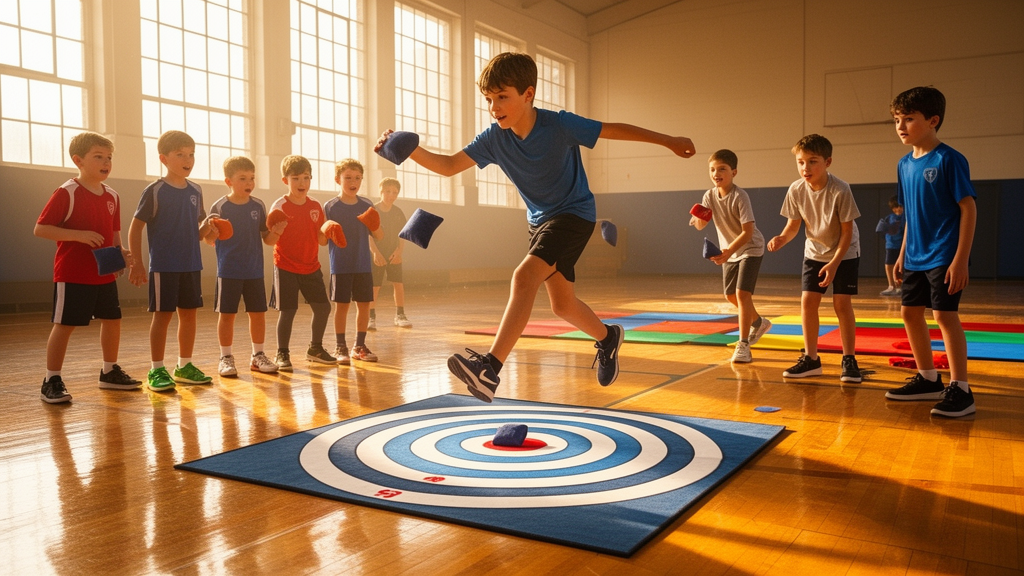
A six-week program of recreational target games improved reaction time, upper-limb movement speed, dynamic balance, and change-of-direction speed in boys aged 10 to 14, with the gains still measurable four weeks after training ended, according to a randomized controlled trial conducted in Konya, Türkiye. The study, accepted for publication in Frontiers in Cognition, suggests that simple games built around hitting or reaching targets may offer measurable sensorimotor benefits beyond those of general recreational play. The trial enrolled 69 students, who were randomly assigned to one of three groups.
Twenty-two boys took part in a Target Games Activity Group, completing a six-week program of three sessions per week, each lasting 45 minutes, focused on games with target-based content. Twenty-three boys were assigned to an Active Control Group, which completed a general recreational games program of the same structure but without target-based elements. A further 24 boys served as a standard Control Group.
After orientation and baseline testing, all participants were assessed at post-test immediately following the program and again at a four-week follow-up. Performance was measured with four established field tests. Reaction time was assessed with the Nelson Hand Reaction Test, upper-limb movement speed with the Eurofit Plate Tapping Test, dynamic balance with the Modified Bass Test, and change-of-direction speed with the Pro-Agility Test.
Data were analyzed using two-way repeated measures ANOVA with Bonferroni post-hoc comparisons, supplemented by ANCOVA models adjusted for pre-test scores to test differences between groups directly. The Time × Group interaction was significant for all four outcomes, indicating that the groups changed differently over the course of the study. In the pre-test-adjusted analyses, the target games group differed significantly from both control groups at follow-up on all four measures.
Effect sizes ranged from small for reaction time and upper-limb movement speed to large for dynamic balance and change-of-direction speed, meaning the most pronounced advantages appeared in the balance and agility domains. The comparison with the active control group proved particularly informative. The target games group's advantage over the active control group was significant at post-test on three of the four measures, while its advantage in upper-limb movement speed emerged only at follow-up.
By contrast, any post-test gains observed in the active control group, where present, were not retained at the four-week follow-up, indicating that general recreational games without target-based content did not produce lasting improvements on these measures. Dynamic balance and change-of-direction speed, the two outcomes showing large effects, were the domains in which the target games group's advantage over both control groups was most pronounced at follow-up. The study has limitations worth noting.
The sample consisted of 69 boys from a single city, all within a narrow age range, and the follow-up extended only four weeks beyond the end of training, so the durability of the effects over longer periods remains unknown. The reported results apply to boys aged 10 to 14 and cannot be generalized to girls, other age groups, or populations with different baseline activity levels. The author concludes that recreational target games are a promising intervention for improving sensorimotor performance in boys of this age group, with gains evident at the four-week follow-up.
Subject of Research: Effects of a recreational target games program on sensorimotor performance in boys aged 10–14 years
Article Title: Recreational target games improve sensorimotor performance in boys aged 10–14 years: a randomized controlled trial with 4-week follow-up
Article References: Altin, M. (2026). Recreational target games improve sensorimotor performance in boys aged 10–14 years: a randomized controlled trial with 4-week follow-up. Frontiers in Cognition, 5, Article 1968283. https://doi.org/10.3389/fcogn.2026.1968283
Image Credits: AI Generated
DOI: 10.3389/fcogn.2026.1968283
Keywords: target games, sensorimotor performance, reaction time, dynamic balance, change-of-direction speed, randomized controlled trial, children, physical activity, motor development, upper-limb speed, Recreational, target
Cite Scienmag News
Glenn Wilkins. (October 23, 2026). Recreational Target Games Boost Balance and Agility in Boys, Trial Finds. Scienmag. https://scienmag.com/recreational-target-games-boost-balance-and-agility-in-boys-trial-finds/
Glenn Wilkins. "Recreational Target Games Boost Balance and Agility in Boys, Trial Finds." Scienmag, 23 October 2026, https://scienmag.com/recreational-target-games-boost-balance-and-agility-in-boys-trial-finds/. Accessed 23 October 2026.
Glenn Wilkins. "Recreational Target Games Boost Balance and Agility in Boys, Trial Finds." Scienmag. October 23, 2026. https://scienmag.com/recreational-target-games-boost-balance-and-agility-in-boys-trial-finds/


