


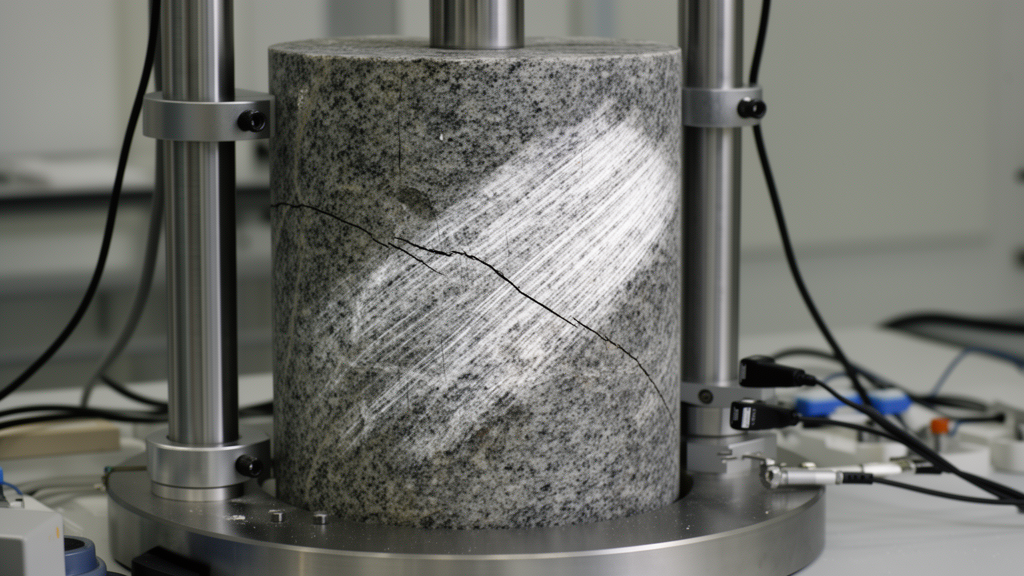
Granite squeezed until it cracks becomes a subtly different material along the way, and ignoring that change can distort how scientists read the micro-earthquakes it produces. A laboratory study of four granite samples subjected to uniaxial loading shows that stress-induced anisotropy, which grew to roughly 20 percent strength during compression, had little effect on the inferred orientations of fracture planes but significantly altered estimates of the non-shear components of the source mechanisms. The findings matter because acoustic emissions generated in rock experiments are widely treated as miniature analogues of natural earthquakes, and the standard processing of their signals assumes the rock is isotropic.
The research, carried out by František Staněk of the Institute of Geophysics of the Czech Academy of Sciences and Silixa Ltd. together with colleagues at the Czech Academy of Sciences, is published in Frontiers in Earth Science. The team reprocessed four series of uniaxial loading experiments on Westerly granite, Mrákotín granite, Brno syenite and Liberec granite, a sequence of rocks with increasing grain-size inhomogeneity ranging from fractions of a millimetre to as much as 20 millimetres. Cylindrical specimens 104 millimetres tall and 52 millimetres in diameter were reshaped into near-regular octagonal prisms to improve planar contact with the acoustic transducers, and compressed in an MTS 815 loading system with feedback control combining axial stress and strain.
Each specimen was fitted with 14 Fuji AE204A sensors, 12 mounted on the specimen surface and 2 embedded in the loading platens, covering a bandwidth of 240 to 520 kilohertz. Ultrasonic pulses at 500 kilohertz were repeatedly fired through the rock during loading, allowing the team to track how P-wave velocities changed with direction and loading stage. More than 15,000 acoustic emission events were captured per specimen, and waveforms were recorded at 10 megahertz with 16-bit resolution. Location accuracy for high-amplitude events was about plus or minus 2 millimetres, validated against known transmitter positions.
Two thresholds in the damage history of each rock emerged from the combined records. Crack initiation appeared at 45 to 55 percent of the ultimate compressive strength, marked by the onset of acoustic emission activity, a change in volumetric stiffness and elevated horizontal attenuation. Crack damage followed at 72 to 78 percent of the strength, signalled by reversal of volumetric strain and an exponential surge in event counts, values consistent with typical granite behaviour.
The physical puzzle at the heart of the study lies in how anisotropy affects seismic source descriptions. In an isotropic medium, shear slip on a planar fault produces a pure double-couple moment tensor, the textbook representation of an earthquake. But when the same shear slip occurs in an anisotropic material, the full moment tensor acquires additional non-double-couple components, including isotropic and compensated linear vector dipole parts. The converse is the trap: non-double-couple components detected in an anisotropic medium do not necessarily indicate tensile or other non-shear fracturing, because the medium itself can manufacture them.
To separate real source physics from medium-induced bias, the authors compared two descriptions of each event. Standard moment tensor inversion was performed with isotropic Green’s functions, in parallel with a source tensor approach that removes the influence of the surrounding elastic anisotropy by relating the moment tensor to the stiffness tensor, an operation analogous to a generalised Hooke’s law. The anisotropy itself was estimated from the ultrasonic velocity measurements, assuming a vertically transversely isotropic medium under the weak-anisotropy formalism introduced by Thomsen, with parameters derived from the vertical and horizontal P-wave velocities. Because no shear-wave data were available, one Thomsen parameter could not be constrained and was set to zero, and the ratio of P- to S-wave velocities was assumed constant.
The measured stress-induced anisotropy was substantial, averaging 21.1 percent for the fine-grained Westerly granite, 19.0 percent for Mrákotín granite, 18.2 percent for Brno syenite and 15.6 percent for Liberec granite, with vertical P-wave velocities rising to between 5.6 and nearly 6.0 kilometres per second during loading. Yet when the two inversion schemes were compared across thousands of reliable events, the orientations of the principal pressure, tension and null axes differed only slightly. Kagan angles, which measure the rotational mismatch between double-couple components, averaged between roughly 5.4 and 6.7 degrees across the four samples, medians between about 4.3 and 5.5 degrees, values comparable to the several degrees of orientation uncertainty expected from previous analyses. No systematic dependence on event magnitude was observed.
The decomposition of the tensors told a different story. Moment tensor solutions, which implicitly carry the anisotropy bias, yielded mean non-double-couple contents between about 54 and 62 percent depending on the sample. Source tensor solutions, corrected for anisotropy, shifted systematically toward lower values, with means between about 38 and 47 percent. The diamond source-type plots showed a markedly narrower and more compact cluster of events along the isotropic axis when anisotropy was accounted for, a pattern the authors interpret as more shear-dominated mechanisms, consistent with tensile microcrack behaviour, and a reduction in spurious non-shear components introduced by the medium. Across all samples, pressure axes clustered subvertically, matching the loading direction, and normal-faulting and strike-slip styles dominated while reverse faulting was nearly absent.
To probe what happens when anisotropy is stronger or more badly mismodelled, the team ran numerical experiments in which the measured anisotropy was artificially increased by factors of 1.05, 1.11, 1.25, 1.33 and 2.0. At the two highest levels the tension and null axes began to mix and eventually interchange roles, strike-slip contributions nearly vanished from the ternary faulting-style diagrams, and the mismatch between moment and source tensor decompositions grew. The separation between the peaks of the non-double-couple distributions rose from roughly 20 percentage points at the measured anisotropy to about 40 points when anisotropy was doubled, demonstrating strong sensitivity of these estimates to errors in the anisotropy model.
The authors stress the limits of their simplified treatment. Only P-wave velocities constrained the stiffness tensor, so only part of the full 21-constant anisotropic description could be recovered, and the Green’s functions remained isotropic, with anisotropic polarisation and quasi-P-wave amplitude effects neglected as second-order approximations. Nevertheless, their conclusion is clear: for granite laboratory experiments, crack orientations can be retrieved accurately even when stress-induced anisotropy of up to about 20 percent is ignored, but anyone seeking to resolve the details of non-shear processes such as crack opening, closure or volumetric change must explicitly account for the anisotropy that loading itself creates.
Subject of Research: Effects of stress-induced anisotropy on acoustic emission source mechanisms in uniaxially loaded granite
Article Title: Fracture mechanisms in stress-induced anisotropic granite
Article References: Staněk, F., Jechumtálová, Z., Petružálek, M., Kolář, P., Lokajíček, T., Vavryčuk, V., & Šílený, J. (2026). Fracture mechanisms in stress-induced anisotropic granite. Frontiers in Earth Science, 14, Article 1890707. https://doi.org/10.3389/feart.2026.1890707
Image Credits: AI Generated
DOI: 10.3389/feart.2026.1890707
Keywords: acoustic emission, granite, stress-induced anisotropy, moment tensor, source tensor, rock mechanics, uniaxial loading, non-double-couple, transverse isotropy, laboratory experiments, Kagan angle, Thomsen parameters
Cite Scienmag News
Violet Maxwell. (October 23, 2026). Hidden anisotropy in stressed granite distorts crack signatures in lab earthquakes. Scienmag. https://scienmag.com/hidden-anisotropy-in-stressed-granite-distorts-crack-signatures-in-lab-earthquakes/
Violet Maxwell. "Hidden anisotropy in stressed granite distorts crack signatures in lab earthquakes." Scienmag, 23 October 2026, https://scienmag.com/hidden-anisotropy-in-stressed-granite-distorts-crack-signatures-in-lab-earthquakes/. Accessed 23 October 2026.
Violet Maxwell. "Hidden anisotropy in stressed granite distorts crack signatures in lab earthquakes." Scienmag. October 23, 2026. https://scienmag.com/hidden-anisotropy-in-stressed-granite-distorts-crack-signatures-in-lab-earthquakes/


